Sunday, April 7, 2013

King Ahab's Pursuit of Prophet Elijah


Did Ancient Hebrews Really "Fear the Sea"?


By Steven Collins


An article in the 1991 edition of the Epigraphic Society Occasional Publications (ESOP) entitled "The Davenport and Newark Inscriptions," by Charles Moyer asserted that certain ancient North American artifacts and inscriptions could not be Hebrew because "the ancient Hebrews feared and hated the sea and have never shown any evidence of being a sea-faring people..." I do not believe that assertion can be substantiated, and the word "never" particularly misstates the historical reality of the ancient Hebrews. This article will document that the ancient Hebrews (i.e. "Israelites") had well-developed sea-faring skills. It will also show why historians have failed to recognize this fact.

Concerning ancient Israel's pre-monarchial period, it is stated in Judges 5:17; "Why did Dan remain in ships?" This comment is made in what is called "Deborah's song," and is a commentary describing what various tribes of Israel did (or did not do) in a victorious military battle. This biblical comment indicates that the tribe of Dan was, at that time, closely identified with a maritime way of life. Some Bibles offer a date of 1200 B.C. as a guide for dating that battle.

Interestingly, Egyptian and Greek sources record that one of the tribes of the Sea Peoples, a sea-raiding people in the eastern Mediterranean at that time, were called the "Danauna" or the "Danaans." The Encyclopedia Britannica (1943 Ed., see Heading "Troy") cites the Egyptian and Greek accounts of these sea raiders and dates them to being present in the Levant "between 1230 and 1190 B.C." [Other sources render the spelling of these people as Danaouna or Danaoi, but all spellings cited include the easily recognizable root word "Dan”]. It is noteworthy that the secular historical dates coincide with the biblical dates for the tribe of Dan being a maritime tribe. Since one of the traits of the tribe of Dan was naming things after its tribal name (Joshua 19:47), it is not surprising that this maritime tribe would have its name recognizable in Egyptian and Greek accounts about them.

Also, the Hebrew tribes of Israel developed very strong maritime skills during the reign of King Solomon via their close alliance with the Phoenicians. Indeed, this alliance was so close that Solomon's alliance with King Hiram of the Phoenician city-states (which began under King David) led to many thousands of Israelites working in Phoenicia and vice-versa as the Hebrews and Phoenicians jointly implemented Solomon's prodigious building projects (I Kings 5). King Hiram shared the special maritime skills of the Phoenicians with the Israelite Hebrews (II Chronicles 8:18 records that Israelite mariners were taught by Phoenicians "who had knowledge of the sea.") II Chronicles 9:21 notes that the Israelites and Phoenicians jointly crewed a common navy. II Chronicles 9:10 and 21 mention Ophir and Tarshish as ports of call for their joint fleet, and the cargo manifest of "ivory, apes and peacocks" indicates their trading fleet had (at a minimum) African and Asian ports-of-call. Contained in my pending four-book set on Israelite history will be information documenting the specific technologies used by the Israelite/Phoenician mariners to navigate the world’s oceans. As readers will see when these book are realeased, the Phoenicians had invented ingenious devices to enable them to navigate planned courses and headings on the open oceans, even in unfavorable weather! These ingenious devices were shared with the Israelites as part of the “knowledge of the sea.” After receiving these technologies, the oceans began navigable highways for the Israelite mariners.

I Kings 9:26-27 records that King Solomon built a fleet which was home-ported in Ezion-geber on the Red Sea, in which Phoenicians also served to teach the Israelites the “knowledge of the sea.” This indicates that King Solomon's Israelite navy became a “two-ocean fleet” as his Mediterranean fleet could sail to Atlantic destinations, and his Red Sea fleet could sail to African, Asian and Pacific ports. I Kings 10:22 adds that the Israelites had at sea a “navy of Tharshish.” Does this refer to a trading fleet that sailed to “Tarshish,” or is there distinct and separate meaning in the word “Tharshish?” Since “Tharshish” was the proper name of one of the patriarchs of the tribe of Benjamin (I Chronicles 7:10), it is possible the writer of I Kings used an Israelite clan name to designate a particular group of Israelites who were assigned to naval service. If so, they would have been readily known to the writer’s contemporaries , but not to readers in the 20th century.

At any rate, Israelite mariners learned their “knowledge of the sea” from what are widely-acknowledged to be the very best maritime teachers available in the ancient world! There is no indication that the Hebrews "feared and hated the sea.” Indeed, it appears King Solomon and the tribes of Israel under his rule were eager to learn the secret maritime skills of the Phoenicians and build their own naval fleets. Why wouldn’t they be eager to learn such knowledge? There would have been a tremendous commercial, economic advantage to joining the Phoenicians’ monopoly of the ancient world’s sea routes.

The Egyptians were also very skilled mariners at that time, and Solomon's first father-in-law was the Pharaoh of Egypt (I Kings 9:9-16). This marriage between the royal houses of Israel and Egypt resulted in a tripartite Phoenician-Israelite-Egyptian alliance in Solomon's time.

After the Hebrew tribes divided into a northern kingdom (Israel) and a southern kingdom (Judah), the Bible records that they became perennial enemies, fighting many wars against each other (albeit with a few interludes of peaceful relations). Biblical accounts show that while the northern kingdom, Israel (which was more populous as it contained ten Israelite tribes and Judah retained only two tribes), remained in alliance with Egypt and Phoenicia, Judah was afterward excluded from the Phoenician alliance. Indeed, the first ruler of the northern kingdom of Israel after the Israelite schism was Jeroboam, a prominent Israelite noble who had previously been a courtier of Egypt's Pharaoh Shishak (I Kings 12:40). This would have resulted in very favorable relations between Egypt and the ten-tribed kingdom of Israel. Evidence that Jeroboam retained a very strong affinity to Egypt is clear in his instituting Egyptian religion (calf-worship) in the northern kingdom of Israel (I Kings 12:25-30). It is evident that Israel’s alliance with the Phoenicians was long-lasting as, almost a century later, we find the royal houses of Israel and the Phoenician city of Sidon intermarried during the reign of King Ahab of Israel (I Kings 16:31). Likewise, Israel's long-standing attachment to the fertility practices of the Phoenicians also argues that the Israelite-Phoenician alliance was quite durable.

The alliances of Israel, the northern Hebrew Kingdom, with Phoenicia and Egypt, and their longstanding fealty to Egyptian and Phoenician religions, would have caused the northern kingdom of Israel to become culturally more like their allies, and progressively less like the Jews, their fellow Israelites from whom they were estranged. The Bible records that the Kingdom of Israel never seriously returned to the worship of the Bible's God, but remained steadfastly in the cultural and religious camp of the Egyptians and (especially) the Phoenicians. This would have resulted, as decades and centuries passed, in the "Hebrew" language of the kingdom of Israel becoming more like the already similar Semitic tongue of their close allies (the Phoenicians) and less like the "Hebrew" language of Judah (the Jewish Hebrew nation). I Kings 12:25-33 records that severing his people’s religious and cultural ties to Judah was a deliberate, state policy of King Jeroboam of Israel! Given this fact, the northern kingdom of Israel would have progressively merged with the culture of their close allies in Tyre and Sidon. Modern archaeologists, who do not realize this fact, routinely label as “Phoenician” the artifacts and inscriptions made by Israelites of the northern Kingdom of Israel. The people of Judah, who retained a more distinctly “Hebrew” culture and language were much less numerous and were excluded from the Phoenician alliance, giving the mistaken impression that ancient “Hebrews” were an insignificant and land-bound people.

Given the historic alliance and affinity between the Phoenicians, Egyptians and Israelite Hebrews (all of whom were maritime powers during their mutual alliance in Solomon's reign), it would not be surprising to see them cooperating in maritime ventures long after Solomon's death. The "Davenport inscriptions" are evidence of such cooperation, as it has Egyptian as well as Phoenician-Hebrew characters. In America B.C., Dr. Barry Fell observed on page 263 the presence [on the Davenport stele] of "some signs resembling Hebrew and others resembling Phoenician." This is what one would expect to find if Israelite Hebrews were a part of this ancient exploration fleet which reached central North America (the modern state of Iowa). The Israelites, having become closely linked to the Phoenicians (politically, economically, culturally, and religiously), would also have become linguistically like the Phoenicians as well! One would expect the written language of the northern kingdom of Israel to reflect a Phoenician/Hebrew amalgam. Because of the longstanding hostility and mistrust between Israel and Judah, the language and writing of Israel would inevitably have become more "Phoenician" in nature and less like the "Hebrew" of the Kingdom of Judah. For this reason, epigraphic remnants of the Israelites of the ten-tribed, northern kingdom of Israel will be found in Phoenician (i.e. Punic) contexts, not in those of the Hebrew language of the kingdom of Judah. When inscriptions are found that seem to blur the distinction between Hebrew and Phoenician, it is very possible (indeed, likely) that those inscriptions are a product of Israelites from the northern Hebrew kingdom of Israel who had blended their cultural identity with the Phoenicians.

There is an event in King Ahab's reign that also argues for a diffusionist perspective in biblical historical accounts. In I Kings 17 and 18, it is recorded that the prophet Elijah was hiding from Israel's King Ahab, and that Ahab searched in every nation for him. I Kings 18:10 cites the following incredulous response of one of Ahab's officials when he finally found Elijah "in his own backyard" in the nation of Israel:

"As the Lord your God lives, there is no nation or kingdom whither my lord [King Ahab] has not sent to seek you; and when they would say, 'he is not here, ' he would take an oath of the kingdom or nation, that they had not found you."

This is one of those biblical passages that biblical critics huff and puff about, regarding it as an example of hyperbole or outright fabrication, believing that there was no way that King Ahab of Israel could command enough respect among the nations to "take oaths" of them or demand that they conduct national searches for a missing prophet. They also scoff at the idea that Ahab cou1d have had access to "all nations and kingdoms" on the earth at that time. However, now that the discoveries and efforts of The Epigraphic Society have demonstrated the diffusionist nature of the ancient world, a context for a literal understanding of this episode readily presents itself. King Ahab and Israel were still closely allied to the Phoenicians, the dominant maritime power of that time. Indeed, King Ahab was married to a Phoenician princess, Jezebel, daughter of the king of Sidon. His continuing close alliance with the Phoenicians meant that Ahab had the ability via the Phoenician (and his own) fleets to send searchers wherever these fleets sailed and traded in either the Old or New Worlds. The Davenport stele, with its record of "mixed Hebrew and Phoenician signs," and the other Phoenician inscriptions found in the New World argue that the sailors of the allied Phoenicians and Israelites (of the northern kingdom) were present in the New World as well. Therefore, there was a means, readily available to King Ahab, to send ships to nations all over the world in search of Elijah. His ability to demand a national search for Elijah, and exact oaths from the leaders of those nations indicates considerable influence on the part of King Ahab of Israel. What was the nature of that power?

The answer is obvious. The long-standing Phoenician/Israelite alliance on the sea controlled access to the ancient world’s maritime commercial routes. Any nation that did not cooperate with Ahab's request could have had their goods and ships forcibly embargoed from the sea routes by the Phoenician/Israelite navies. If the Egyptians were then still cooperating with the Phoenicians and Israelites (the Davenport stele argues that periods of such cooperation between their language groupings still did exist), Ahab's threat would have been backed by not two, but three powerful navies! Ahab was not an insignificant king on the land either. An alliance of nations (including King Ahab's Israel) fought the Assyrian Empire under Shalmaneser III to a stalemate in the battle of Karkar (or "Qarqar") in 854 B.C. Ahab's search occurred during what the Bible records as a three and one-half year drought caused by God at the instigation of Elijah. Ahab's period of searching would have occurred during that drought. There was time enough for Ahab to send messenger ships to all known nations, have those nations search for Elijah (basically checking to see if anyone answering to Elijah's description had arrived on any vessel from Israel's region of the world), and send word back to Ahab via the same messenger ships.

Regarding Judah, one biblical account shows that the Jews (the Hebrews of Judah) were also unafraid of sea travel. I Kings 22:44-49 and II Chronicles 20:36-37 record that during one of the rare reapproachments between the estranged Hebrew kingdoms of Israel and Judah, Jehoshaphat, the king of Judah attempted to build a fleet of ships at Ezion-geber, the home-port of one of Solomon's previous international fleets. This is hardly the action of a people who "feared and hated the sea." The project was wrecked by an "act of God," but it is interesting to note that Israel's king (Ahab's son) offered to let his sailors assist the crews of the new ships that Judah was building. Since Judah was trying to reestablish itself as a maritime force, this offer only makes sense in the same vein in which King Hiram's offer was made to Solomon when Solomon was building his fleets--that Israel's king was offering to share "the knowledge of the sea" with Judah's novice sailors. This offer provides biblical confirmation that the Israelites of the northern kingdom possessed the sophisticated maritime skills of the Phoenicians during the time of King Ahab and Israel’s subsequent kings. It also indicates that Judah's intent in building these ships was to create a fleet capable of long, "open-water" voyages, not mere coastal-hopping trips down the Red Sea. For such a fleet, Judah would have needed skilled mariners to teach them such arts as celestial navigation, sailing to take advantage of trade winds, recognizing predictable oceanic currents, etc. The king of Israel knew Judah would need such help, and his offer was likely an effort to ingratiate himself to the Jewish king, Jehoshaphat (who was wealthy and powerful). Such skills would have been completely unnecessary in small coastal vessels that were intended for short, land-hugging voyages. Jehoshaphat was clearly attempting to restore some of Solomon's glory by replicating Solomon's construction of a major fleet at Ezion-geber, but the effort was abortive.

The effort of the Jews during Jehoshaphat's reign should not be construed to mean that they finally worked up the courage to venture forth on the "fearful sea." Rather, it is a reflection of the role national economic strength played in determining maritime power in the ancient world. It took a great deal of money to build a fleet, train sailors, finance its operation over time, etc. As is clear from the Bible's accounts, the reign of King Jehoshaphat was a time of restored economic power and national wealth for the kingdom of Judah. Therefore, Jehoshaphat's effort to build a great fleet was simply a predictable function of his nation's restored ability to fund and support a large trading fleet.

The above observations refute any contention that the Hebrews were either afraid of the sea or insignificant maritime powers. Indeed, during the time that all the tribes of Israel were united under King Solomon, the Hebrews built large fleets and became privy to the Phoenicians' “knowledge of the sea." After the Israelite tribes divided into two nations, the northern kingdom of Israel remained closely linked to the Phoenicians, sharing the strong maritime tradition of their allies. Even the smaller Jewish kingdom of Judah, excluded from a Mediterranean maritime presence by the more powerful Phoenician/Israelite alliance, displayed an eagerness to build a large fleet of ships on the Red Sea as soon as economic and political circumstances allowed such a project to be implemented.

Charles Moyer's article, in commenting on the biblical commandment against graven images, states: "history has shown us that the Jewish people have quite thoroughly followed this commandment." His line of reasoning was that the Newark stones [artifacts inscribed in ancient Hebrew which were found in the Mound-Builder sites in ancient America’s Ohio River Valley] were not likely to be ancient Hebrew artifacts because of an assumed depiction of a deity. Such an assertion indicates a lack of awareness that there were two very different Hebrew nations in the ancient world. It is a common historical misconception that the terms "Jew" and "Hebrew" were synonymous in the ancient world. That was not the case. As we have seen, the larger, non-Jewish Hebrew kingdom of Israel was usually an enemy of the Jewish kingdom of Judah. The northern kingdom of Israel regularly disregarded the biblical laws of God, including the injunction against making or depicting a graven image. Therefore, Hebrews from the kingdom of Israel would rarely have had any qualms about making or depicting a figure of a deity.

However, Jews from the southern kingdom of Judah also sometimes made or depicted graven images. There were several periods in Judah's history where fealty to the laws of God was forgotten (and even scorned) for extended periods of time. Consider the following examples. King Manasseh of Judah instituted infant sacrifice, compelled the Jews to worship foreign gods, and was openly-contemptuous of God and his laws.Judah was also once ruled by Queen Athaliah, a devotee of Baal and foreign gods. She also caused the Jewish nation to openly disobey biblical laws (including the one against graven images). Indeed, by the time Josiah became king of Judah, the Jews had become so lax about the laws of God that no one even knew what the laws of God were any more! In Josiah's eighteen year as king (circa 621 BC), the Jews found a forgotten scroll of the law and had to relearn the laws of god "from scratch." [The above examples are described in II Kings 11 and II Chronicles 33.] Therefore, one has to be cautious about asserting that Jews would never make graven images because there are periods of Jewish history when their making graven images would have been common! Coupled with the fact that their fellow Israeltie tribes in the northern kingdom of Israel regularly made and served graven images associated with the gods of Phoenicia (or other lands), there is no basis to reject an inscription as being Hebrew simply because it depicts a graven image.

While the supposed "graven image" on the Newark stones is actually a representation of Moses (not a deity), as noted in Bill Rudersdorf's article "Lost Horizons," ESOP, 1991, it is worth noting the inaccuracy of asserting that a particular inscription could not be Hebrew merely because it contained a depiction of a deity. Additionally, the discussion of the Hebrews' maritime alliance with the Phoenicians and the Phoenicians' willingness to share "the knowledge of the sea" with the Israelites meant that the ancient kingdom of Israel would have been a maritime power for much (if not all) of its existence. On the other hand, the Jews (the kingdom of Judah) were apparently not a significant maritime power after the division of the Israelites into two kingdoms. However, they were eager enough to build a large fleet of ships when their national strength and finances permitted them to do so. Given the above, I see no evidence that the Hebrews ever "feared the sea." Indeed, the Bible's historical accounts describe events which make literal sense when considered in light of the political alliances of that time and a diffusionist view of ancient mankind's actual abilities and far-flung contacts.

....

Taken from: http://stevenmcollins.com/html/did_ancient_israel_fear_the_se.html

Sunday, March 10, 2013

King Tut’s Tomb Restoration


worldtourismjournal


Monday, December 14, 2009

Egypt Starts King Tut’s Tomb Restoration

http://www.travelvideo.tv

December 11, 2009

Egypt Starts King Tut’s Tomb Restoration and Other News about Antiquities in Egypt
Egypt has started implementing the tomb of Tutankhamen restoration project, Culture Minister Farouq Hosni said on Tuesday 10/11/2009. The Tutankhamen project will undertake detailed planning for the conservation and management of the tomb and its wall paintings.
“I always see the tomb of King Tut and wonder about those spots, which no scientist has been able to explain. I was worried about these, and have asked experts to examine the scenes,” Dr. Zahi Hawas [he has since been sacked], Secretary General of the Supreme Council of Antiquities (SCA) pointed out.
By comparison with other tombs in the Valley of the Kings, Tutankhamen’s tomb is relatively simple. Of the tomb’s four rooms, only the walls of the burial chamber are decorated.
The wall paintings in this chamber, as well as some of the
tomb’s other surfaces, are marred by disfiguring brown spots, which were noted by Carter’s excavation team.
The nature and origin of the spots have never been fully ascertained, and they are among the technical conservation challenges presented by the tomb.
Four archaic wells discovered in Egypt
Egyptian -French archaeologists have unearthed in El- Sharqiya province four ancient wells that date back to the 25th and 26th pharaonic dynasties. The wells are part of a newly-discovered Sacred Lake in a temple to the Egyptian goddess Mut in the ruins of ancient Tanis.
Supreme Council of Antiquities Secretary General Zahi Hawwas said on Sunday 8/11/2009 the wells vary in shape and size.
Two of them have circular shapes with a 210-220 cm diameter, while the other two are square.
They are believed to have been used by the people for daily purposes, he added.
The Sacred Lake was uncovered in October. It was found 12 meters below ground at the San al-Hagar archaeological site in Egypt’s eastern Nile Delta and was 15 meters long and 12 meters wide and built out of limestone blocks. It was in good condition. It was the second sacred lake found at Tanis, which became the northern capital of ancient Egypt in the 21st pharaonic dynasty, over 3,000 years ago.
The first lake at the site was found in 1928. The goddess Mut, sometimes depicted as a vulture, was the wife of Amun, god of wind and the breath of life. She was also mother of the moon god Khonsu.
Discoveries of Polish archaeologists in a Byzantine basilica in Egypt
Polish archaeologists discovered an unknown baptistery, and a few hundred bronze coins during the tenth archaeological season in Marea, a town situated 45 kilometers southeast of Alexandria.
Whilst excavating the floors in the basilicas main nave and its northern side nave the scientists discovered a baptistery. Its dimension is 4.5 by 2.5 meters and is 1.5 meters high. It is built from large stone blocks.
The archaeologists also discovered a well attached to the baptistery with special holes in its walls for the people who where to clean it. , that was attached to the baptistery, It hasn’t been established whether water from the well,
Two giant structures were discovered in the southern cave. They were probably built there to create a small area next to the side entrance to the basilica. Archaeologists discovered fragments of a marble bowl for holy water between them. In the northeastern corner of the basilica archaeologists discovered a camouflaged cellar made up of two rooms, partially rock-hewn. The cellar was full of almost one hundred small water vessels and olive lamps. They also discovered a few hundred bronze coins. Two ditches above the cellar served to ventilate it.
Egyptian, Hungarian culture ministers inaugurate archaeological cultural celebration in Egyptian Museum
Egyptian Culture Minister Farouq Hosni and his Hungarian counterpart Istvan Hiller opened Saturday 7/11/2009 an exhibition showcasing 140 artifacts discovered by the Hungarian archaeological mission in Egypt.
Secretary General of the Egyptian Supreme Council of Antiquities (SCA) Zahi Hawwas was present.
The exhibition, which was held at the Egyptian Museum in Tahrir Square, is organized to mark the 102nd anniversary of the Hungarian archaeological mission operating in Egypt.
Members of the Hungarian archeological mission and several
Egyptian archaeologists attended the event, at which the Egyptian and Hungarian culture ministers hailed bilateral cooperation in the cultural and archaeological fields.
The Hungarian mission operated in and around Thebes 102 years ago, Hawwas said.

Thursday, March 7, 2013

Jordan Questions A-ha-ab-bu Sir-’i-la-a-a as the biblical King Ahab of Israel


Biblical Chronology
Vol. 4, No. 2
February, 1992
Copyright © James B. Jordan 1992

Ahab and Assyria (Chronologies and Kings VIII)


by James B. Jordan

(This issue of Biblical Chronology continues a discussion of the Biblical and Assyrian chronologies, begun last month. If you do not have a copy of the January 1992 issue, you can obtain one from the publisher.)

Was Ahab at Qarqar?
Allis writes: "According to his Monolith Inscription, Shalmaneser III, in his sixth year (854 B.C.) made an expedition to the West and at Qarqar defeated Irhuleni of Hamath and a confederacy of 12 kings, called by him `kings of Hatti and the seacoast.’ Qarqar is described as the royal residence of Irhuleni. It was there, not far from Hamath, that the battle took place. Irhuleni was the one most directly concerned. But in describing the allied forces, Shalmaneser lists them in the following order:
      He brought along to help him 1,200 chariots, 1,200 cavalrymen, 20,000 foot soldiers of Adad-’idri of Damascus; 700 chariots, 700 cavalrymen, 10,000 foot soldiers of Irhuleni from Hamath; 2,000 chariots, 10,000 foot soldiers of A-ha-ab-bu Sir-’i-la-a-a.
These three are probably mentioned first as the most important. It is rather odd that Irhuleni’s troops are mentioned only second in the list, inserted between Adad-’idri’s and Ahabbu’s. Then follow in order the contingents of Que, Musri, Irqanata, Matinu-ba’lu of Arvad, Usanata, Adunu-ba’lu of Shian, Gindibu’ of Arabia, Ba’sa of Ammon. Most of these countries were clearly in the distant north, Syria and Ammon being the nearest to Israel, and both of them Israel’s bitter enemies. Among the eleven listed (he speaks of twelve kings), only five brought chariots; and most of them brought fewer troops than the first three, though some of the figures cannot be accurately determined, because of the condition of the inscription.
"In view of the make-up of this confederacy of kings, the question naturally arises whether Ahab, who had been recently at war with Ben-haded and was soon to renew hostilities with him, would have joined a coalition of kings of countries, most of which were quite distant, and the nearest of which were bitterly hostile, to go and fight against a king with whom he had never been at war,–an expedition which involved leaving his capital city and taking a considerable army to a distance of some 300 miles and through mountainous country, and, most questionable of all, leaving Damascus, the capital of his recent enemy Ben-hadad in his rear (thus exposing himself to attack), in order to oppose a distant foe whose coming was no immediate threat to his own land or people. Shalmaneser’s father, the terrible Ashurnasirpal, had come as near to Palestine as Shalmaneser then was at Qarqar. But no king of Israel had felt it necessary to oppose his victorious advance to the West. Such an undertaking by Ahab, king of Israel, seems highly improbable to say the least.
"The name Ahab (Ahabbu), while uncommon, is not unique. We meet is as the name of a false prophet, who was put to death by Nebuchadnezzar (Jer. 29:21). The name appears to mean `father’s brother,’ i.e., `uncle.’ It may possibly be shortened from Ahabbiram (my uncle is exalted) or a similar name. But it is to be noted that the name Ahabbu might be read equally well as Ahappu and be an entirely different name than Ahab, quite probably Hurrian, which would accord well with the make-up of the confederacy.
"The name of Ahabbu’s country is given as Sir’ila-a-a. The reading is somewhat uncertain, since the first character might also be read as shud or shut. Even if sir is correct, the name is a poor spelling of Israel; and it is double questionable because nowhere else on Assyrian tablets is Israel given this name. On the monuments it is called mat Humri, the land of Omri. It is perhaps not without significance that although the battle of Qarqar is mentioned in several of Shalmaneser’s inscriptions, Ahabbu is mentioned on only one of them. The Assyrian kings were great braggarts. Israel was quite remote from Shalmaneser’s sphere of influence. If Ahab of Israel were referred to, we might perhaps expect more than this one slight mention of him.
"Adad-’idri was apparently Irhuleni’s chief ally, being mentioned first. If this Syrian king was the enemy-friend of Ahab, we might expect him to be called Hadad-ezer, which is the Hebrew equivalent of the name and is given to the king of Zobah of David’s time. The name Adad-’idri may stand for Bar (Hebrew, Ben)-Adad-’idri (Heb., ezer), and so be shortened at either end, to Ben-hadad or Hadad-ezer. So it may be, that the Ben-hadad of the Bible and the Adad-’idri of Shalmaneser’s Annals are the same king."
But not necessarily, says Allis. Assuming that Adad-`idri is the same as Ben-hadad does not tell us which of many Ben-hadads this was. "Ancient rulers often had the same name. We now know of three kings who bore the famous name Hammurabi. There were 5 Shamsi-Adads, 5 Shalmanesers, 5 Ashur-niraris among the Assyrian kings. Egypt has 4 Amenhoteps, 4 Amenemhets, 12 Rameses, 3 Shishaks, and 14 Ptolemies. Syria had apparently both Ben-hadads and Hadad-ezers. Israel had 2 Jeroboams; and both Judah and Israel had a Jehoash, a Jehoram, and an Ahaziah in common. It may be that Ba’sa king of Ammon who fought at Qarqar, had the same name as Baasha king of Israel. Names may be distinctive and definitive; they may also be confusing and misleading.
"There is no mention of the battle of Qarqar in the Bible. It is generally assumed that it was fought several years before Ahab’s death, though Thiele claims that the battle of Ramoth-gilead took place only a few months after Qarqar.
"In the account which Shalmaneser gives of this battle, he claims a glorious victory. On the Monolith Inscription, which gives the fullest account of it, we read: `The plain was too small to let (all) their (text: his) souls descend (into the nether world), the vest field gave out (when it came) to bury them. With their (text: sing.) corpses I spanned the Orontes before there was a bridge. Even during the battle I took from them their chariots, their horses broken to the yoke.’ We are accustomed to such bragging by an Assyrian king and to discount it. But this certainly does not read like a drawn battle or a victory for the allies; and if there is any considerable element of truth in the claim made by Shalmaneser, `even during the battle I took from them their chariots, their horses broken to the yoke,’ this loss would have fallen more heavily on Ahabbu than on any other of the confederates, since Shalmaneser attributes to him 2,000 chariots, as compared with Adad-’idri’s 1,200 and Irhuleni’s 700. If Ahab had suffered so severely at Qarqar, would he have been likely to pick a quarrel with a recent ally and to do it so soon? The fact that Shalmaneser had to fight against this coalition again in the 10th, 11th, and 14th years of his reign does not prove this glorious victory to have been a real defeat for Shalmaneser. Yet, despite what would appear to have been very serious losses for the coalition (all their chariots and horses), we find according to the construction of the evidence generally accepted today, Ahab in a couple of years or, according to Thiele in the same year, picking a quarrel or renewing an old one with his recent comrade-in-arms, Ben-hadad, and fighting a disastrous battle against him (1 Kings 22); and a few years later we find Ben-hadad again fighting against Israel (2 Kings 6:8-18), and even besieging Samaria (vss. 24ff.). Is this really probable? Clearly Ben-hadad had no love for Israel!
"The biblical historian describes the battle at Ramoth-gilead together with the preparations for it, in considerable detail (1 Kings 22), as he later describes the attack on Dothan (2 Kings 6:8-23) and the siege of Samaria which followed it. Of Qarqar he says not a single word. Why this should be the case if Ahab was actually at Qarqar is by no means clear. It was not because the Hebrew historian did not wish to mention a successful expedition of wicked king Ahab, for he has given a vivid account of Ahab’s great victory of Ben-hadad (1 Kings 20:1-34) which led even to the capture of the king of Syria himself. And, if Qarqar had been a humiliating defeat for Ahab, we might expect that the biblical writer would have recorded it as a divine judgment on the wicked king of Israel, as he does the battle at Ramoth-gilead, in which Ahab perished.
"It is of course true that the record of Ahab’s reign is not complete (1 Kings 23:39). His oppression of Moab is mentioned only indirectly in connection with an event in the reign of Jehoahaz (2 Kings 3:4f.). It is the Mesha inscription which gives us certain details. Yet in view of its importance the omission of any reference to a battle with Shalmaneser in which Ahab took a prominent part would be strange, to say the least." (Allis, pp. 414-417).
In my opinion, Allis’s arguments settle the question. There is no good reason to believe that the Ahabbu or Ahappu of the Shalmaneser Monolith Inscription is the same as the Ahab of the Bible. All evidence is against it. Accordingly, the alleged synchronism between the Assyrian Eponym Canon and the Biblical chronology does not exist, and there is no reason to try and shorten the chronology found in the books of Kings and Chronicles.
We shall devote one more issue of Biblical Horizons to this matter, taking up some of the other alleged synchronisms.

Tuesday, December 4, 2012

El Amarna Art


Gallery of Amarna Art

Welcome - Please be patient as our images load.
(If images are displayed as overlapping text, try a lower resolution)


This bright fresco from the palace in Akhetaten is one of my favourites. Only this lower corner was preserved, showing two of Akhenaten's young daughters.
Ashmolean Museum, Oxford, height 30 cm.
Image source: Christine Hobson, The World of the Pharaohs, New York: Thames and Hudson, 1987, p.109
Other versions on the web: Daughters of Akhenaten (better contrast), House in Tell el-Amarna

The colossal statue of Akhenaten seen here as studied by Ray Winfield Smith. This picture gives a feeling for the size of the statues (from Karnak) and the perspective you see them through in real life (Smith is standing on step-ladder, I believe).
Egyptian Museum, Cairo
Image source: Ray Winfield Smith, Emory Kristof, "Computer Helps Scholars Re-Create an Egyptian Temple", National Geographic, November 1970, Vol. 138, No. 5, p. 653.

Here a first spirited gosling breaks free from an egg. This wooden bird sat atop an unguent jar in Tutankhamun's tomb. It demonstrates the attention paid by artists of the Amarna period to the nature around them.
Image source: "Tutankhamun's Golden Trove," National Geographic, October 1963, Vol. 124, No 4, p. 646.

The canopic-jar lids from Tutankhamun's tomb are particularly beautiful. The art from Tutankhamun's tomb is thought to be in part a collection of artifacts originally intended for Akhenaten, Nefertiti, or other Amarna nobles, and demonstrates the art of the final phases of the Amarna period.
Image source: Kent R. Weeks, "Valley of the Kings," National Geographic, September 1998, Vol. 194, No. 3, p. 28.

This unfortunately poor picture shows a young, idealist Pharaoh Akhenaten. I see a rare innocent, hopeful look about this painted sandstone piece, from his early reign.
Staatliche Museum, Berlin, approx. 8 in.
Image source: Helen Gardner, Art through the Ages, New York: Harcourt, Brace and Company, 1936, p. 56, fig. 79

This relief from a talatat block shows Nefertiti. Though we wouldn't usually call these somewhat exaggerated features beautiful, it shows her delicate features. This piece dates from Akhenaten's early reign, at Karnak, when the new form of Amarna art was first being experimented with.
Image source: Ray Winfield Smith, Emory Kristof, "Computer Helps Scholars Re-Create an Egyptian Temple", National Geographic, November 1970, Vol. 138, No. 5, p. 645

This touching little statuette of Akhenaten and Nefertiti is probably from a domestic shrine in Akhetaten. The King and Queen are sweetly holding hands. It is from somewhat later in their reign.
Painted limestone, height 22.2 cm
Image source: Lawrence M. Berman, Bernadette Letellier, Pharaohs: Treasures of Egyptian Art from the Louvre, Cleveland: Cleveland Museum of Art, 1996, p. 61.

This is a floor-painting I believe is from Akhetaten (someone correct me if I'm wrong). It shows the trees and the pool from intermixed angles, to show the best parts of each component. I like it for the cheerful colour and interesting interpretation of trees.
Image source: Seton Lloyd, The Art of the Ancient Near East, New York: Frederick A. Praeger, 1963, p. 164, fig 126

This painted relief shows Smenkhkare and Meritaten taking a walk in a garden. That later artwork has a relaxed, poetic mood about it. This piece in particular seems carefree and relaxed, and portrays, as many reliefs of the Amarna period did, a scene of intimate daily life.
Height 24 cm, Former National Museums, Berlin
Image Source: Irmgard Woldering, The Art of Egypt: The Time of the Pharaohs, New York: Greystone Press, 1963, p. 111, plate 31.
Other versions on the web: House in Tell el-Amarna

This sweet-looking little bird was part of a room in the North Palace at Amarna which was decorated with a huge scene of bird-life. The relaxed brushstrokes building up the image seem out of place in our conception of Egyptian art as monumental, static and powerful. But evidently the Egyptians of the Amarna period were very interested in portraying wildlife, as most of the palaces at Akhetaten are profusely decorated with marsh and wildlife scenes, few of which have survived the ravages of time in good condition, as the Egyptian fresco was not true fresco (applied to dry rather than wet plaster) and so is less durable.
Image source: Seton Lloyd, The Art of the Ancient Near East, New York: Frederick A. Praeger, 1963, p. 183.

This is a famous sculpture of Queen Tiye. Beneath her apparently drab wig lies a silver and golden headdress which was at one time covered up with this brown material, and covered in blue glass beads, now missing. The golden nubs sticking out were once part of cobras adorning her crown. (For more about this, see Dorothea Arnold, The Royal Women of Amarna, New York: The Metropolitan Museum of Art, 1996) The stern look of the sculpted face is common in representations of Queen Tiye.
Yew wood, Agyptisches Museum, Berlin, from Medinet el-Ghurab
Image source: Irmgard Woldering, The Art of Egypt: The Time of the Pharaohs, New York: Greystone Press, 1963, p. 132.

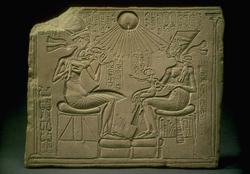
This is a closeup of a famous stela (click here for whole stela) showing Akhenaten and Nefertiti with some of their children carved as miniature adults in their laps. It's a touching family scene, one of the aspects of Amarna art that makes it famous. I like the sure-of-itself style in this piece -- it doesn't seem experimental anymore, nor is it at all willing to change to suit the thousand-year-old standards of Egyptian relief. I think especially in the lighting in this picture, it looks a little alien, too.
Image source: Art Images for College Teaching, items EN006 and EN008.
Other versions on the web: Ägyptisches Museum und Papyrussammlung

Many people claim that Akhenaten was ugly, and had his artists paint others as ugly too to make himself feel better. This seems ridiculous to me - Akhenaten has a power in his unique look. I think this fragmentary colossus shows particularly well his unique beauty. With the expert help of David Kennedy, this image was transformed into the Akhenaten you see on my Introduction page.
Image source: I don't remember. Please let me know if you find it on the web.

This is another, very different, image of Akhenaten. This was carved later in his reign (the previous image was carved much earlier), and shows an almost sad person, to my eye. He once sat next to Queen Nefertiti, whose arm still wraps around his back. This statue was featured in the exhibition Pharaohs: Treasures of Egyptian Art from the Louvre which I was fortunate enough to see in Cleveland.
Image source: Unknown, but the same image can be found on the cover of: Lawrence M. Berman, Bernadette Letellier, Pharaohs: Treasures of Egyptian Art from the Louvre, Cleveland: Cleveland Museum of Art, 1996

This beautiful carved head was found at Amarna, still nearly perfect. It was carved to represent one of the princesses and remains one of my favourite amarna pieces. Unfortunately, I have only this small picture at the moment.
Brown Quartzite, Agyptisches Museum, Berlin
Image source: Now-lost website of the Royal Women of Amarna exhibition. See Dorothea Arnold, The Royal Women of Amarna, New York: The Metropolitan Museum of Art, 1996, fig. 48, p. 56.

What Amarna art gallery would be complete without the beautiful bust of Nefertiti? And what needs be said?
Agyptisches Museum, Berlin
Image source: Art Images for College Teaching, item EN010.
Other versions on the web: my favourite, very nice head-on with information - this one is all over the internet, several views of the last one , a pretty bad one.

Thanks for visiting our Gallery. I hope you've developed a taste for the unique art of this little piece of history. Now for more art of the Amarna period may I recommend:


Search / Sitemap

powered by FreeFind


Taken from: http://katherinestange.com/egypt/gallery.htm
This page is part of The Akhet-Aten Home Page
maintained by Kate Stange (email / webpage)
Content Copyright © 1996-2000.
Last updated March 1, 2000.


Thursday, November 29, 2012

Why did the Prophet Elisha curse the “youths” for making fun of his baldness (2 Kings 2:23-24)?


Question: "Why did the Prophet Elisha curse the “youths” for making fun of his baldness (2 Kings 2:23-24)?"

Answer: There are a few key issues we must understand in regards to this account of the youths cursing Elisha. The text reads, “From there Elisha went up to Bethel. As he was walking along the road, some youths came out of the town and jeered at him. ‘Go on up, you baldhead!’ they said. ‘Go on up, you baldhead!’ He turned around, looked at them and called down a curse on them in the name of the LORD. Then two bears came out of the woods and mauled forty-two of the youths.” It seems unbelievable that God would cause two bears to maul a group of children for making fun of a man for being bald. First, the King James Version has done us a disservice by translated the term as “children.” The Hebrew word can refer to children, but rather more specifically means "young men." The NIV, quoted here, uses the word “youths.” Second, the fact that the bears mauled 42 of the youths indicates that there were more than 42 youths involved. This was not a small group of children making fun of a bald man. Rather, it was a large demonstration of young men who assembled for the purpose of mocking a prophet of God. Third, the mocking of “go on up, you baldhead,” is more than making fun of baldness. The baldness of Elisha referred to here may be: 1) natural loss of hair; 2) a shaved head denoting his separation to the prophetic office; or more likely, 3) an epithet of scorn and contempt, Elisha not being literally bald. The phrase “go up” likely was a reference to Elijah, Elisha’s mentor, being taken up to Heaven earlier in 2 Kings chapter 2:11-12. These youths were sarcastically taunting and insulting the Lord’s prophet by telling him to repeat Elijah’s translation. In summary, 2 Kings 2:23-24 is not an account of God mauling young children for making fun of a bald man. Rather, it is a record of an insulting demonstration against God’s prophet by a large group of young men. Because these young people of about 20 years of age or older (the same term is used of Solomon in 1 Kings 3:7) so despised the prophet of the Lord, Elisha called upon the Lord to deal with the rebels as He saw fit. The Lord’s punishment was the mauling of 42 of them by two female bears. The penalty was clearly justified, for to ridicule Elisha was to ridicule the Lord Himself. The seriousness of the crime was indicated by the seriousness of the punishment. The appalling judgment was God’s warning to all who would scorn the prophets of the Lord.
 
....
 

Wednesday, November 28, 2012

Trove subject:"Tell el-Amarna (Egypt)"


Taken from: http://trove.nla.gov.au/result?q=subject%3A%22Tell+el-Amarna+(Egypt)%22


Books

view all 83 results
Minimise
  1. Excavations at Tell el-Amarna, Egypt, in the 1913-1914
    Borchardt, Ludwig, 1863-1938
    [ Book : 1916 ]
    Keywords: antiquities; egypt; tell el-amarna (egypt)
    Read online at Open Library/Internet Archive
    View online
    This resource is very relevant to your query (score: 16.795)
    This resource is very relevant to your query (score: 16.795)
  2. Syria and Egypt from the Tell el Amarna letters / by W.M. Flinders Petrie
    Petrie, W. M. Flinders Sir, (William Matthew Flinders) 1853-1942
    [ Book : 2 versions : 1898 ]
    Keywords: Syria - History.; Tell-el-Amarna tablets.; Egypt - History.
    Read online at Hathi Trust
    View online
    At 6 libraries
    This resource is very relevant to your query (score: 16.191)
    This resource is very relevant to your query (score: 16.191)
  3. Amarna : ancient Egypt's age of revolution / Barbara Watterson
    Watterson, Barbara
    [ Book : 2 versions : 1999-2002 ]
    Keywords: Art, Egyptian - Egypt.; Tell el-Amarna (Egypt) - Civilization.; Tell el-Amarna (Egypt) - Religion.

    At 9 libraries
    Amarna : ancient Egypt's age of revolution / Barbara Watterson
    This resource is very relevant to your query (score: 15.385)
    This resource is very relevant to your query (score: 15.385)
  4. Excavations at Tell el-Amarna, Egypt, in 1913-1914 / by Ludwig Borchardt
    Borchardt, Ludwig, 1863-1938
    [ Book : 2 versions : 1916-1921 ]
    Keywords: Tell el-Amarna (Egypt); Egypt - Antiquities.
    At 2 libraries
    This resource is very relevant to your query (score: 15.346)
    This resource is very relevant to your query (score: 15.346)
  1. The city of Akhenaten, Part 3, The central city and the official quarters : the excavations at Tell el-Amarna during the seasons 1926-1927 and 1931-1936
    Pendlebury, J. D. S (John Devitt Stringfellow), 1904-1941; Boodle, Leonard A; Černý, Jaroslav; Clark, H.B; Lavers, R.S; Brunner Digitisation Project; Egypt Exploration Society; Macquarie University. Library
    [ Article : 1951 ]
    Languages: eng
    Keywords: Egypt -- Antiquities; Tell el-Amarna (Egypt)
    View online
    At Macquarie University
    This resource is very relevant to your query (score: 14.353)
    This resource is very relevant to your query (score: 14.353)
  2. The city of Akhenaten, Part 2, The north suburb and the desert altars : the excavations at Tell el Amarna during the season 1926-1932
    Frankfort, Henri, 1897-1954; Fairman, H. W (Herbert Walter), 1907-1982; Pendlebury, J. D. S (John Devitt Stringfellow), 1904-1941; Brunner Digitisation Project; Egypt Exploration Society; Macquarie University. Library
    [ Article : 1933 ]
    Languages: eng
    Keywords: Egypt -- Antiquities; Tell el-Amarna (Egypt)
    View online
    At Macquarie University
    This resource is very relevant to your query (score: 14.347)
    This resource is very relevant to your query (score: 14.347)
  3. Amarna letters : essays on ancient Egypt, c.1390-1310 B.C
    [ Periodical : 1991-2011 ]
    Keywords: Tell-el-Amarna (Egypt) - Antiquities - Periodicals.; Egypt - History - Eighteenth dynasty, ca. 1570-1320 B.C - Periodicals.
    At Macquarie University
    This resource is very relevant to your query (score: 13.845)
    This resource is very relevant to your query (score: 13.845)
  4. The city of Akhenaten, Part 1, Excavations of 1921 and 1922 at el-ʻAmarneh
    Peet, Thomas Eric, 1882-1934; Gunn, Battiscombe, 1883-1950; Guy, P. L. O (Philip Langstaffe Ord), b. 1885; Newton, Francis Giesler, 1878-1924; Woolley, Leonard, Sir, 1880-1960; Brunner Digitisation Project; Egypt Exploration Society; Macquarie University. Library
    [ Article : 1923 ]
    Languages: eng
    Keywords: Egypt -- Antiquities; Tell el-Amarna (Egypt)
    View online
    At Macquarie University
    This resource is very relevant to your query (score: 10.999)
    This resource is very relevant to your query (score: 10.999)
  1. Nefertiti revealed
    Discovery Channel (Firm)
    [ Video : 2 versions : 2003-2006 ]
    Keywords: Nefertiti Queen of Egypt, 14th cent. B.C.; DVD - Documentary.; Excavations (Archaeology) - Egypt.
    ... Region 4. This program examines the life and mysterious death of Nefertiti, wife of Akhenaton and queen of Egypt ...
    At 7 libraries
    This resource is very relevant to your query (score: 6.309)
    This resource is very relevant to your query (score: 6.309)
  2. Nefertiti : Egypt's mysterious queen / produced and directed by Peter Minns
    British Broadcasting Corporation
    [ Video : 3 versions : 1999 ]
    Keywords: Nefertiti Queen of Egypt, 14th cent. B.C.; Egypt - History - To 332 B.C.; Akhenaton King of Egypt.
    ... to the discovery of her tomb. More than 3,000 years ago, Pharaoh Akhenaten notoriously transformed Egypt during what was known as the Amarna ...
    At 6 libraries
    This resource is very relevant to your query (score: 5.539)
    This resource is very relevant to your query (score: 5.539)
  3. Akhenaten and Nefertiti : the royal gods of Egypt
    ABC-TV (Australia)
    [ Video : 3 versions : 2002-2006 ]
    Keywords: Akhenaton King of Egypt.; Egypt - Religion.; DVD-Video discs.
    ... to be worshipped like Gods on earth created one of the greatest upheavlas in Ancient Egypt's 3,000-year history ...
    At 3 libraries
    This resource is very relevant to your query (score: 4.972)

Tuesday, November 6, 2012

Scroll of Esther shaped as reversible version of Jezebel cycle


Some very interesting points made here, taken from:
http://prophetess.lstc.edu/~rklein/Documents/Zlotnick.htm


Helena ZLOTNICK
Biblica 82 (2001) 477-495


From Jezebel to Esther:
Fashioning Images of Queenship in the Hebrew Bible


Whatever else had inspired the recording of the translation of a chaste and beautiful Jewish woman from her cousin’s home to the harem of a gentile king, the fact remains that there were few biblical antecedents to chart Esther’s progress through a palatial phase. Much has been written about the stereotype of the Jewish courtier in a foreign court but the image of Joseph constitutes a poor source of inspiration for that of a Jewish queen attempting to exert power from a royal bedchamber. There are, in fact, few narratives in the HB that focus on the critical activities generated in the intimacy of royal marriage. Of these, the episodes centering on Jezebel and Ahab provide comprehensive glimpses at a royal bedroom and at its intricacies1.
At the heart of this study stands the hypothesis that the story of Esther and Ahasuerus must be read as a rehabilitative narrative of the tale of Jezebel and Ahab. To be exact, the narrative of Esther, if read sensibly and sensitively, bears unmistakable allusions to that of Jezebel. Both share an ideological kinship that aspires to define the desired characteristics and behavior of Israelite/Jewish queens.
An investigation into the use of Jezebel as a shadowy foil to Esther highlights biblical (redactional) ideas regarding queenly images, queenly spheres of influence and the molding of ‘Israelite’/Jewish queens2. Underlying both narratives, ultimately, is a condemnation of Israelite/Jewish monarchy. Such a theory can also account, in part, for some of the striking omissions of the ‘exilic’ Esther narrative, not the least the absence of prophets and the failure to refer explicitly to God. To illustrate these points in full I will also institute comparisons with
_____________________
478
early Roman queens. Cross-cultural parallels of this sort have the potential of contributing to fuller understanding of Jewish (and Roman) reconstructions of the monarchic past as a tissue of familial narratives focusing on the reputation or notoriety of female protagonists.
I. The Royal Wife: Queens as Protagonists
Jezebel is remembered, above all, for her role in the famed episode of the vineyard of Naboth (1 Kgs 21)3. The story begins with direct negotiations between two men, a king and his subject, Ahab and Naboth, over the legal acquisition of a plot of land adjacent to a royal residence. The exchange is terminated with Naboth’s insistence on the inalienable character of his property. His refusal to comply with the king’s desire leaves Ahab with two options: he can abandon his rosy visions of a palatial garden (21,2) or he can exert his authority to prevail, by hook and by crook, over the scruples and the objections of Naboth. The king chooses neither. Returning home from his unprofitable dialogue with Naboth he retires to his bedchamber in a foul mood and plunges into a fast4.
As the scene shifts from the outside with its vineyards and hypothetical gardens to the royal bedroom the queen enters the picture. Her ‘credentials’ had already been established. Readers had been familiarized with this Sidonian princess as the moving spirit behind her husband’s devotion to the Baal (16,31), and as the mortal enemy of YHWH’s prophets (18,4.13)5. The fact that Ahab’s marriage with her
_____________________
479
also signaled the acceptance of the Omrides by their neighbors was deemed irrelevant by the biblical redactor. Yet, with the exception of Solomon, only Ahab achieved the kind of ‘international’ status that made him a desirable match in the eyes of neighboring kings.
Jezebel’s intrusion into Ahab’s self-imposed solitude re-enacts the tale of the vineyard verbally and in the intimacy of the royal bedroom. Within this familial context Jezebel emerges as the king’s solicitous spouse rather than as a bearer of idolatry. Her question, ‘What is the matter with you and why are you not eating’ (1 Kgs 21,5), supports this image. Ahab replies with a distorted version of the words exchanged with Naboth. According to his presentation Naboth was guilty of obstinacy if not of disobedience through an unreasonable refusal of complying with the king’s seemingly reasonable request.
On the surface, this brief and rare glimpse into a royal marriage reveals a model of spousal relations and an inordinate degree of marital harmony and trust6. Ahab admits his weakness to a sympathetic wife expecting, presumably, support and understanding. She expresses perhaps indignation perhaps surprise and promises the fulfillment of his desires. He refrains from probing her promise. Even before this bedroom snapshot the text refers to the couple’s closeness and her status, in spite of Ahab’s other wives. He shares with her not only her gods but also information about the management of the kingdom, including the difficulties attendant on the maintenance of correct relations with YHWH’s prophet, Elijah (1 Kgs 19,1). She issues a death threat to Elijah that effectively undermines Ahab’s conciliatory politics and demonstrates her standing at the court.
How extraordinary was the association of an ‘Israelite’ queen, even of foreign descent, with unlimited accessibility to the king can be fully appreciated through the fashioning of royal intimacy in the scroll of Esther7. Only three royal couples in the HB, Jezebel and Ahab, Esther and Ahasuerus, David and Bathsheba, are seen, or rather heard in direct verbal communication. But the nature of Bathsheba’s intercession is dictated by motherly and not by wifely concerns. Her
_____________________
480
appearance in the king’s bedroom, where another woman had been occupying the king’s bed, is carefully orchestrated by a prophet. She is neither Jezebel nor Esther.
Like Jezebel, Esther is one of many royal consorts. Unlike Jezebel, when Esther approaches her royal husband she is not only afraid of the consequences of appearing without summons but she also behaves as a humble petitioner rather than a royal consort (Esth 4,11). Even in the privacy of her own rooms Esther has to tread carefully. After obtaining permission to stage a private banquet for the king and a favorite minister (Haman) she dares not bring up her grievance before plying Ahasuerus with drinks (Esth 7,1.2.7). And even then she waits till Ahasuerus seeks enlightenment regarding the identity of the author of the anti-Jewish measures in his kingdom.
When Esther exposes Haman Ahasuerus, like Ahab, retires in anger not to his bedroom but rather to an adjacent garden. That the scroll conjures up for the king’s inflamed spirit the exact same soothing landscape that Ahab had desired to create out of Naboth’s vineyard seems hardly a coincidence. Ahasuerus’ brief stroll in the queen’s garden is staged as a prelude to the climax of the plot and marks the end of Haman’s career. Ahab’s urge to enlarge the palace’s garden sets in motion a series of crimes and signals the demise of his dynasty.
Both the Dtr historian (= the redactor of 1 Kgs 21) and the author of the scroll cloth with mockery the marriages they delineate. The former casts the king’s bedroom as a launching pad for queenly crimes; the latter places the queen in bed with her enemy rather than with her lawful consort. In both narratives communications between king and queen, although direct, are marked by evasions and half-truths. Ahab and Jezebel communicate through deceptions. He provides an edited version of his dealings with Naboth while she avoids further delving into both his statements and her own strategies. Esther hides her true identity from Ahasuerus when she joins the harem. She also conceals her true intention from him when she solicits permission to hold a private banquet for Haman. If Ahasuerus believed his beautiful wife, a rather doubtful proposition, he elected to humor her by pretending ignorance.
An interplay between the words and the actions of the protagonists further reveals parallels between the tales of Jezebel and Esther. Jezebel reminds Ahab of his royal status only to undermine her own assertion by assuming kingly power. Mordechai, ostensibly a caring
_____________________
481
relative, reminds Esther of her position at the court solely to prompt her to use it in spite of danger to her life in obeying his order. Neither Ahab nor Esther, of course, requires the admonition. But the reminders also imply an admission of Mordechai’s own helplessness and of Ahab’s inability to deal with the situation. As the action shifts into the hands of the two queens the scroll is still careful to entrust the initial urging into the hands of a male relative, thereby ‘correcting’ the Dtr history that had cast Jezebel as the prompter and the actor.
A choice of seminal gestures and phrases in the scroll’s description of critical preliminaries appears to recall, somewhat perversely but accurately, the earlier narrative. When Esther hears that Mordechai has been seen donning mourning clothes at the gate of the palace she orders an inquiry into this seemingly inexplicable and apparently inexcusable public display (Esth 4,1-5). Jezebel addresses her grief-stricken and fasting spouse in a similar mode, likewise implying that his behavior is uncalled for. At the heart of the familial encounters on the eve of a crisis are two difficult phrases that emphasize the addressee’s status. ‘Who knows? Perhaps you have attained royalty for just such a time as this?’ (Esth 4,14)8. Jezebel addresses Ahab with a similarly pregnant question: ‘Do you now govern Israel?’ (1 Kgs 21,7). In both instances a rhetoric of timeliness is intended to spur the protagonists to action. Mordechai succeeds in coercing Esther to act; Jezebel becomes an actor rather than a prompter.
Structurally, the later narrative also encodes the making of Esther as a queen in a sequence that echoes Jezebel’s queenly progress. In the wake of the fateful exchange between Esther and Mordechai Esther, like Jezebel after her interchange with Ahab, appropriates control over the course of events. She issues an order to summon the Jews of Susa for a three-day fast (Esth 4,16). In the reconstructed order of events in 1 Kgs 21 Jezebel acts along precisely the same lines: she summons the council of the elders in Naboth’s town and calls for a fast (21,9). In both cases the queen effectively transfers the gestures (fasting; mourning) that launch fatal encounters between kin (Ahab/Jezebel; Mordechai/Esther) to a wider circle of the public, thereby opening the door to an outbreak or a resolution of a crisis.
_____________________
482
Lest, however, these close analogies inspire unwary readers with either sympathy towards Jezebel or hostility to Esther, the latter narrator carefully parts the ways of the two queens. Jezebel disappears, physically, from subsequent proceedings. Her invisible presence, however, is constantly referred to in the text. By contrast, Esther appears in all her regal splendor in the inner palace court as she implements the first part of her plan to save the Jews from extinction. She is fully visible, unlike Jezebel, but her intentions are concealed from the beholder. Esther is also beautiful, a familiar attribute of matriarchs in the HB. Jezebel lacks a face and a figure, as though she is made of an evil spirit alone. Moreover, readers are aware of Jezebel’s aim from the start as she sets out to fulfil her husband’s wish. Her method of achieving it soon becomes apparent. In the scroll neither husband nor its readers are familiarized with Esther’s schemes to deliver her promise.
II. The Two Faces of Queenship
Casting an Esther as a Jezebel carried, potentially, dangerous connotations. The hostility of biblical narrators to queens who, like Jezebel, usurp the role of kings in a manner that highlights the limitations of kingly power and the breakdown of male authority within the home is undisguised. It finds an amplified echo in the annals of the early Roman monarchy (6th century BCE) which chart the career of two queens, Tanaquil and Tullia, who bear curious similarities to the biblical female monarchs. Because Roman authors are considerably more expansive than biblical narrators they provide valuable insights into the process that molded queenly images in antiquity.
In the hindsight of several centuries, the history of early Rome emerges in the pages of the historian Livy (57-14 BCE) as a family narrative dominated by the ambitions of its female members and punctuated by their sense of honor and shame9. Of these, Tullia, like Jezebel, is a daughter of a king (Servius Tullius). Her husband, Tarquinius (Superbus), is likewise a son of a monarch (Tarquinius Priscus) who, however, had designated another man, a non-relative, as his successor. To win the stakes in the complicated game of succession
_____________________
483
the couple embarks on a career of crimes, including the murder of their first respective spouses and the killing of Tullia’s father, the reigning ruler. Although apparently a match made in heaven, Livy shows no hesitation in casting Tullia as the moving spirit behind the rocky ride to the throne of Rome.
Echoing what Jezebel might have said to Ahab, had the text been recorded and transmitted in full, Tullia addresses her husband as follows:
If you are the man I thought I was marrying, then show yourself to be a man and a king. If not ... you have compounded a crime with cowardice. What is the matter with you? You are not from Corinth or from Tarquinii, like your father, nor is it necessary for you to make yourself a king in a foreign land. The gods of your family, your ancestors, the image of your father, the royal palace, its throne and the very name Tarquinius make and proclaim you king. Why else, if your spirit is too mean to (undertake) this, do you deceive the city? Why do you allow yourself to be looked upon as a prince? Depart to Taquinii or Corinth where you can sink once more into oblivion...10.
Focusing on the interaction between the family and the state as two social entities Livy shows how the privileging of the family interest at the expense of public duty generates chaos11. Tullia and Tarquinius base their claim to the kingship on kinship alone, thus reversing and subverting the principle of merit and of inclusion on which the Roman royal succession had been established from the start. Jezebel ‘vindicates’ the king who is also her husband, thereby undermining the foundations of the royal system of dispensing justice.
In Livy’s landscape of early Rome the palace is the focus and the symbol of the couple’s unbridled ambitions. From the seclusion of their domestic space Tullia and Tarquinius launch their criminal activities. When Tarquinius appears in the curia (= senate house) with an armed bodyguard, Tullia burst on the scene and hails him as king. Her action and gesture constitute a double transgression. Not only does she violate the physical boundaries of males’ space by intruding into male business in the forum, but she also crosses the frontiers of male authority by being the first to confer royalty on a man in public.
Responding to censure, not the least from her own husband, Tullia
_____________________
484
defends herself by appealing to another queenly model. She regards herself as a faithful imitator, if not an improved version of Tanaquil, her mother-in-law who had been instrumental in helping her own husband (Tarquinius Priscus) to become a king at Rome, and who had ensured the smooth transfer of power to a successor she herself had chosen (Servius Tullius, Tullia’s father).
Livy’s presentation of Tanaquil is ambiguous. In his words, she is ‘a woman of the most exalted birth and not of a character lightly to endure a humbler rank in her new [Roman] environment than the one she had enjoyed by birth’12. To save the monarchy Tanaquil alters the deliberative process reserved for the senate and the people of Rome. When her husband falls victim to an assassination plot, she encourages Servius to take the reigns into his hands:
To you, Servius, if you are a man, belongs this kingdom, not to those who by the hands of others have committed a dastardly crime. Arouse yourself and follow the guidance of the gods ... Now is the time ... Rise up to the occasion. We, too, although foreigners, ruled over Rome. Consider who you are and not where you were born. If your judgement is numb in so sudden a crisis then follow my council 13.
The fact that Livy leaves the ultimate tribute to Tanaquil in Tullia’s hands reflects a deep-seated uneasiness with the assumption of male power by women, laudable as their intentions and ultimate results might have been. Although Tanaquil’s resourcefulness saves the dynasty that she had created she also violates male norms by claiming a higher authority than the traditional mos maiorum (custom) would have allowed any woman, queens included. By setting herself and her late husband as models for Tullius to be imitated, Tanaquil also paves the way to Tullia.
As the biblical narrative recreates Jewish queenship in the scroll of Esther, the leading female character undergoes the same kind of transformation that underlies the Tanaquil-to-Tullia process, but in reverse. To begin with, Esther is not only Jewish but a woman with impeccable royal (Jewish) blood in her veins. Jezebel is constantly branded a foreigner in a manner that reflects not only her ethnicity but also her proclivities14. In the redactional history of the Hebrew Bible
_____________________
485
the Deuteronomist antipathy to foreigners, and particularly to foreign queens, has been associated with a deep-seated fear of idolatry through contamination15. The elevation of foreigners to Rome’s throne, by contrast, reflects Rome’s greatness and her openness to strangers, while Tullia’s urging of her husband to seize the throne on the ground of his ‘nativeness’ is clearly misplaced.
The scroll depicts the decree of Ahasuerus-Haman ordering the elimination of the Jews as a writ of national emergency. The clash between Ahab and Naboth appears, at first, as carrying little import beyond the king’s petty desire to expand to plant vegetables. Yet behind the issue of the vineyard versus royal garden lurks the larger question of the legitimate scope of monarchical actions vis-à-vis the king’s subjects16. In the Esther scroll the queen reacts to a patriarchal call to action and only exercises her potential royal power to save her people, as Tanaquil does to save Rome from revolution. Jezebel, like Tullia, acts on her own initiative, subverting male standards of royal behavior.
Just how perilously close to each other are, nevertheless, constructs of royal women like Tanaquil and Tullia on the one hand, and Jezebel and Esther on the other, can be further gauged from the attitude of all the texts to the public appearance of queens. Roman and Jewish authors are unanimous in banning women from the public eye. Jezebel and Esther never appear in public. Tanaquil makes a single public appearance when there is no one else who can save the dynasty. Even then she remains standing at a window in the palace, shielded by its walls. Tullia’s venturing into the forum invokes censure by her husband, and by the historian Livy. But Tanaquil’s position near a top window, although emphasizing Tullia’s boldness in venturing outdoors, also signifies the female usurpation of male authority at home. Ultimately, both women embark on a course of action that contradicts male expectations of female royalty. Nevertheless Tanaquil garners praise while Tullia is condemned.
Jezebel’s sole ‘public’ appearance is made as a spectator standing at the window of the palace that another king is about to possess. Observing the approach of Jehu, she stands at the window as a visual
_____________________
486
reminder of the legitimacy of her royal position and of his usurpation. Her words reinforce the image that her presence conveys: ‘Is it peace, Zimri, murderer of his master?’ (2 Kgs 9,30). Her words, like Tanaquil’s to Tullius, are filtered through space and the conventions of official language as she faces the successor of her dynasty and her ultimate executioner17.
Esther is never seen or heard addressing directly any man besides her husband and cousin/father. In fact, no biblical narrator or redactor ventured to place either queen, Jezebel or Esther, outside the confines of the palace itself. Both women use messengers to gather information and agents to convey their commands and their threats. Yet, like Tanaquil and Tullia, the two biblical queens were destined for vastly disparate ‘after-life’. In collective memory Jezebel became a stereotype of shrewish and detestable queens18. Esther’s adventures are still celebrated.
III. Naboth’s Trial: Jezebel the Persecutor
Underlying Jezebel’s assumption of royal authority in the case of Naboth is the pitting of her patron-god, the Baal, with the national Israelite divinity, YHWH. Within this context the queen’s uncompromising loyalty to her husband, in itself a commendable wifely trait, is completely obscured. Esther is not even expected to display spousal loyalty to her royal husband but rather a commitment to her own community of origin. Her dilemma as a wife and a queen is staged as a predicament of the Jewish people as a whole. Ahab’s reflects the king’s own pettiness.
In the name of Ahab Jezebel communicates the king’s alleged commands to the local authorities in Naboth’s hometown. The redacted story does not explain whether she had been empowered to do so. It implies that she abused, rather than used the king’s implicit trust in her19. In the scroll of Esther not a single person, wife or otherwise,
_____________________
487
is allowed to issue royal commands without the king’s explicit seal of approval. Jezebel acts on her own initiative and without the prompting of a male relative. In her eyes she is embarking on a just vindication of the injured royal dignity.
The theme of writing on behalf of the king, with or without explicit permission, and of using the royal seal to convey the legality of the message dominates both the Jezebel and the Esther accounts20. 1 Kgs 21,8 depicts Jezebel as writing a royal letter to Naboth’s peers by herself but in Ahab’s name, and using his seal. She is thus engaged in a pursuit that is not only unacceptable when undertaken by men without duly conferred authority but is the height of impropriety when practiced by a woman. Yet, according to 1 Kgs 21,9 the letter merely contained a call for a local fast although the redacted sequence of the events strongly suggests that it also contained instructions regarding the staging of the whole affair.
Esther’s sojourn at the court is marked from the very start by directions incorporated in written commands. She is joined to the harem upon the publication and dissemination of a royal order to gather beauties from all over the kingdom (Esth 2,8). Ahasuerus endorses Haman’s request to eliminate the Jews with his own seal (= ring) (Esth 3,10) and the royal scribes articulate the command in a series of letters that they distribute (Esth 3,12-13). The fact that such orders had been issued in the name of the king and not of his minister is tacitly ignored by Esther when she pleads in front of Ahasuerus (Esth 7,4-6). The king’s implicit or explicit permission is precisely the aspect that the redactor of the Naboth affair never lets the readers forget when he insists on the concealed authorship of Jezebel. Finally, to illustrate the changing fortunes of Haman, Ahasuerus allows Esther and Mordechai to issue in his name and with his seal commands relating to the fate of their enemies (Esth 8,8). According to the scroll’s redactor, such royal orders, albeit not a royal initiative, nevertheless possess full legal validity and are irreversible (Esth 8,8).
In Livy’s depictions of early Rome queens never resort to the use or the abuse of their proximity to the source of power through the issuance of written documents. Both Tanaquil and Tullia address the public directly and orally, without mediation. Livy evidently did not deem it necessary to clothe Tullia’s illegal deeds with legitimacy
_____________________
488
through the power of the written royal word. Her truly offensive transgression in Livy’s eyes resided in the crossing of gender boundaries in public and not in secrecy. Casting Jezebel as a usurper of the king’s authority through stealth reflects both the real limits of queenly power and the redactor’s own biases. To rehabilitate this queenly image the scroll carefully invests Esther with direct royal authority to issue empire-wide commands in the king’s name.
Without, evidently, Ahab’s knowledge or permission Jezebel bids the leading men in Naboth’s town to announce a public fast and to appoint Naboth to head this solemn occasion. No reason is given to account for the fast, nor is objection offered21. Perhaps the drought that had marked Ahab’s reign provided the pretext. Unlike Naboth, his peers obey the royal desire without demure or protest22. The fast, as in other biblical narratives, serves as a preliminary to a critical public occasion. In Neh 9,1 a fast precedes the ceremony of the renewal of the ancient covenant between YHWH and the exilic community in Yehud. In 1 Kgs 21 the fast is concluded with a judicial murder that signals the demise of the Omride dynasty. Throughout Persia the news of the decree ordering the execution of the Jews prompts a general fast (Esth 4,4). Like Jezebel, Esther calls for a fast as she prepares herself for what can become a fatal encounter with the king (Esth 4,16).
In the midst of the public fasting ceremony in Jezreel two unnamed men accuse Naboth of blaspheming God and king23. The text makes no reference to the source of the accusation nor does it explicitly connect Jezebel with the two men. Their identity remains concealed. Yet, had they been non-entities their incriminating evidence may not have been accepted as promptly as it was. Jezebel’s complicity is implied throughout. The charge of blasphemy is interesting. Lev 24
_____________________
489
provides a precedent for the public stoning of a man who blasphemes God. However, the Pentateuchal tale focuses on a blasphemer who is half Israelite, half Egyptian, leaving open the question of the fate of a fully-fledged Israelite. There are no rules relating to procedure in the case of blaspheming a king24. Nor is it clear if the charge against Naboth involved a public or private manifestation of disrespect. The two knaves testify that he had done so presumably within earshot.
What the redactional recording of the Jezreel proceedings leaves in no doubt is its ‘reading’ of the entire affair as a blasphemy. In this interpretative fashion the tale is launched with Naboth’s (futile) appeal to YHWH. It continues with Ahab’s (fruitful) entrusting the queen with a resolution, and ends with a fatal accusation of blasphemy. In the process, Jezebel, already cast as the persecutor of YHWH’s prophets, is characterized as a prosecutor of YHWH’s innocent worshipper25.
The transformation of a private grievance (between Naboth and Ahab), through Jezebel, into a public charge becomes the dominant motif behind the scroll’s recreation of the events that led to a ‘judgement’ (without trial) of the Jews of Persia. Originating as an encounter between two individuals, Haman and Mordechai, a private feud is turned into a public affair when Haman approaches Ahasuerus with accusations regarding the Jewish community of the Persian empire. Like Jezebel, Haman cannot broach the real object of his impeachment speech and, like her once more, he concocts a general charge that depicts the Jews as a subversive element in the kingdom. Presenting them as people who ‘do not abide by the royal laws’ (Esth 3,8) Haman, like Jezebel, initiates a legitimate action against an appointed victim. And once more like the queen who promises the delivery of Naboth’s vineyard into Ahab’s hands, Haman assures the king of substantial material rewards as a result of the anti-Jewish law.
_____________________
490
While the Dtr historian has no interest in the effect of Jezebel’s actions on the community of Naboth, Esther’s author-redactor expands on the reactions of Jews and non-Jews to the publication of the king’s commands. The only person who remains blissfully ignorant of the impeding fate of the Jews is Esther herself, like Ahab who is also seemingly unaware of his wife’s plans. When Elijah clarifies the situation for the king’s benefit Ahab plunges into mourning (1 Kgs 21,27) in a manner recaptured by the scroll as it describes the general lamentation over the royal command (Esth 4,3). Ahab’s remorseful fasting is sufficient to appease God, at least for the time being (1 Kgs 21,28) but does not prevent the ultimate demise of his dynasty. Ahasuerus’ remorse brings fatality to Haman and salvation to his intended victims.
Now, the twin themes of fasting and feasting underlie both narratives26. As Ahab starts a fast over his failure to acquire Naboth’s property Jezebel encourages him to eat. But she herself, a generous provider of nourishment to hundreds of Baalistic prophets (1 Kgs 18,19), is destined to be eaten as food for dogs. Upon Elijah’s disclosures of Naboth’s execution Ahab expresses his repentance through another fast. Jezebel is never accredited with remorse. When Ahab dies on the battlefield (in royal terms an honorable death), a victim of his own ruse, his blood provides a drink to stray dogs. Ironically, then, the royal couple ends by feeding animals, she with her body and he with his blood. They remain united in infamy even after death.
Throughout Esther feasting and fasting highlight the changing conditions of individuals and of collectivities. The general merriment and banqueting that characterize the beginning of the story turn into a Jewish fast and mourning. Esther prepares a banquet in the midst of her own fast. Jewish salvation is celebrated through large quantities of food and drink. What do the protagonists aim to achieve through self-imposed fasting or through feasting? Ahab’s initial fast prompts the (‘criminal’) action of his wife; his second fast rekindles God’s mercy. For all intents and purposes, then, fasting is a powerful weapon of achieving personal purposes. Mordechai’s fast at the gate of the palace
_____________________
491
upon learning of Haman’s decree constitutes a transgression of the law of the land and reinforces the image of Jewish recalcitrance that Haman had portrayed. The general Jewish fast following the Ahasuerus-Haman decree seems equally incapable of averting doom. Only Esther appears to use the period of fasting as a preparation for a difficult task ahead. The irony is palpable. To approach a monarch whose main claim to fame is the celebration of lavish banquets Esther and her people have to experience the opposite of a royal lifestyle.
In a series of intriguing and intricate inversions the Esther scroll adopts and adapts actions and protagonists of the Jezebel story to convey, ultimately, a similar message. Just as Naboth’s real murderers are doomed to perdition Haman’s plans are destined to lead to his own undoing. Beyond such simplistic similarities lies, however, a complex ideology. Because of the origins of the Israelite monarchy the power of kings must remain limited. In a post-exilic existence, such as the scroll of Esther depicts, there is in fact no room at all for a Jewish king. The only viable royalty is that of a gentile monarch. In this context a Jewish queen is born, or rather created, not as a consort of a Jewish king but as an instrument to save her people in a moment of exigency.
IV. Conclusion: Jezebel the ‘sorceress’ and Elijah the ‘magician’
In the encounter between Elijah and Ahab over the royal appropriation of private property, Naboth’s death is described as a ‘murder’ (1 Kgs 21,19)27. There is, however, no murderer in the plain and direct sense of the word. Kings or queens need not resort to bloodying their hands. The punishment to which Ahab and Jezebel are subjected as a result of Naboth’s death makes, therefore, little sense. In the annals of the Israelite monarchy a similarly motivated murder, notably that of Uriah by David (2 Sam 11), is cast as an act of impiety against God28. And although the prophet Nathan pronounces a twofold punishment, neither David himself nor his dynasty are destined to immediate extinction as Ahab’s is. Furthermore, Ahab
_____________________
492
meets his death through a ruse, precisely the same type of stratagem that his wife had employed to secure his happiness.
In Deuteronomistic narratives when kings commit crimes they are reprimanded by prophets, retract, and are duly punished by YHWH. But when the agent of the ‘crime’ is a woman, a foreigner, and a queen the story gains a twist. The king appears to lose his will and to recede into inactivity. The queen adopts royal tactics and commands the scene. Like David, Jezebel entrusts visibility to trusted brokers. Unlike David, she is never confronted directly either by YHWH or by a prophet. Such privileged mode of communication is solely the right of impious kings.
To justify in full the elimination of a legitimate monarch (Ahab) and of his legitimate queen the Dtr narrative(s) compound(s) Jezebel’s guilt in the Naboth case with other charges. In a deadly encounter between Jehoram of Israel, Ahazia of Judaea and Jehu, the latter newly anointed by Elisha, Jezebel is accused of sorcery and prostitution (2 Kgs 9,22b). The allegation is puzzling. At redactional level it denotes the full enormity of her impiety. A comparison with Tanaquil, however, hints at a different possibility.
‘Expert in the interpretation of celestial signs like most Etruscans’ Tanaquil reinforces her husband’s ambitions and plans by relating tidings from the gods29. Tanaquil’s supernatural gifts, the result of her particular brand of Etruscan religiosity, contribute to her exceptional standing in the palace. The gods communicate their wishes through her interpretative skills, enabling her to serve both the family and the state. Conversely, Jezebel’s ‘magical’ powers emphasize the queen’s blatant violation of Yahwist piety and royal (Dtr) ideology. What Livy construed in Tanaquil’s case as an inordinate and positive brand of religiosity is condemned in the biblical narrative as female ‘sorcery’ and ‘prostitution’30.
The negative hue firmly attached to Jezebel’s ‘sorcery’, in itself a trait that is never quite demonstrated in the narrative, is best explained within the context of her rivalry with Elijah31. In the Elijah sagathe prophet constantly engages in ‘sorcery’ or in miraculous demonstration
_____________________
493
of his Yahwist attachment. His brand of magic is a sure sign of his being ‘a man of God(s)’ (1 Kgs 17,24) and of YHWH being the only one and true God (1 Kgs 18,39). While Jezebel’s ‘magic’ secures the succession of her son in spite of prophetic doom, Elijah’s parallel powers require constant attestation32. In the greatest magic show Elijah disappears out of human purview. Jezebel, unaided by the Baal or by witchcraft, is torn asunder and her blood drenches the earth. Yet, it is precisely Elijah’s heroic proportion that serves to magnify Jezebel’s sorcery.
The charge of prostitution, as has been often remarked, appears calculated to invoke Jezebel’s apostasy and her commitment to the Baal33. In the mouth of Jehu and in the ears of Jezebel’s son the word echoes with further irony. It reminds the audience that her betrayal of YHWH and of his prophets (= prostitution) had been as vigorous and disastrous as her loyalty to her husband and to her god. Such an interpretation receives support from the fact that the scene between Jezebel’s son and her destined murderer (Jehu) is carefully placed in Jezreel, on Naboth’s former plot (2 Kgs 9,21).
Jezebel, the ‘prostitute’ and the ‘witch’, violates norms of kingly behavior and weakens the precarious balance of power between kings and YHWH’s prophets34. Her promotion of the Baal undermines YHWH’s sphere of influence. Impious, sacrilegious, and a transgressor of the boundaries of women and of queens, Jezebel is cast as the antithesis of what a Jewish queen ought to be. To remedy the damage that she had inflicted on the delicate balance between YHWH and Israel Esther is created in her reversed image.
By shadowing Jezebel through Esther the scroll also provides a
_____________________
494
commentary on the desirability of a kingship in general and on the character and activities of queens in particular. Clothing the tale of Jezebel and Ahab in an exilic garb further served to remind the audience of the perils inherent in intermarriage35. The absence of the habitual condemnation of intermarriage in the scroll of Esther is as striking as is the absence of YHWH. In the exilic existence that the Esther tale aspires to delineate the only acceptable Jewish queen is, strangely, one who is matched not with a Jewish king but with a gentile one. Nor are her royal functions of relevance. Esther does not bear children to the king, nor does she secure the dynasty. The absence of these critical components of all royal marriages is important. She is brought into the harem to serve a single purpose that, strictly speaking, has nothing whatsoever to do with her.
With superb irony the narrator of Esther’s and Mordechai’s vicissitudes at the court leaves both YHWH and prophets out of the story. Their absence raises the larger question of the place of YHWH in exile and outside the promised land of Israel. Although the issue of idolatry and apostasy is never raised, Haman’s words to Ahasuerus vividly illustrate the problems of the preservation of the Torah in a non-Jewish territory. Even God cannot appear in this context. At the heart of the rehabilitative narrative of the scroll lies, therefore, an unsolved problem, an end without an end. As Esther fulfils the purpose that Mordechai assigns her readers are left in the dark regarding the ‘happily ever after’. How long did the king’s affection last? If cyclical, as the beginning of the story strongly suggests, Esther’s end could have resembled Vashti’s.
Ultimately the biblical narrative excised queens altogether. In exilic redactional perspectives figures such as Jezebel remained a threat even in remote hindsight. The only viable royal woman was one whose movements were controlled by men. If the prospect of reviving the monarchy occasionally crossed the exilic horizons, the possibility of another Jezebel could never be entertained. From the very beginning kingship had been unpalatable to YHWH and to His prophets. Their aversion had been, seemingly, fully justified. Anyone who contemplates the redacted annals of the impieties of the Israelite and the Judaean kings, and the activities of their queens, must share the Deuteronomistic conviction of the futility of Jewish kingship.
_____________________
495
In Jewish history the monarchy began with Saul son of Kish, a Benjaminite. The last royal member of the house, Esther, likewise a Benjaminite and a scion of Saul, becomes a queen in a gentile court, thus concluding a period that had started with prophetic indignation against the appointment of kings (1 Sam 8) and ended with the abandonment of the Jewish people to their fate in a gentile-dominated diaspora. In a summary of the monarchical era the exilic Dtr historian accuses the Israelites of deliberately provoking the wrath of YHWH through their devotion to evil (2 Kgs 17,17). The words provide an uncanny echo of the aberration that Ahab had practiced under the influence of Jezebel36. Between Saul and Esther, then, tower the figures of Jezebel and Ahab as symbols of all the evil inherent in the ideology and the very existence of an Israelite/Jewish monarchy.

Department of History
The University of Kansas
3001 Wescoe Hall
Lawrence, KA 66045-2130 (USA)
Helena ZLOTNICK
SUMMARY
Only three royal couples in the HB are seen in direct communication. Of these, two, namely Ahab and Jezebel, Ahasuerus and Esther, contribute unique insights into the interpretative and redactional processes that cast later narratives around themes of earlier stories, and both around the figure of a queen. In this article I explore the hypothesis that the scroll of Esther was shaped as a reversible version of the Jezebel cycle. With the aid of narratives of the early Roman monarchy, a sensitive and sensible reading of the biblical texts relating to Jezebel and Esther demonstrates the constructive process of an ideology of queenship. Underlying both constructs is a condemnation of monarchy in general.
© 2001 Biblica

________________________________
NOTES
1 Besides these two only 1 Kgs 1 deals with a crucial bedroom scene. But Bathsheba is first and foremost a mother and not a wife. On queen-mothers as arbiters of royal succession see H. ZLOTNICK, "Securing the Succession: Mothers and Prophets in 1 Kgs 1" (forthcoming).
2 C. SMITH, " ‘Queenship’ in Israel: The cases of Bathsheba, Jezebel and Athaliah", King and Messiah in Israel and the Ancient Near East (ed. J. DAY) (JSOTSS 270; Sheffield 1998) 142-162, on the absence of the concept in the HB and on the queen-mother as the dominant female character at court. Jezebel, however, is not a queen-mother, nor is Esther. Moreover, the only child whose rights Jezebel may have advanced is a daughter rather than a son.
3 R. BOHLEN, Der Fall Naboth. Form, Hintergrund und Werdegang einer alttestamentlichen Erzählung (1 Kön 21) (TThSt 35; Trier 1978), for full analysis. On the three stages of composition/redaction (‘original’, Dtr expansion, and exilic elaboration), W.M. SCHNIEDEWIND, "History and Interpretation: The Religion of Ahab and Manasseh in the Book of Kings", CBQ 55 (1993) 649-661, esp. 655. On scholarly controversies regarding the layering of 1 Kgs 21 see R. MARTIN-ACHARD, "La vigne de Naboth (1 Rois 21) d’après des études récentes", ETR 66 (1991) 1-16, and standard commentaries, including J. GRAY, I & II Kings. A Commentary (OTL; London 21970); G.H. JONES, 1 and 2 Kings (NCBC; Grand Rapids 1984); J.T. WALSH, 1 Kings (Berit Olam; 1996); and T.E. FRETHEIM, First and Second Kings (Westminster Bible Companion; Louisville 1999).
4 Cf. 1 Kgs 20,43, a redactional bridging touch, which uses the same expression to describe Ahab’s reaction to YHWH’s chiding.
5 On the hostility of the D theologians to Jezebel and her religious affiliation, P. TRIBLE, "Exegesis for Storytellers and Other Strangers", JBL 114 (1995) 3-19, esp. 4 and passim.
6 Cf. Proverbs’ ideal wife (Prov 31,11-12 (trust of husband; rewarding husband with good and not with evil deeds) and 31,16-17 (plotting to obtain a field and to plant a vineyard!).
7 Since Jezebel’s ‘foreignness’ was clearly irrelevant in the determination of royal succession, she can be regarded as ‘Israelite’ for all intents and purposes. On Esther see my analysis in H. ZLOTNICK, Dinah’s Daughters. Gender and Judaism from the Hebrew Bible to Late Antiquity (Philadelphia 2001 [in print]).
8 My translation is based on J.W.H. VAN WIJK-BOS, Ezra, Nehemiah, and Esther (Westminster Bible Companion; Louisville 1998) but see the comments of Paton in his invaluable commentary on possible corruption and on the elusive structure and meaning of this phrase.
9 My comments are based on C.G. CALHOON, "Lucretia, Savior and Scapegoat: The Dynamics of Sacrifice in Livy 1.57-59", Helios 24 (1997) 151-169.
10 Titus Livius, Ab urbe condita 1.47.3-5. Trans.: Titus Livius, Opera. With an English translation by B.O. Foster et al. (LCL 114; Cambridge 1988 [11919]) 165, modified.
11 A. FELDHERR, Spectacle and Society in Livy’s History (Berkeley 1998) 190.
12 Titus Livius, Ab urbe 1.34.3 (Foster’s translation, modified).
13 Ibid., 1.41.4 (Foster’s translation, modified).
14 On the importance of the motif of Jezebel as the proverbial foreign woman, J.A. SOGGIN, "Jezabel oder die fremde Frau", Mélanges bibliques et orientaux en l’honneur de M. Henri Cazelles (AOAT 212; Kevelaer 1981) 453-459.
15 G. KNOPPERS, "Sex, Religion and Politics: The Deuteronomist on Intermarriage", HAR (1994) 121-142.
16 On the king’s role of ensuring justice throughout his kingdom, H. SCHULTE, "The End of the Omride Dynasty: Social-Ethical Observations on the Subject of Power and Violence", Semeia 66 (1994) 133-148, esp. 134.
17 CALHOON, "Lucretia, Savior and Scapegoat", 158 (on Tanaquil). On the heroic quality of Jezebel’s last moments, P.D. ACKROYD, "Goddesses, Women and Jezebel", Images of Women in Antiquity (eds. A. CAMERON – A. KUHRT) (London 1983) 245-249, esp. 246.
18 Cf. J.L. NELSON, "Queens as Jezebels: The Careers of Brunhild and Balthild", SCH(L)S 1 (1978), 31-77.
19 Note the absence of the title ‘queen’ in the narrative versus its ubiquitous use in the Esther narrative (Esth 2,22; 4,4; 5,2 and passim)
20 M. BAL, "Lots of Writing", Ruth and Esther (ed. A. BRENNER) (A Feminist Companion to the Bible 3; Sheffield 1999) 212-238.
21 A. ROFÉ, "The Vineyard of Naboth: The Origin and Message of the Story", VT 38 (1988) 92, on the proclamation of fasts in times of national crisis. Cf. Elijah’s summoning the people to put an end to the drought, E.K. HOLT, "‘Urged on by his Wife Jezebel...’ A literary Reading of 1 Kgs 18 in Context", SJOT 9 (1995) 85.
22 Their behavior contrasts with the resistance to submission exhibited by the ‘elders’ whom Ahab had summoned to discuss Ben Hadad’s demands (1 Kgs 20,7). On the expanding ‘circle of guilt’, J.T. WALSH, "Methods and Meanings: Multiple Studies of I Kings 21", JBL 111 (1992) 199, 201.
23 On the legal aspects of the accusation, F.I. ANDERSEN, "Socio-Juridical Background of the Naboth Incident", JBL 85 (1966) 46-57, concluding that Naboth had actually promised to sell but reneged and that his refusal was presented at the ‘trial’ as a blasphemy justifying the forfeiture of his land by the intended buyer.
24 Assuming that the text separates between God and king, although it can also be taken as a standard formula linking the two. Exod 22,27, invoked by all commentators, merely prohibits the cursing of God and of )y#&n (king?) without imposing penalty. Nor are the verbs describing the banned action in Exod the same employed to describe Naboth’s alleged crime. Supporting, indirectly, Rofé’s assumption of a late (5–4 centuries BCE) date for the redaction of 1 Kgs 21 (ROFÉ, "Vineyard", 97-101).
25 Hence the seemingly irrelevant appeal of Naboth to YHWH in the initial encounter between him and Ahab for no law prohibited the alienation of ancestral property. However, as FRETHEIM, First and Second Kings, 118, correctly emphasizes, priestly law (Lev 25,23) insists that all the land belonged to YHWH and, by implication, cannot be sold for any reason or in perpetuity.
26 WALSH, "Methods", 204, on fasting as a component of penitential practices and religious observances that furnishes a bond between the two parts of 1 Kgs 21 and as a clue to deciphering the tale as an attack on the stability of society that laws and religious practices guarantee. On eating and drinking as paralleling the motifs of life and death, ibid., 205, 207-208.
27 A rare word, used mostly in prescriptions regarding cities of refuge and, of course, in the Decalogue. See H. ZLOTNICK, Covenant of Words. A Feminist Reading of the Ten Commandments (forthcoming).
28 M. WHITE, "Naboth’s Vineyard and Jehu’s Coup: The Legitimation of a Dynastic Extermination", VT 44 (1994) 68-69, on parallels between the two tales and the casting of 1 Kgs in the mold of the David-Bathsheba-Uriah tale.
29 Titus Livius, Ab urbe 1.34.9 (Foster’s translation).
30 SCHULTE, "The End", 142, interprets the phrase as a reflection on Jezebel’s role as a priestess of fertility cults.
31 N. NA’AMAN, "Prophetic Stories as Sources for the Histories of Jehoshaphat and the Omrides", Bib 78 (1997) 160, on the shaping of the negative evaluation of Ahab’s reign through their embedding in the Elijah cycle.
32 The notice in 1 Kgs 22,53, in itself an exception to the rule of recording exclusive male succession, seems to support the assumption of Jezebel’s success and status.
33 Blood and prostitution/prostitutes constitute another underlying redactional theme, beginning with 1 Kgs 22,38 where the blood washed off Ahab’s chariot washed prostitutes in Samaria and ending with 2 Kgs 9,22b. On the former as a late insertion, I. BENZINGER, Die Bücher der Könige erklärt (KHC 9; Leipzig 1899).
34 Jezebel’s sorcery or witchcraft, in other words the attribution of supernatural powers through her links with the Baal, must be contrasted with the functions of YHWH’s prophets, above all with the supernatural qualities that they possess through their faith in YHWH. On the latter see the remarks of C. GROTTANELLI, Kings and Prophets. Monarchic Power, Inspired Leadership, and Sacred Text in Biblical Narrative (New York 1998) 134-135.
35 ROFÉ, "Vineyard", 102, briefly noted the text’s ‘protest against intermarriage’ that texts of the period voice. On Ezra-Nehemiah’s attitude to intermarriage see H. ZLOTNICK "The Silent Women of Yehud", JJS 51 (2000) 3-18.
36 M.Z. BRETTLER, The Creation of History in Ancient Israel (London 1995) 122.