Wednesday, July 3, 2013

A New Elijah A New Jeremiah


Taken from: www.splendorofthetruth.org/.../Advent_C_2_-_Baptist.338114608.doc


2nd Sunday of Advent, Year C

The New Jeremiah

The greatest danger to Christians today is a type of familiarity with our faith that breeds contempt.  We know about the miracles that God worked in the past, we know about the prophecies of Christ fulfilled in Scripture, and we know about the workings of the Holy Spirit in us and in the Church today.  But sometimes we say “so what?”  We grow bored with the drama of salvation history, and we do not see how God affects our lives.  Boredom and contempt have led Christians to give up their faith and embrace strange new religions that keep them entertained with lies. 
If we would only read what the Scriptures really say!  If we would only study what has really happened in history!  We would see the ingenious and awe-inspiring plan of God carried out to the smallest detail in the life of every human being on the planet, including each of us.  We would be ecstatic with His plan to transform us into living reflections of his glory and power like the very angels in heaven by sanctifying us with his own Holy Spirit through our sacramental life in the Church. 
And we would appreciate the earth-shattering appearance of St. John the Baptist today.  What began almost 900 years earlier with Elijah finishes with John, who is the last and greatest of the prophets.  Elijah appeared suddenly from nowhere, wearing rough clothing and rebuking King Ahab and his wicked wife Jezebel.  John the Baptist also appears suddenly in the desert, wearing rough clothing and rebuking King Herod and his wicked wife Herodias. 
But if we look deeper into God’s plan, we will be even more amazed by the similarities between St. John the Baptist and another prophet.  Over 600 years before John lived Jeremiah.  Jeremiah was a priest of the old covenant, born of a priestly family, though it seems he never served in the Temple.  John was also a priest, born of his priestly father Zechariah, though he too never served in the Temple.  At the start of the Book of the prophet Jeremiah, God tells him “Before I formed you in the womb, I knew you, and before you were born, I sanctified you and made you a prophet to the nations” (Jeremiah 1:5).  John was sanctified by Christ in the womb before he was born, which caused him to leap for joy in his mother Elizabeth’s womb, and he became Christ’s own prophet to prepare the way.  Both Jeremiah and John never married because of the difficult days ahead, and indeed, both of them were imprisoned by wicked kings and executed by their own people: John by beheading, and Jeremiah by being stoned to death.  John is not only a new Elijah come to convert Israel; he is a new Jeremiah. 
And if we look deeper still, we see that John shares more than outward characteristics with Jeremiah.  John also completes the final work of Jeremiah.  Jeremiah lived at the end of a kingdom.  In his last days, Babylon was threatening to destroy the Kingdom of Judah and everything holy to the Chosen people.  So Jeremiah commanded the people to hide three sacred items to preserve their bond with God before they fled into Egypt.  He commanded them to take the holy fire from the altar in the Temple and to keep it burning secretly, to keep the Law of God hidden within their hearts by refusing to worship idols, and to hide the Arc of the Covenant, the seat of God’s living presence among them (see 2 Maccabees 2:1-7).
600 years later, St. John the Baptist is living at the beginning of a Kingdom—the Kingdom of God which he is heralding.  The time has come to reveal those three sacred items hidden by Jeremiah—to complete his work—so that God can recreate a holy people.  The holy fire from the altar consumed all offerings, giving them forever to God.  John reveals to the people that the Christ will baptize them with the Holy Spirit and fire.  The Holy Spirit will consume the faithful, body and soul, like offerings, giving them forever to God through baptism. 
The Law of God taught the people how they ought to live.  By his teaching, John reveals to the crowds how they ought to live, and prepares them for the Lawgiver himself, Jesus Christ.  Finally, the Arc of the Covenant was literally a seat or throne for God in the Temple.  The Holy of Holies was the room that held the Arc, which was God’s living presence among the Chosen people.  John reveals to the people the real, living presence of God among them as one of them: the true man and true God, Jesus Christ himself.
Is this all blind coincidence?  Of course not!  This is God’s plan from the beginning!  St. John the Baptist, the last and greatest of the prophets, the new Elijah, the new Jeremiah, is completing Jeremiah’s final work so the Kingdom of God can begin. 
As Advent continues, we will hear about miracles and prophesies.  We will hear about the ingenious and awe-inspiring plan of God which involves each one of us here.  Let the Scriptures inspire you!  Let human history inspire you!  See God’s plan with fresh eyes, and be filled with joy that he has chosen to transform you into a reflection of His own glory—into a son or daughter of God!

Rev. Eric Culler

Thursday, June 27, 2013

Similarities between Jonah and the Elijah-Elisha narrative


....
 
The similarities between Jonah and the Elijah-Elisha narrative run deeper still. Consider the following parallels between Elijah and Jonah: “both flee, both are faced with death, both fall asleep into a deep sleep, both sit under a tree and ask to die, and both are associated with a forty-day activity.”8 Like Elijah-Elisha, Jonah not only prophesies concerning the king of Israel, but also on foreign soil concerning its king/kingdom (1 Kgs 19:15; 2 Kgs 8:7-15; Jonah 3:1-4). Interestingly, Elisha proclaims the desired recovery of the deathly ill king of Syria, while knowing that God’s plan ultimately entails the king’s death (2 Kgs 8:10). Sadly, this outcome will extend the divine discipline of Israel, which evil comes through the hands of the usurper who murders the Syrian king on the day after the announcement of the favorable prophecy (2 Kgs 8:11-15; cf. 10:32-33). Similarly, Jonah reluctantly announces his desired ruin of the royal city of Assyria, while knowing that God would rather extend mercy to a repentant Nineveh (Jonah 3:4; 4:2). Shockingly, the entire city repents and turns from its evil way on the very day of the unfavorable oracle, which results in the Lord turning from the evil he was going to bring upon it.
 
....
 
Taken from:

Tuesday, May 7, 2013

Oedipus and Akhnaton


Publishing details
 
Author:Immanuel Velikovsky
Title:Oedipus and Akhnaton
Subtitle:Myth and History
Publ. date:1960
PublisherDoubleday and Company
ISBNISBN 0-385-00529-6
LIC No:n/a
Dedicated to:Horace M. Kallen
Books by Velikovsky

Oedipus and Akhnaton (1960) is Velikovsky's fourth book, and second in the series following Ages in Chaos. Velikovsky explains that he:
"... read Freud's last book, Moses and Monotheism, and was prompted to read more about Akhnaton, the real hero of that book. Soon I was struck by some close parallels between this Egyptian king and the legendary Oedipus. A few months later I found myself in the libraries of the New World, among many large volumes containing the records of excavations in Thebes and el-Amarna. This study carried me into the larger field of Egyptian history and to the concept of Ages in Chaos - a reconstruction of twelve hundred years of ancient history, twelve years of toil. [..]"
"... it properly follows Ages in Chaos, Volume 1, which covered the time from the great upheaval that closed the Middle Kingdom in Egypt to the time of Pharaoh Akhnaton. The present short book tells his story and that of the tragic events at the end of the Eighteenth Dynasty. In its wake, another volume of Ages in Chaos, too long postponed, will be concluded, bringing my historical reconstruction to the advent of Alexander."[1]

Book contents

  • Acknowledgments
  • Foreword
  • Illustrations
Part 1
  • The Legend
  • The Sphinx
  • The Seven-Gated Thebes and The Hundred-Gated Thebes
  • Amenhotep III and Tiy
  • A Stranger on the Throne
  • "King Living in Truth"
  • The City of the Sun
  • The Queen's Brother
  • The King's Mother and Wife
  • Incest
  • Nefretete
  • The King Deposed
  • The Blind Seer
  • The Blind King
Part 2
  • "A Ghastly Sight of Shame"
  • "Crowned with Every Rite"
  • "A Tomb-Pit in the Rock"
  • "Only One Sister O'er His Bier"
  • Tiy's End
  • "This Was Oedipus"
  • King Ay and a "Tumult of Hatred"
  • The Curse
  • Trails Over the Sea
  • The Seer of Our Time
  • End

Notes

  1. Immanuel Velikovsky, Oedipus and Akhnaton, 1960, Doubleday & Company, ISBN: 0-385-00529-6

....

Taken from: http://www.velikovsky.info/Oedipus_and_Akhnaton

Sunday, April 7, 2013

King Ahab's Pursuit of Prophet Elijah


Did Ancient Hebrews Really "Fear the Sea"?


By Steven Collins


An article in the 1991 edition of the Epigraphic Society Occasional Publications (ESOP) entitled "The Davenport and Newark Inscriptions," by Charles Moyer asserted that certain ancient North American artifacts and inscriptions could not be Hebrew because "the ancient Hebrews feared and hated the sea and have never shown any evidence of being a sea-faring people..." I do not believe that assertion can be substantiated, and the word "never" particularly misstates the historical reality of the ancient Hebrews. This article will document that the ancient Hebrews (i.e. "Israelites") had well-developed sea-faring skills. It will also show why historians have failed to recognize this fact.

Concerning ancient Israel's pre-monarchial period, it is stated in Judges 5:17; "Why did Dan remain in ships?" This comment is made in what is called "Deborah's song," and is a commentary describing what various tribes of Israel did (or did not do) in a victorious military battle. This biblical comment indicates that the tribe of Dan was, at that time, closely identified with a maritime way of life. Some Bibles offer a date of 1200 B.C. as a guide for dating that battle.

Interestingly, Egyptian and Greek sources record that one of the tribes of the Sea Peoples, a sea-raiding people in the eastern Mediterranean at that time, were called the "Danauna" or the "Danaans." The Encyclopedia Britannica (1943 Ed., see Heading "Troy") cites the Egyptian and Greek accounts of these sea raiders and dates them to being present in the Levant "between 1230 and 1190 B.C." [Other sources render the spelling of these people as Danaouna or Danaoi, but all spellings cited include the easily recognizable root word "Dan”]. It is noteworthy that the secular historical dates coincide with the biblical dates for the tribe of Dan being a maritime tribe. Since one of the traits of the tribe of Dan was naming things after its tribal name (Joshua 19:47), it is not surprising that this maritime tribe would have its name recognizable in Egyptian and Greek accounts about them.

Also, the Hebrew tribes of Israel developed very strong maritime skills during the reign of King Solomon via their close alliance with the Phoenicians. Indeed, this alliance was so close that Solomon's alliance with King Hiram of the Phoenician city-states (which began under King David) led to many thousands of Israelites working in Phoenicia and vice-versa as the Hebrews and Phoenicians jointly implemented Solomon's prodigious building projects (I Kings 5). King Hiram shared the special maritime skills of the Phoenicians with the Israelite Hebrews (II Chronicles 8:18 records that Israelite mariners were taught by Phoenicians "who had knowledge of the sea.") II Chronicles 9:21 notes that the Israelites and Phoenicians jointly crewed a common navy. II Chronicles 9:10 and 21 mention Ophir and Tarshish as ports of call for their joint fleet, and the cargo manifest of "ivory, apes and peacocks" indicates their trading fleet had (at a minimum) African and Asian ports-of-call. Contained in my pending four-book set on Israelite history will be information documenting the specific technologies used by the Israelite/Phoenician mariners to navigate the world’s oceans. As readers will see when these book are realeased, the Phoenicians had invented ingenious devices to enable them to navigate planned courses and headings on the open oceans, even in unfavorable weather! These ingenious devices were shared with the Israelites as part of the “knowledge of the sea.” After receiving these technologies, the oceans began navigable highways for the Israelite mariners.

I Kings 9:26-27 records that King Solomon built a fleet which was home-ported in Ezion-geber on the Red Sea, in which Phoenicians also served to teach the Israelites the “knowledge of the sea.” This indicates that King Solomon's Israelite navy became a “two-ocean fleet” as his Mediterranean fleet could sail to Atlantic destinations, and his Red Sea fleet could sail to African, Asian and Pacific ports. I Kings 10:22 adds that the Israelites had at sea a “navy of Tharshish.” Does this refer to a trading fleet that sailed to “Tarshish,” or is there distinct and separate meaning in the word “Tharshish?” Since “Tharshish” was the proper name of one of the patriarchs of the tribe of Benjamin (I Chronicles 7:10), it is possible the writer of I Kings used an Israelite clan name to designate a particular group of Israelites who were assigned to naval service. If so, they would have been readily known to the writer’s contemporaries , but not to readers in the 20th century.

At any rate, Israelite mariners learned their “knowledge of the sea” from what are widely-acknowledged to be the very best maritime teachers available in the ancient world! There is no indication that the Hebrews "feared and hated the sea.” Indeed, it appears King Solomon and the tribes of Israel under his rule were eager to learn the secret maritime skills of the Phoenicians and build their own naval fleets. Why wouldn’t they be eager to learn such knowledge? There would have been a tremendous commercial, economic advantage to joining the Phoenicians’ monopoly of the ancient world’s sea routes.

The Egyptians were also very skilled mariners at that time, and Solomon's first father-in-law was the Pharaoh of Egypt (I Kings 9:9-16). This marriage between the royal houses of Israel and Egypt resulted in a tripartite Phoenician-Israelite-Egyptian alliance in Solomon's time.

After the Hebrew tribes divided into a northern kingdom (Israel) and a southern kingdom (Judah), the Bible records that they became perennial enemies, fighting many wars against each other (albeit with a few interludes of peaceful relations). Biblical accounts show that while the northern kingdom, Israel (which was more populous as it contained ten Israelite tribes and Judah retained only two tribes), remained in alliance with Egypt and Phoenicia, Judah was afterward excluded from the Phoenician alliance. Indeed, the first ruler of the northern kingdom of Israel after the Israelite schism was Jeroboam, a prominent Israelite noble who had previously been a courtier of Egypt's Pharaoh Shishak (I Kings 12:40). This would have resulted in very favorable relations between Egypt and the ten-tribed kingdom of Israel. Evidence that Jeroboam retained a very strong affinity to Egypt is clear in his instituting Egyptian religion (calf-worship) in the northern kingdom of Israel (I Kings 12:25-30). It is evident that Israel’s alliance with the Phoenicians was long-lasting as, almost a century later, we find the royal houses of Israel and the Phoenician city of Sidon intermarried during the reign of King Ahab of Israel (I Kings 16:31). Likewise, Israel's long-standing attachment to the fertility practices of the Phoenicians also argues that the Israelite-Phoenician alliance was quite durable.

The alliances of Israel, the northern Hebrew Kingdom, with Phoenicia and Egypt, and their longstanding fealty to Egyptian and Phoenician religions, would have caused the northern kingdom of Israel to become culturally more like their allies, and progressively less like the Jews, their fellow Israelites from whom they were estranged. The Bible records that the Kingdom of Israel never seriously returned to the worship of the Bible's God, but remained steadfastly in the cultural and religious camp of the Egyptians and (especially) the Phoenicians. This would have resulted, as decades and centuries passed, in the "Hebrew" language of the kingdom of Israel becoming more like the already similar Semitic tongue of their close allies (the Phoenicians) and less like the "Hebrew" language of Judah (the Jewish Hebrew nation). I Kings 12:25-33 records that severing his people’s religious and cultural ties to Judah was a deliberate, state policy of King Jeroboam of Israel! Given this fact, the northern kingdom of Israel would have progressively merged with the culture of their close allies in Tyre and Sidon. Modern archaeologists, who do not realize this fact, routinely label as “Phoenician” the artifacts and inscriptions made by Israelites of the northern Kingdom of Israel. The people of Judah, who retained a more distinctly “Hebrew” culture and language were much less numerous and were excluded from the Phoenician alliance, giving the mistaken impression that ancient “Hebrews” were an insignificant and land-bound people.

Given the historic alliance and affinity between the Phoenicians, Egyptians and Israelite Hebrews (all of whom were maritime powers during their mutual alliance in Solomon's reign), it would not be surprising to see them cooperating in maritime ventures long after Solomon's death. The "Davenport inscriptions" are evidence of such cooperation, as it has Egyptian as well as Phoenician-Hebrew characters. In America B.C., Dr. Barry Fell observed on page 263 the presence [on the Davenport stele] of "some signs resembling Hebrew and others resembling Phoenician." This is what one would expect to find if Israelite Hebrews were a part of this ancient exploration fleet which reached central North America (the modern state of Iowa). The Israelites, having become closely linked to the Phoenicians (politically, economically, culturally, and religiously), would also have become linguistically like the Phoenicians as well! One would expect the written language of the northern kingdom of Israel to reflect a Phoenician/Hebrew amalgam. Because of the longstanding hostility and mistrust between Israel and Judah, the language and writing of Israel would inevitably have become more "Phoenician" in nature and less like the "Hebrew" of the Kingdom of Judah. For this reason, epigraphic remnants of the Israelites of the ten-tribed, northern kingdom of Israel will be found in Phoenician (i.e. Punic) contexts, not in those of the Hebrew language of the kingdom of Judah. When inscriptions are found that seem to blur the distinction between Hebrew and Phoenician, it is very possible (indeed, likely) that those inscriptions are a product of Israelites from the northern Hebrew kingdom of Israel who had blended their cultural identity with the Phoenicians.

There is an event in King Ahab's reign that also argues for a diffusionist perspective in biblical historical accounts. In I Kings 17 and 18, it is recorded that the prophet Elijah was hiding from Israel's King Ahab, and that Ahab searched in every nation for him. I Kings 18:10 cites the following incredulous response of one of Ahab's officials when he finally found Elijah "in his own backyard" in the nation of Israel:

"As the Lord your God lives, there is no nation or kingdom whither my lord [King Ahab] has not sent to seek you; and when they would say, 'he is not here, ' he would take an oath of the kingdom or nation, that they had not found you."

This is one of those biblical passages that biblical critics huff and puff about, regarding it as an example of hyperbole or outright fabrication, believing that there was no way that King Ahab of Israel could command enough respect among the nations to "take oaths" of them or demand that they conduct national searches for a missing prophet. They also scoff at the idea that Ahab cou1d have had access to "all nations and kingdoms" on the earth at that time. However, now that the discoveries and efforts of The Epigraphic Society have demonstrated the diffusionist nature of the ancient world, a context for a literal understanding of this episode readily presents itself. King Ahab and Israel were still closely allied to the Phoenicians, the dominant maritime power of that time. Indeed, King Ahab was married to a Phoenician princess, Jezebel, daughter of the king of Sidon. His continuing close alliance with the Phoenicians meant that Ahab had the ability via the Phoenician (and his own) fleets to send searchers wherever these fleets sailed and traded in either the Old or New Worlds. The Davenport stele, with its record of "mixed Hebrew and Phoenician signs," and the other Phoenician inscriptions found in the New World argue that the sailors of the allied Phoenicians and Israelites (of the northern kingdom) were present in the New World as well. Therefore, there was a means, readily available to King Ahab, to send ships to nations all over the world in search of Elijah. His ability to demand a national search for Elijah, and exact oaths from the leaders of those nations indicates considerable influence on the part of King Ahab of Israel. What was the nature of that power?

The answer is obvious. The long-standing Phoenician/Israelite alliance on the sea controlled access to the ancient world’s maritime commercial routes. Any nation that did not cooperate with Ahab's request could have had their goods and ships forcibly embargoed from the sea routes by the Phoenician/Israelite navies. If the Egyptians were then still cooperating with the Phoenicians and Israelites (the Davenport stele argues that periods of such cooperation between their language groupings still did exist), Ahab's threat would have been backed by not two, but three powerful navies! Ahab was not an insignificant king on the land either. An alliance of nations (including King Ahab's Israel) fought the Assyrian Empire under Shalmaneser III to a stalemate in the battle of Karkar (or "Qarqar") in 854 B.C. Ahab's search occurred during what the Bible records as a three and one-half year drought caused by God at the instigation of Elijah. Ahab's period of searching would have occurred during that drought. There was time enough for Ahab to send messenger ships to all known nations, have those nations search for Elijah (basically checking to see if anyone answering to Elijah's description had arrived on any vessel from Israel's region of the world), and send word back to Ahab via the same messenger ships.

Regarding Judah, one biblical account shows that the Jews (the Hebrews of Judah) were also unafraid of sea travel. I Kings 22:44-49 and II Chronicles 20:36-37 record that during one of the rare reapproachments between the estranged Hebrew kingdoms of Israel and Judah, Jehoshaphat, the king of Judah attempted to build a fleet of ships at Ezion-geber, the home-port of one of Solomon's previous international fleets. This is hardly the action of a people who "feared and hated the sea." The project was wrecked by an "act of God," but it is interesting to note that Israel's king (Ahab's son) offered to let his sailors assist the crews of the new ships that Judah was building. Since Judah was trying to reestablish itself as a maritime force, this offer only makes sense in the same vein in which King Hiram's offer was made to Solomon when Solomon was building his fleets--that Israel's king was offering to share "the knowledge of the sea" with Judah's novice sailors. This offer provides biblical confirmation that the Israelites of the northern kingdom possessed the sophisticated maritime skills of the Phoenicians during the time of King Ahab and Israel’s subsequent kings. It also indicates that Judah's intent in building these ships was to create a fleet capable of long, "open-water" voyages, not mere coastal-hopping trips down the Red Sea. For such a fleet, Judah would have needed skilled mariners to teach them such arts as celestial navigation, sailing to take advantage of trade winds, recognizing predictable oceanic currents, etc. The king of Israel knew Judah would need such help, and his offer was likely an effort to ingratiate himself to the Jewish king, Jehoshaphat (who was wealthy and powerful). Such skills would have been completely unnecessary in small coastal vessels that were intended for short, land-hugging voyages. Jehoshaphat was clearly attempting to restore some of Solomon's glory by replicating Solomon's construction of a major fleet at Ezion-geber, but the effort was abortive.

The effort of the Jews during Jehoshaphat's reign should not be construed to mean that they finally worked up the courage to venture forth on the "fearful sea." Rather, it is a reflection of the role national economic strength played in determining maritime power in the ancient world. It took a great deal of money to build a fleet, train sailors, finance its operation over time, etc. As is clear from the Bible's accounts, the reign of King Jehoshaphat was a time of restored economic power and national wealth for the kingdom of Judah. Therefore, Jehoshaphat's effort to build a great fleet was simply a predictable function of his nation's restored ability to fund and support a large trading fleet.

The above observations refute any contention that the Hebrews were either afraid of the sea or insignificant maritime powers. Indeed, during the time that all the tribes of Israel were united under King Solomon, the Hebrews built large fleets and became privy to the Phoenicians' “knowledge of the sea." After the Israelite tribes divided into two nations, the northern kingdom of Israel remained closely linked to the Phoenicians, sharing the strong maritime tradition of their allies. Even the smaller Jewish kingdom of Judah, excluded from a Mediterranean maritime presence by the more powerful Phoenician/Israelite alliance, displayed an eagerness to build a large fleet of ships on the Red Sea as soon as economic and political circumstances allowed such a project to be implemented.

Charles Moyer's article, in commenting on the biblical commandment against graven images, states: "history has shown us that the Jewish people have quite thoroughly followed this commandment." His line of reasoning was that the Newark stones [artifacts inscribed in ancient Hebrew which were found in the Mound-Builder sites in ancient America’s Ohio River Valley] were not likely to be ancient Hebrew artifacts because of an assumed depiction of a deity. Such an assertion indicates a lack of awareness that there were two very different Hebrew nations in the ancient world. It is a common historical misconception that the terms "Jew" and "Hebrew" were synonymous in the ancient world. That was not the case. As we have seen, the larger, non-Jewish Hebrew kingdom of Israel was usually an enemy of the Jewish kingdom of Judah. The northern kingdom of Israel regularly disregarded the biblical laws of God, including the injunction against making or depicting a graven image. Therefore, Hebrews from the kingdom of Israel would rarely have had any qualms about making or depicting a figure of a deity.

However, Jews from the southern kingdom of Judah also sometimes made or depicted graven images. There were several periods in Judah's history where fealty to the laws of God was forgotten (and even scorned) for extended periods of time. Consider the following examples. King Manasseh of Judah instituted infant sacrifice, compelled the Jews to worship foreign gods, and was openly-contemptuous of God and his laws.Judah was also once ruled by Queen Athaliah, a devotee of Baal and foreign gods. She also caused the Jewish nation to openly disobey biblical laws (including the one against graven images). Indeed, by the time Josiah became king of Judah, the Jews had become so lax about the laws of God that no one even knew what the laws of God were any more! In Josiah's eighteen year as king (circa 621 BC), the Jews found a forgotten scroll of the law and had to relearn the laws of god "from scratch." [The above examples are described in II Kings 11 and II Chronicles 33.] Therefore, one has to be cautious about asserting that Jews would never make graven images because there are periods of Jewish history when their making graven images would have been common! Coupled with the fact that their fellow Israeltie tribes in the northern kingdom of Israel regularly made and served graven images associated with the gods of Phoenicia (or other lands), there is no basis to reject an inscription as being Hebrew simply because it depicts a graven image.

While the supposed "graven image" on the Newark stones is actually a representation of Moses (not a deity), as noted in Bill Rudersdorf's article "Lost Horizons," ESOP, 1991, it is worth noting the inaccuracy of asserting that a particular inscription could not be Hebrew merely because it contained a depiction of a deity. Additionally, the discussion of the Hebrews' maritime alliance with the Phoenicians and the Phoenicians' willingness to share "the knowledge of the sea" with the Israelites meant that the ancient kingdom of Israel would have been a maritime power for much (if not all) of its existence. On the other hand, the Jews (the kingdom of Judah) were apparently not a significant maritime power after the division of the Israelites into two kingdoms. However, they were eager enough to build a large fleet of ships when their national strength and finances permitted them to do so. Given the above, I see no evidence that the Hebrews ever "feared the sea." Indeed, the Bible's historical accounts describe events which make literal sense when considered in light of the political alliances of that time and a diffusionist view of ancient mankind's actual abilities and far-flung contacts.

....

Taken from: http://stevenmcollins.com/html/did_ancient_israel_fear_the_se.html

Sunday, March 10, 2013

King Tut’s Tomb Restoration


worldtourismjournal


Monday, December 14, 2009

Egypt Starts King Tut’s Tomb Restoration

http://www.travelvideo.tv

December 11, 2009

Egypt Starts King Tut’s Tomb Restoration and Other News about Antiquities in Egypt
Egypt has started implementing the tomb of Tutankhamen restoration project, Culture Minister Farouq Hosni said on Tuesday 10/11/2009. The Tutankhamen project will undertake detailed planning for the conservation and management of the tomb and its wall paintings.
“I always see the tomb of King Tut and wonder about those spots, which no scientist has been able to explain. I was worried about these, and have asked experts to examine the scenes,” Dr. Zahi Hawas [he has since been sacked], Secretary General of the Supreme Council of Antiquities (SCA) pointed out.
By comparison with other tombs in the Valley of the Kings, Tutankhamen’s tomb is relatively simple. Of the tomb’s four rooms, only the walls of the burial chamber are decorated.
The wall paintings in this chamber, as well as some of the
tomb’s other surfaces, are marred by disfiguring brown spots, which were noted by Carter’s excavation team.
The nature and origin of the spots have never been fully ascertained, and they are among the technical conservation challenges presented by the tomb.
Four archaic wells discovered in Egypt
Egyptian -French archaeologists have unearthed in El- Sharqiya province four ancient wells that date back to the 25th and 26th pharaonic dynasties. The wells are part of a newly-discovered Sacred Lake in a temple to the Egyptian goddess Mut in the ruins of ancient Tanis.
Supreme Council of Antiquities Secretary General Zahi Hawwas said on Sunday 8/11/2009 the wells vary in shape and size.
Two of them have circular shapes with a 210-220 cm diameter, while the other two are square.
They are believed to have been used by the people for daily purposes, he added.
The Sacred Lake was uncovered in October. It was found 12 meters below ground at the San al-Hagar archaeological site in Egypt’s eastern Nile Delta and was 15 meters long and 12 meters wide and built out of limestone blocks. It was in good condition. It was the second sacred lake found at Tanis, which became the northern capital of ancient Egypt in the 21st pharaonic dynasty, over 3,000 years ago.
The first lake at the site was found in 1928. The goddess Mut, sometimes depicted as a vulture, was the wife of Amun, god of wind and the breath of life. She was also mother of the moon god Khonsu.
Discoveries of Polish archaeologists in a Byzantine basilica in Egypt
Polish archaeologists discovered an unknown baptistery, and a few hundred bronze coins during the tenth archaeological season in Marea, a town situated 45 kilometers southeast of Alexandria.
Whilst excavating the floors in the basilicas main nave and its northern side nave the scientists discovered a baptistery. Its dimension is 4.5 by 2.5 meters and is 1.5 meters high. It is built from large stone blocks.
The archaeologists also discovered a well attached to the baptistery with special holes in its walls for the people who where to clean it. , that was attached to the baptistery, It hasn’t been established whether water from the well,
Two giant structures were discovered in the southern cave. They were probably built there to create a small area next to the side entrance to the basilica. Archaeologists discovered fragments of a marble bowl for holy water between them. In the northeastern corner of the basilica archaeologists discovered a camouflaged cellar made up of two rooms, partially rock-hewn. The cellar was full of almost one hundred small water vessels and olive lamps. They also discovered a few hundred bronze coins. Two ditches above the cellar served to ventilate it.
Egyptian, Hungarian culture ministers inaugurate archaeological cultural celebration in Egyptian Museum
Egyptian Culture Minister Farouq Hosni and his Hungarian counterpart Istvan Hiller opened Saturday 7/11/2009 an exhibition showcasing 140 artifacts discovered by the Hungarian archaeological mission in Egypt.
Secretary General of the Egyptian Supreme Council of Antiquities (SCA) Zahi Hawwas was present.
The exhibition, which was held at the Egyptian Museum in Tahrir Square, is organized to mark the 102nd anniversary of the Hungarian archaeological mission operating in Egypt.
Members of the Hungarian archeological mission and several
Egyptian archaeologists attended the event, at which the Egyptian and Hungarian culture ministers hailed bilateral cooperation in the cultural and archaeological fields.
The Hungarian mission operated in and around Thebes 102 years ago, Hawwas said.

Thursday, March 7, 2013

Jordan Questions A-ha-ab-bu Sir-’i-la-a-a as the biblical King Ahab of Israel


Biblical Chronology
Vol. 4, No. 2
February, 1992
Copyright © James B. Jordan 1992

Ahab and Assyria (Chronologies and Kings VIII)


by James B. Jordan

(This issue of Biblical Chronology continues a discussion of the Biblical and Assyrian chronologies, begun last month. If you do not have a copy of the January 1992 issue, you can obtain one from the publisher.)

Was Ahab at Qarqar?
Allis writes: "According to his Monolith Inscription, Shalmaneser III, in his sixth year (854 B.C.) made an expedition to the West and at Qarqar defeated Irhuleni of Hamath and a confederacy of 12 kings, called by him `kings of Hatti and the seacoast.’ Qarqar is described as the royal residence of Irhuleni. It was there, not far from Hamath, that the battle took place. Irhuleni was the one most directly concerned. But in describing the allied forces, Shalmaneser lists them in the following order:
      He brought along to help him 1,200 chariots, 1,200 cavalrymen, 20,000 foot soldiers of Adad-’idri of Damascus; 700 chariots, 700 cavalrymen, 10,000 foot soldiers of Irhuleni from Hamath; 2,000 chariots, 10,000 foot soldiers of A-ha-ab-bu Sir-’i-la-a-a.
These three are probably mentioned first as the most important. It is rather odd that Irhuleni’s troops are mentioned only second in the list, inserted between Adad-’idri’s and Ahabbu’s. Then follow in order the contingents of Que, Musri, Irqanata, Matinu-ba’lu of Arvad, Usanata, Adunu-ba’lu of Shian, Gindibu’ of Arabia, Ba’sa of Ammon. Most of these countries were clearly in the distant north, Syria and Ammon being the nearest to Israel, and both of them Israel’s bitter enemies. Among the eleven listed (he speaks of twelve kings), only five brought chariots; and most of them brought fewer troops than the first three, though some of the figures cannot be accurately determined, because of the condition of the inscription.
"In view of the make-up of this confederacy of kings, the question naturally arises whether Ahab, who had been recently at war with Ben-haded and was soon to renew hostilities with him, would have joined a coalition of kings of countries, most of which were quite distant, and the nearest of which were bitterly hostile, to go and fight against a king with whom he had never been at war,–an expedition which involved leaving his capital city and taking a considerable army to a distance of some 300 miles and through mountainous country, and, most questionable of all, leaving Damascus, the capital of his recent enemy Ben-hadad in his rear (thus exposing himself to attack), in order to oppose a distant foe whose coming was no immediate threat to his own land or people. Shalmaneser’s father, the terrible Ashurnasirpal, had come as near to Palestine as Shalmaneser then was at Qarqar. But no king of Israel had felt it necessary to oppose his victorious advance to the West. Such an undertaking by Ahab, king of Israel, seems highly improbable to say the least.
"The name Ahab (Ahabbu), while uncommon, is not unique. We meet is as the name of a false prophet, who was put to death by Nebuchadnezzar (Jer. 29:21). The name appears to mean `father’s brother,’ i.e., `uncle.’ It may possibly be shortened from Ahabbiram (my uncle is exalted) or a similar name. But it is to be noted that the name Ahabbu might be read equally well as Ahappu and be an entirely different name than Ahab, quite probably Hurrian, which would accord well with the make-up of the confederacy.
"The name of Ahabbu’s country is given as Sir’ila-a-a. The reading is somewhat uncertain, since the first character might also be read as shud or shut. Even if sir is correct, the name is a poor spelling of Israel; and it is double questionable because nowhere else on Assyrian tablets is Israel given this name. On the monuments it is called mat Humri, the land of Omri. It is perhaps not without significance that although the battle of Qarqar is mentioned in several of Shalmaneser’s inscriptions, Ahabbu is mentioned on only one of them. The Assyrian kings were great braggarts. Israel was quite remote from Shalmaneser’s sphere of influence. If Ahab of Israel were referred to, we might perhaps expect more than this one slight mention of him.
"Adad-’idri was apparently Irhuleni’s chief ally, being mentioned first. If this Syrian king was the enemy-friend of Ahab, we might expect him to be called Hadad-ezer, which is the Hebrew equivalent of the name and is given to the king of Zobah of David’s time. The name Adad-’idri may stand for Bar (Hebrew, Ben)-Adad-’idri (Heb., ezer), and so be shortened at either end, to Ben-hadad or Hadad-ezer. So it may be, that the Ben-hadad of the Bible and the Adad-’idri of Shalmaneser’s Annals are the same king."
But not necessarily, says Allis. Assuming that Adad-`idri is the same as Ben-hadad does not tell us which of many Ben-hadads this was. "Ancient rulers often had the same name. We now know of three kings who bore the famous name Hammurabi. There were 5 Shamsi-Adads, 5 Shalmanesers, 5 Ashur-niraris among the Assyrian kings. Egypt has 4 Amenhoteps, 4 Amenemhets, 12 Rameses, 3 Shishaks, and 14 Ptolemies. Syria had apparently both Ben-hadads and Hadad-ezers. Israel had 2 Jeroboams; and both Judah and Israel had a Jehoash, a Jehoram, and an Ahaziah in common. It may be that Ba’sa king of Ammon who fought at Qarqar, had the same name as Baasha king of Israel. Names may be distinctive and definitive; they may also be confusing and misleading.
"There is no mention of the battle of Qarqar in the Bible. It is generally assumed that it was fought several years before Ahab’s death, though Thiele claims that the battle of Ramoth-gilead took place only a few months after Qarqar.
"In the account which Shalmaneser gives of this battle, he claims a glorious victory. On the Monolith Inscription, which gives the fullest account of it, we read: `The plain was too small to let (all) their (text: his) souls descend (into the nether world), the vest field gave out (when it came) to bury them. With their (text: sing.) corpses I spanned the Orontes before there was a bridge. Even during the battle I took from them their chariots, their horses broken to the yoke.’ We are accustomed to such bragging by an Assyrian king and to discount it. But this certainly does not read like a drawn battle or a victory for the allies; and if there is any considerable element of truth in the claim made by Shalmaneser, `even during the battle I took from them their chariots, their horses broken to the yoke,’ this loss would have fallen more heavily on Ahabbu than on any other of the confederates, since Shalmaneser attributes to him 2,000 chariots, as compared with Adad-’idri’s 1,200 and Irhuleni’s 700. If Ahab had suffered so severely at Qarqar, would he have been likely to pick a quarrel with a recent ally and to do it so soon? The fact that Shalmaneser had to fight against this coalition again in the 10th, 11th, and 14th years of his reign does not prove this glorious victory to have been a real defeat for Shalmaneser. Yet, despite what would appear to have been very serious losses for the coalition (all their chariots and horses), we find according to the construction of the evidence generally accepted today, Ahab in a couple of years or, according to Thiele in the same year, picking a quarrel or renewing an old one with his recent comrade-in-arms, Ben-hadad, and fighting a disastrous battle against him (1 Kings 22); and a few years later we find Ben-hadad again fighting against Israel (2 Kings 6:8-18), and even besieging Samaria (vss. 24ff.). Is this really probable? Clearly Ben-hadad had no love for Israel!
"The biblical historian describes the battle at Ramoth-gilead together with the preparations for it, in considerable detail (1 Kings 22), as he later describes the attack on Dothan (2 Kings 6:8-23) and the siege of Samaria which followed it. Of Qarqar he says not a single word. Why this should be the case if Ahab was actually at Qarqar is by no means clear. It was not because the Hebrew historian did not wish to mention a successful expedition of wicked king Ahab, for he has given a vivid account of Ahab’s great victory of Ben-hadad (1 Kings 20:1-34) which led even to the capture of the king of Syria himself. And, if Qarqar had been a humiliating defeat for Ahab, we might expect that the biblical writer would have recorded it as a divine judgment on the wicked king of Israel, as he does the battle at Ramoth-gilead, in which Ahab perished.
"It is of course true that the record of Ahab’s reign is not complete (1 Kings 23:39). His oppression of Moab is mentioned only indirectly in connection with an event in the reign of Jehoahaz (2 Kings 3:4f.). It is the Mesha inscription which gives us certain details. Yet in view of its importance the omission of any reference to a battle with Shalmaneser in which Ahab took a prominent part would be strange, to say the least." (Allis, pp. 414-417).
In my opinion, Allis’s arguments settle the question. There is no good reason to believe that the Ahabbu or Ahappu of the Shalmaneser Monolith Inscription is the same as the Ahab of the Bible. All evidence is against it. Accordingly, the alleged synchronism between the Assyrian Eponym Canon and the Biblical chronology does not exist, and there is no reason to try and shorten the chronology found in the books of Kings and Chronicles.
We shall devote one more issue of Biblical Horizons to this matter, taking up some of the other alleged synchronisms.

Tuesday, December 4, 2012

El Amarna Art


Gallery of Amarna Art

Welcome - Please be patient as our images load.
(If images are displayed as overlapping text, try a lower resolution)


This bright fresco from the palace in Akhetaten is one of my favourites. Only this lower corner was preserved, showing two of Akhenaten's young daughters.
Ashmolean Museum, Oxford, height 30 cm.
Image source: Christine Hobson, The World of the Pharaohs, New York: Thames and Hudson, 1987, p.109
Other versions on the web: Daughters of Akhenaten (better contrast), House in Tell el-Amarna

The colossal statue of Akhenaten seen here as studied by Ray Winfield Smith. This picture gives a feeling for the size of the statues (from Karnak) and the perspective you see them through in real life (Smith is standing on step-ladder, I believe).
Egyptian Museum, Cairo
Image source: Ray Winfield Smith, Emory Kristof, "Computer Helps Scholars Re-Create an Egyptian Temple", National Geographic, November 1970, Vol. 138, No. 5, p. 653.

Here a first spirited gosling breaks free from an egg. This wooden bird sat atop an unguent jar in Tutankhamun's tomb. It demonstrates the attention paid by artists of the Amarna period to the nature around them.
Image source: "Tutankhamun's Golden Trove," National Geographic, October 1963, Vol. 124, No 4, p. 646.

The canopic-jar lids from Tutankhamun's tomb are particularly beautiful. The art from Tutankhamun's tomb is thought to be in part a collection of artifacts originally intended for Akhenaten, Nefertiti, or other Amarna nobles, and demonstrates the art of the final phases of the Amarna period.
Image source: Kent R. Weeks, "Valley of the Kings," National Geographic, September 1998, Vol. 194, No. 3, p. 28.

This unfortunately poor picture shows a young, idealist Pharaoh Akhenaten. I see a rare innocent, hopeful look about this painted sandstone piece, from his early reign.
Staatliche Museum, Berlin, approx. 8 in.
Image source: Helen Gardner, Art through the Ages, New York: Harcourt, Brace and Company, 1936, p. 56, fig. 79

This relief from a talatat block shows Nefertiti. Though we wouldn't usually call these somewhat exaggerated features beautiful, it shows her delicate features. This piece dates from Akhenaten's early reign, at Karnak, when the new form of Amarna art was first being experimented with.
Image source: Ray Winfield Smith, Emory Kristof, "Computer Helps Scholars Re-Create an Egyptian Temple", National Geographic, November 1970, Vol. 138, No. 5, p. 645

This touching little statuette of Akhenaten and Nefertiti is probably from a domestic shrine in Akhetaten. The King and Queen are sweetly holding hands. It is from somewhat later in their reign.
Painted limestone, height 22.2 cm
Image source: Lawrence M. Berman, Bernadette Letellier, Pharaohs: Treasures of Egyptian Art from the Louvre, Cleveland: Cleveland Museum of Art, 1996, p. 61.

This is a floor-painting I believe is from Akhetaten (someone correct me if I'm wrong). It shows the trees and the pool from intermixed angles, to show the best parts of each component. I like it for the cheerful colour and interesting interpretation of trees.
Image source: Seton Lloyd, The Art of the Ancient Near East, New York: Frederick A. Praeger, 1963, p. 164, fig 126

This painted relief shows Smenkhkare and Meritaten taking a walk in a garden. That later artwork has a relaxed, poetic mood about it. This piece in particular seems carefree and relaxed, and portrays, as many reliefs of the Amarna period did, a scene of intimate daily life.
Height 24 cm, Former National Museums, Berlin
Image Source: Irmgard Woldering, The Art of Egypt: The Time of the Pharaohs, New York: Greystone Press, 1963, p. 111, plate 31.
Other versions on the web: House in Tell el-Amarna

This sweet-looking little bird was part of a room in the North Palace at Amarna which was decorated with a huge scene of bird-life. The relaxed brushstrokes building up the image seem out of place in our conception of Egyptian art as monumental, static and powerful. But evidently the Egyptians of the Amarna period were very interested in portraying wildlife, as most of the palaces at Akhetaten are profusely decorated with marsh and wildlife scenes, few of which have survived the ravages of time in good condition, as the Egyptian fresco was not true fresco (applied to dry rather than wet plaster) and so is less durable.
Image source: Seton Lloyd, The Art of the Ancient Near East, New York: Frederick A. Praeger, 1963, p. 183.

This is a famous sculpture of Queen Tiye. Beneath her apparently drab wig lies a silver and golden headdress which was at one time covered up with this brown material, and covered in blue glass beads, now missing. The golden nubs sticking out were once part of cobras adorning her crown. (For more about this, see Dorothea Arnold, The Royal Women of Amarna, New York: The Metropolitan Museum of Art, 1996) The stern look of the sculpted face is common in representations of Queen Tiye.
Yew wood, Agyptisches Museum, Berlin, from Medinet el-Ghurab
Image source: Irmgard Woldering, The Art of Egypt: The Time of the Pharaohs, New York: Greystone Press, 1963, p. 132.

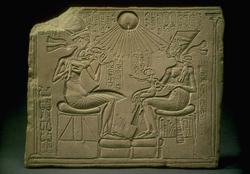
This is a closeup of a famous stela (click here for whole stela) showing Akhenaten and Nefertiti with some of their children carved as miniature adults in their laps. It's a touching family scene, one of the aspects of Amarna art that makes it famous. I like the sure-of-itself style in this piece -- it doesn't seem experimental anymore, nor is it at all willing to change to suit the thousand-year-old standards of Egyptian relief. I think especially in the lighting in this picture, it looks a little alien, too.
Image source: Art Images for College Teaching, items EN006 and EN008.
Other versions on the web: Ägyptisches Museum und Papyrussammlung

Many people claim that Akhenaten was ugly, and had his artists paint others as ugly too to make himself feel better. This seems ridiculous to me - Akhenaten has a power in his unique look. I think this fragmentary colossus shows particularly well his unique beauty. With the expert help of David Kennedy, this image was transformed into the Akhenaten you see on my Introduction page.
Image source: I don't remember. Please let me know if you find it on the web.

This is another, very different, image of Akhenaten. This was carved later in his reign (the previous image was carved much earlier), and shows an almost sad person, to my eye. He once sat next to Queen Nefertiti, whose arm still wraps around his back. This statue was featured in the exhibition Pharaohs: Treasures of Egyptian Art from the Louvre which I was fortunate enough to see in Cleveland.
Image source: Unknown, but the same image can be found on the cover of: Lawrence M. Berman, Bernadette Letellier, Pharaohs: Treasures of Egyptian Art from the Louvre, Cleveland: Cleveland Museum of Art, 1996

This beautiful carved head was found at Amarna, still nearly perfect. It was carved to represent one of the princesses and remains one of my favourite amarna pieces. Unfortunately, I have only this small picture at the moment.
Brown Quartzite, Agyptisches Museum, Berlin
Image source: Now-lost website of the Royal Women of Amarna exhibition. See Dorothea Arnold, The Royal Women of Amarna, New York: The Metropolitan Museum of Art, 1996, fig. 48, p. 56.

What Amarna art gallery would be complete without the beautiful bust of Nefertiti? And what needs be said?
Agyptisches Museum, Berlin
Image source: Art Images for College Teaching, item EN010.
Other versions on the web: my favourite, very nice head-on with information - this one is all over the internet, several views of the last one , a pretty bad one.

Thanks for visiting our Gallery. I hope you've developed a taste for the unique art of this little piece of history. Now for more art of the Amarna period may I recommend:


Search / Sitemap

powered by FreeFind


Taken from: http://katherinestange.com/egypt/gallery.htm
This page is part of The Akhet-Aten Home Page
maintained by Kate Stange (email / webpage)
Content Copyright © 1996-2000.
Last updated March 1, 2000.