Saturday, November 16, 2013

Naboth's Vineyard and the Foundation of Jezreel


  1. Nadav Na'aman
    1. Department of Jewish History, Tel Aviv University, Tel Aviv 69978, Israel

Abstract

This article examines the possible historical background of the story of Naboth's vineyard. It opens with a methodological introduction to the problem of the historicity of prophetic stories, which is followed by a short analysis of the story's date, its literary structure and plot. The results of the excavations at Tel Jezreel are compared with the biblical description and archaeological evidence of the foundation of Samaria. In light of the archaeological and textual analysis and some extra-biblical sources, it is suggested that the story takes place in Jezreel and refers to the time when Ahab was planning to build a new royal centre in the place and negotiated with the local inhabitants about purchasing their lands. The article compares the different descriptions of Naboth's murder in 1 Kings 21 and 2 Kgs 9.25-26, and makes clear distinction between the original historical episode and the literary and ideological details that were added by the author in order to fill the gaps and elaborate the plot.


...

For article, see: http://jot.sagepub.com/content/33/2/197

Tuesday, November 12, 2013

Prophet Elijah as Greek Myrtilus


Taken from: http://westerncivilisationamaic.blogspot.com.au/2012/01/pelops-as-king-ahab.html


Pelops, Ahab and the

Achaeans


by

John R. Salverda


Elijah as Myrtilus

Myrtilus (a name suspiciously like another Hittite name of the same era, 'Mursilis' TISHBITE in Hebrew "Tishbi" implying from the settlement of Teshub. There is a play-on-words here. Tishbi uses the same letters that spell "Tashuv" i.e. return or repent. Elijah exhorted the Israelites to repent. Coincidently, "Teshub" was also the name of the chief god of the Hittites.) also was murdered, and in his case it was said to be accusations, that were lodged against him by Hippodameia, thus manipulating Pelops into committing the crime. This is the method employed by the Biblical Ahab and Jezebel against Naboth, but Jezebel brought accusations against, and called for the death of, someone else as well, one who was a bit more like the Greek Myrtilus, the great prophet Elijah. The greatness of Elijah, as portrayed in the Jewish literature, is not reflected in the mythological figure of Myrtilus, but the myth is a biased version of the Scriptural story, as told presumably, by the sons and followers of Ahab whom, we would not expect to honor Elijah. Even so, the sons of Pelops had to admit that the 'traitor' Myrtilus, did have some very Elijah-like attributes. The curse, for instance, that Myrtilus proclaimed against the house of Pelops, turned out to be a true prophecy. Myrtilus was acknowledged as a prophet, he was said to be one of 'the sons of Hermes,' (Hermes, the serpent stick carrying messenger of god, has elsewhere been identified as the Greek version of Moses, who in turn was sometimes referred to as 'Nebo,' meaning the 'prophet.'http://www.britam.org/salverda/io.html) Similarly Elijah, as many believe, is supposed to have belonged to an organization that was called, 'the sons of the prophets,' (2KI 4:1.) .

'And there came a messenger, and told him, saying, They have brought the heads of the king's sons. And he said, Lay ye them in two heaps at the entering in of the gate until the morning.' (2KI 10:8) The Scriptural story about the 'heads' is almost certainly true, and it must have had a lasting traumatic effect on the psyche of those followers of Ahab who fled to Greece and told the tale of Pelops, for this morbid display is attested to in the Greek myths as well. Oenomaus, the myth relates, cut off the heads of those who dared to contest him in the chariot chase and lost. These heads he exhibited on the gate of his palace and the story specifically mentions the regret felt by Pelops upon seeing the 'faces' on display. (According to Hyginus, Fab. 84, when Pelops saw the heads of the unsuccessful suitors nailed over the door, he started to regret his impudence. He therefore appealed to Myrtilus, the charioteer of Oenomaus, promising half of the kingdom if he would change his affiliation and collaborate with him.) Ahab's corresponding regret, (appealing to Elijah, just as Pelops had appealed to Myrtilus) famously portrayed in the Scriptures (1 Kings 21:17-29) as an act of true repentance, resulted in a postponement of reckoning for his sin which would be imposed instead upon his sons, the same sons whose heads made up the grisly exhibition here referred to. It could be argued that Ahab himself did not actually 'see' the heads, however this argument could be refuted by saying that Ahab was afforded a 'vision' of the retribution visited upon his sons through the Prophet ('seer') Elijah.

In the Scriptures, the heads were also displayed because of a lost chariot chase, in this case it was Jehu (anointed by Elijah 1Kings 19:15,16) who furiously drove his chariot on behalf of the Almighty to work out His revenge for the death of Naboth. Jehu overtook his opponent's chariot piercing him through the heart and that is why the heads were on display. These heads were indeed the heads of the other suitors for the throne, the sons of Ahab. The Biblical quote runs thusly; '' And Jehoram king of Israel and Ahaziah king of Judah went out, each in his chariot, and they went out against Jehu, and met him in the portion of Naboth the Jezreelite. ... And Jehu drew a bow with his full strength, and smote Jehoram between his arms, and the arrow went out at his heart, and he sunk down in his chariot. Then said Jehu ' Take up, and cast him in the portion of the field of Naboth the Jezreelite: for ' Surely I have seen yesterday the blood of Naboth, and the blood of his sons, saith THE ALMIGHTY; and I will requite thee in this plat, saith THE ALMIGHTY. Now therefore take and cast him into the plat of ground, according to the word of THE ALMIGHTY. But when Ahaziah the king of Judah saw this, he fled ... And Jehu followed after him, and said, Smite him also in the chariot.' (II Kings 9:21-28) The chariot killing of Ahaziah the king of Judah and grandson of Ahab even more closely parallels the killing of the suitors by Oenomaus because, although it is difficult to piece together the different accounts, (compare 2 Chron. 22 :7-9), it is apparent that Ahaziah fled and was captured by the men of Jehu, then Jehu ordered Ahaziah to be placed in his chariot so that he could be killed in it, then he was granted a head start. Ahaziah was mortally wounded as he fled to Megiddo, where he died of his wounds, he was buried in Jerusalem. So it was a kind of chase, as in the Greek myth.

Obviously the men of Ahab (the Achaeans) held Elijah (Myrtilus) in low esteem, considering him to be a traitor. However Ahab, as was true of all Hittite rulers, (in accordance with a known Hittite document restricting the absolute power of Hittite kings, called the "Edict of Telipinus") did not have absolute power (Jezebel, the daughter of a different kind of King, did not seem to understand this.). He was required to justify his decisions to the royal clan (comprised of princes, royal cousins, the priesthood, elders of the state, and others of prestige). Elijah was highly respected and Ahab could not hate him openly. When Elijah admonished Ahab, the King had to clearly and visibly display his repentance, not just out of fear of the curse but also in order to maintain the loyalty of the clan. Pelops as well is said to have regretted his treatment of Myrtilus, and after the death of the seer, Pelops is said to have introduced and enforced the worship of Hermes (the Greek Moses), the supposed father of Myrtilus, among the Achaeans. Pelops built a few shrines to Hermes, and even instituted some of the rites and rituals that were advocated by Hermes, such as maintaining an ark which contained the fleece of the sacrificed golden lamb (indicating the lamb of god no doubt) the purpose of which was to justify the Pelopid dynasty (an obvious parallel to the Mosaic Ark of the Covenant, containing the Messianic promise and justifying the Davidic dynasty). And in fact, there was a more honorable opinion of Myrtilus that was known to the ancient Greeks. Pindar, and other early writers, say that it was Poseidon's gift of the flying chariot that won the race for Pelops, not the treachery of the seer Myrtilus. Pindar describes how god bestowed on Pelops a chariot with winged steeds. 'Honoring him, the god gave him a golden chariot, and horses with untiring wings. He overcame the might of Oenomaus, and took the girl as his bride.' (Pindar, Olympian 1. 85) On a chest at Olympia the horses of Pelops in the chariot race were represented with wings (Paus. 5.17.7). The earliest mention of Myrtilus' treachery is to be found in the writings of Pherecydes in the 5th century BC. and, at any rate, Myrtilus was respected by many and was not unanimously despised even by the Achaeans (the men of Ahab).

It may be argued by some that Naboth was not like Oenomaus in that he is not associated with driving a chariot, and that his death did not involve a chariot race. True enough, for although the portion of the Scriptures that involves Ahab, is full of chariotry, and Ahab is portrayed as "contesting" with Naboth over his vineyard, the particular chapter of Naboth's murder does not involve a chariot. However, that argument overlooks the fact that the foremost clash, and overarching theme outlined in that section of the Scriptures is the contest between the polytheism of Ahab against the Monotheism of Elijah and incidentally of Naboth, whom Elijah had sided with against Ahab. The climax of this clash was the contest at mount Carmel which culminated with a very famous chariot race between Ahab and Elijah (in which Elijah miraculously succeeded although on foot). A more careful reading of the Greek myth reveals that Oenomaus, the Greek Naboth was not the driver of his own chariot he was merely riding along, and that his chariot was actually driven by his charioteer Myrtilus, the Greek Elijah, 'the chariot of Israel, and the horsemen thereof.' Notice that Elijah is referred to Scripturally as the "horseman of the chariot," not just a rider in the chariot, but its' horseman. Thus it is not unreasonable to conclude that Elijah was envisioned in his heavenly translation as not merely being picked up by it, but rather that he was ensconced in the heavenly chariot as it's charioteer. "And it came to pass, as they still went on, and talked, that, behold, there appeared a chariot of fire, and horses of fire, and parted them both asunder; and Elijah went up by a whirlwind into heaven. And Elisha saw it, and he cried, My father, my father, the chariot of Israel, and the horsemen thereof. And he saw him no more: and he took hold of his own clothes, and rent them in two pieces." (2 Kings 2:11,12) Oddly Josephus himself seems to doubt the story of the heavenly chariot, saying of Elijah only, that no one knows of his death, "Now at this time it was that Elijah disappeared from among men, and no one knows of his death to this very day; but he left behind him his disciple Elisha, as we have formerly declared. And indeed, as to Elijah, and as to Enoch, who was before the deluge, it is written in the sacred books that they disappeared, but so that nobody knew that they died." (Antiquities, 9). At any rate it does seem reasonable for some to blame (or credit as the source my be) Jezebel, who called for his death and caused his exile, for his "disappearance."

After the chariot/foot race from Mount Carmel of Ahab and Elijah, Jezebel called for the immediate death of Elijah. Elijah himself prayed for his own death at that time (never-the-less the Scriptures have Elijah out living Ahab). Likewise the death of the seer Myrtilus was called for by Hippodameia. In both cases the last day of the great prophet/seer was spent in a flying chariot supplied by God/god. However in the myth told by the Achaeans the flying chariot was supplied to Pelops and it was he who invited the seer to take a ride in it. As they were flying high in the heavens Pelops killed Myrtilus by Kicking him out.

The prophecies of Myrtilus continued to come true for generations after his earthly departure. Like Elijah, Myrtilus did not lose consciousness after death, he even, again like Elijah, came back occasionally to preside over the death of the cursed dynasty, especially royal chariot deaths, for as some say, that the ghost of Myrtilus was the 'horse scarer' in the Hippodrome at Olympia. Myrtilus, also like Elijah, was translated into heaven at his death, where he was placed in the heavenly chariot which is known to this very day as the constellation called, 'Auriga,' or as we say, 'the charioteer.' Here perhaps, the Greek myth has a more 'logical' explanation for the story of Elijah's apotheosis and the fiery chariot of the Heavenly God.
 
....

Friday, October 25, 2013

Colosses of Memnon, masterpiece by Amenophis Son of Hapu


[The AMAIC considers this article as interesting, though not necessarily true,
and would certainly not date Amenhotep son of Hapu anywhere near as early as c. 1350 BC]

 
Posted by: on Sep 18, 2009 |
 
In Egypt, the return of agglomerated (geopolymer) stone
1300 years after the Great Pyramids,
under Amenhotep III and Akhenaton (18th Dynasty)
.


Divine incarnation in carved stone became the rule under the New Kingdom around 1400-1200 B.C. and the hegemony of the god Amun. The soft sandstone from the Silsilis quarries, used for in the great temples at Karnak and Luxor, is so easy to carve that everything appears simple. So why should there be any controversy about the monuments and objects dating from this period? Because some are made out of an extreme hard material: quartzite!
It is true that 1300 years after the great pyramids, agglomerated stone, geopolymer stone was again being used, albeit sporadically, under the domination of Amun. After all these years, the worship of the god Khnum and initiation into his mysterious technology had not been forgotten. The greatest Egyptian scientist-architect-scribe, Amenophis Son of Hapu (1437-1356 B.C.), eminence grise of the pharaoh Amenhotep III, XVIIIth Dynasty, re-introduced it and used his alchemical (geopolymer) knowledge to build amazing statues made out of quartzite with geosynthesis and geopolymerisation. And the heretical king Akhenaton, son of Amenhotep III, did the same in order to rival the supremacy of Amun by forbidding carved granite stone.

....


The clues for geosynthesis (geopolymerization), artificial quartzite stone
Geologists fail to agree between themselves in determining the origin of the quartzite stone used to the famous colosses. To summarise, French and German archaeologists/geologists claim that the Colosses of Memnon were sculpted in a quarry 70 km further south down the Nile and that they were brought up by boat. Other British and American researchers propose an even more extraordinary exploit. According to them, the statues were carved, then transported upstream on the Nile from a place 700 km downstream near to Cairo. Each team of scientists uses more and more sophisticated methods in pursuing their research, including atomic absorption, x-ray fluorescence and neutron activation. When applied to the most enigmatic of Egyptian monuments, these new techniques shed more confusion than light.
In Antiquity, the statues commanded respect; the colosses of Memnon are monoliths: they are made from a single block of stone weighing nearly 1000 tonnes and standing on a pedestal of 550 tonnes. They are 20 metres high, equal to a seven storey building. The stone from which they are made is quartzite, which is practically impossible to carve. The members of the Egyptian expedition organised by Bonaparte at the beginning of the nineteenth century recorded several notes on the stages and on the Egyptian quartzite quarries. Thus we can read in La Description de l’Égypte :
“None of the great quartzite blocks bear any trace of tools that is so common in the sandstone and granite quarries: a material that is so hard, so refractory in the face of sharp tools cannot, it is true, be worked by the same methods as ordinary sandstone nor even of granite. We know nothing of how the blocks of such a rock were squared, how their surfaces were dressed or how they were given the beautiful polish that can still be seen in some places; but though we cannot guess the means, we are no less obliged to admire the results. There is nothing that can give a better idea of the highest state of advancement of the mechanical arts in antiquity as the beautiful execution of these figures and the pure lines of the hieroglyphs engraved in this material, harder and more difficult to work than granite. The Egyptians recoiled in front of none of these difficulties; nothing seemed to hinder them; the working is free throughout. Did the sculptor, in the middle of engraving a hieroglyphic character, strike one of the flints or pieces of agate that are encrusted in the material, the line of the character continued in all its purity, and neither the agate nor its enveloping stone bear the slightest crack.”
The consequences of this last observation are very important. What is the technology that could enable hieroglyphs to be engraved in this way? The Pharaoh Amenhotep III puts these statues down to a “miracle”. Later on, in hieroglyphic documents, the stone is designated as “biat inr”, which means “stone obtained after a miracle”. To what miraculous technology is Amenhotep alluding?
Once we accept the geopolymerization technique we can understand how Amenophis Son of Hapu, was able to make this quartzite rock and cast to the colosses of Memnon, these enormous statues more than seven storeys high. With the technique of geopolymer stone, we can also explain the controversy surrounding the different interpretations of the analysis results obtained by various scientific teams.
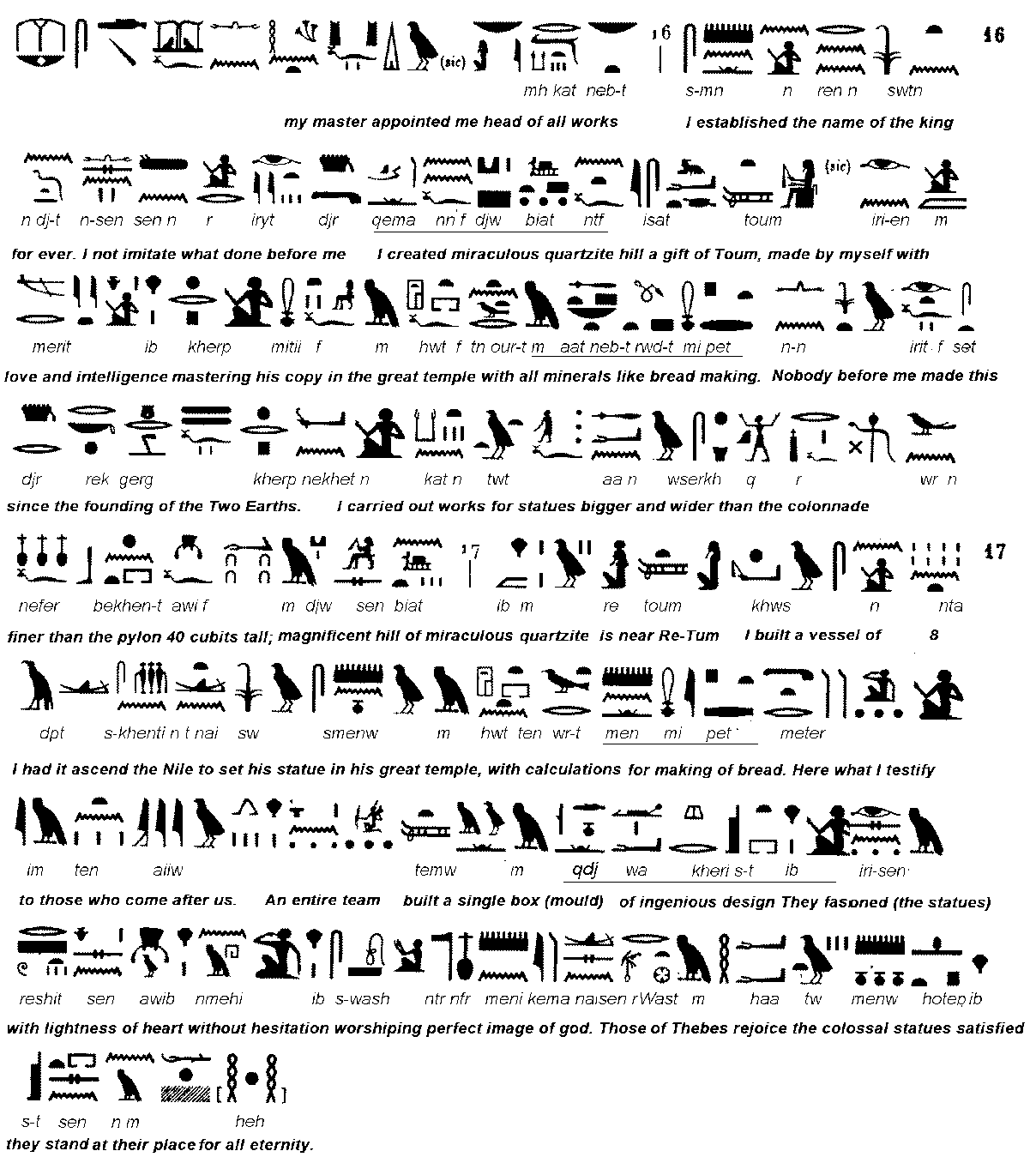
On his biographical statue at Karnak, Royal scribe Amenophis (1350 BC) describes the building of these colossal statues by the technique of agglomeration (geopolymer stone) “as bread is made” using a box (a mould) specially made by his workers. Here are lines 16 and 17 of his biographical inscription, in a translation by Joseph Davidovits, which differs from that of egyptologists (see Inscriptions), because they were unable to interpret the technical key-words:
“My master (the Pharaoh Amenhotep III) appointed me head of all works. I have not imitated what was done before me. I created a miraculous quartzite hill a gift of Tum, made by myself with love and intelligence, mastering his copy in the great temple with all minerals like the making of bread. Nobody before me has done such a thing, since the founding of the Two Earths. I have carried out work to make statues of great girth and taller than the colonnade, finer than the pylon 40 cubits tall; this magnificent mountain of miraculous quartzite is near Re-Tum. I had a vessel of 8 built and I had it ascend the Nile to set its image (its statue) in its great temple, according to our calculations (with the technology), as for the making of bread. Here is what I testify to those who come after us. An entire team built a single box (mould) of ingenious design. They fashioned (the statues) with the lightness of their heart, without hesitation, then worshipped the perfect image of the god (pharaoh) thus created. Then came those of Thebes, rejoicing in the colossal statues and satisfied that they would stand for all eternity.”


New translation by Joseph Davidovits (technical keywords are underlined). Egyptologists translate the technical key-words “making of bread” involving the word “pet” into “enduring like the heavens”, which means nothing (see the traditional translation by egyptologists in Inscriptions). The bread making technology refers to the use of a pasty material that would be worked out like dough to produce geopolymer stone ....

....

Taken from: http://www.geopolymer.org/archaeology/civilization/colosses-of-memnon-masterpiece-by-amenophis-son-of-hapu

Tuesday, October 8, 2013

Hiel defies Joshua's command re Jericho


Rebuilding of Jericho


There's a neat little study of 1 Kings 16:34 (Hiel's rebuilding of Jericho) in a 1996 issue of Biblica.
Charles Conroy, the author, begins with a structural analysis of 1 Kings 16:29-34. He points out that grammatically the passage breaks down into an introductory statement (29a), a summary of the reign of Ahab (29b-33), and a final statement (34). Hiel's work is mentioned in the final section.

Conroy then points to the parallels within the text between Ahab and Hiel. Both are said to be builders and both are subjects of 3 separate verbs of construction: Ahab "erected" an altar to Baal, "built" a house for Baal in Samaria, and "made" an Asherah (vv. 32-33). Hiel "built" Jericho, "laid its foundations" and "set up its gates" (v. 34).

Though Conroy does not push the parallels, this emphasis on building has two effects: first, it connects Ahab (and Hiel) with Solomon, the great builder previously mentioned in 1 Kings; second, it highlights the fact that Ahab's work (like Hiel's) is a reversal of the conquest, restoring the Baal-worship that had been destroyed under Joshua.

Conroy does note, however, a further parallel between Ahab and Hiel: Ahab thinks it a little thing to follow the way of Jeroboam, and goes to Baal worship; in a similar move, Hiel of "Bethel" (the place of Jeroboam's calves) thinks it a little thing to build Bethel, and moves to rebuild Jericho. Conroy also points out that Hiel loses his two sons while building Hiel, arguing that this foreshadows Ahab's later loss of his two sons: Ahaziah and Jerhoam.

Finally, he points out that the geographic references in 16:34 (Bethel and Jericho) anticipate the movements of Elijah and Elisha in 2 Kings 2.

Conroy unfortunately ends the essay with some speculations on the diachronic development of the text, asking the unanswerable question of when 16:34 was inserted. Be that as it may, his study of the "final form" of this text is provocative and convincing.

posted by Peter J. Leithart on Thursday, August 07, 2003 at 05:19 PM

http://www.leithart.com/archives/000001.php


Wednesday, October 2, 2013

Velikovsky Identified biblical 'Zerah the Ethiopian' with pharaoh Amenhotep II

 
....
 
In the chapter dealing with the sack of the Temple of Jerusalem, it was demonstrated that the biblical Shishak, its plunderer, was Thutmose III of the Eighteenth Dynasty, and the objects of his loot, depicted on the bas relief at Karnak, were identified as the vessels, utensils, and furniture of the Temple. His heir Amenhotep II was identified as the Biblical Zerah who invaded Palestine in the days of King Asa at the beginning of the ninth century. Thus they could not have been the Libyan kings Shoshenk and Osorkon. These Libyans reigned later ....


....
 
81. Amenhotep II lived not in the fifteenth but in the ninth century, and was the scriptural Zerah.
82. The theory that the Ethiopian Zerah came from Arabia is wrong; equally wrong is the theory that he is a mythological figure.
83. The battle of Ain-Reshet, referred to by Amenhotep II, is the battle of Mareshet-Gath, which was lost by Amenhotep II and won by Asa.
84. This intrusion of Amenhotep II-Zerah is also narrated in the poem of Keret found in Ras Shamra.
85. The theory that Terah of the Poem, who invaded the south of Palestine with millions of soldiers, is the father of Abraham, is wrong.
86. The Shemesh-Edom of the war-annals of Amenhotep II is the Edomite city of Shapesh (Shemesh) referred to in the Poem of Keret.
 
....

Tuesday, September 24, 2013

Did God Deceive King Ahab?


Is God a Liar? 1 Kings 22 in Context (Part 1)


1 Kings 22 tells the story of Ahab’s final battle and death at the hands of the Syrians. Just before Ahab goes up to Ramoth Gilead with Jehoshaphat in v 29 there is an interesting scene that has been the subject of much scholarly discussion. According to v 10 Ahab and Jehoshaphat were sitting at the gate of Samaria and 400 prophets were prophesying before them and telling them that the Lord would deliver Ramoth Gilead into Ahab’s hand (v 6). But at the request of Jehoshaphat another prophet named Micaiah was brought before the two kings. He initially echoed what the other prophets had said but when pressed by Ahab told him the truth – Israel would be defeated and Ahab would die (v 17). Beginning in v 19 Micaiah then provided a rare behind-the-scenes look at what happened in the heavenly realm:

And Micaiah said, “Therefore, hear the word of the LORD. I saw the LORD sitting on His throne, and all the host of heaven standing by Him on His right and on His left. And the LORD said, ‘Who will entice Ahab to go up and fall at Ramoth-Gilead?’ And one said this while another said that. Then a spirit came forward and stood before the LORD and said, ‘I will entice him.’ And the LORD said to him, ‘How?’ And he said, ‘I will go out and be a deceiving spirit in the mouth of all his prophets.’ Then He said, ‘You are to entice him and also prevail. Go and do so.’ Now therefore, behold, the LORD has put a deceiving spirit in the mouth of all these your prophets; and the LORD has proclaimed disaster against you.” (vv 19-23)
 
One of the big questions this scene raises is: how can God be involved in deception? How can God deceive Ahab so that he will go up to Ramoth in Gilead and die? Is God a liar who actively plots Ahab’s death by means of deception?
While I don’t claim to have a full explanation for all the details of this intriguing scene, I do want to point out a couple of things. First, as scholars have noted, it is important to remember that God actually informs Ahab of the deception and of the consequences of going up to Ramoth Gilead before Ahab goes into battle. If God had actually wanted to deceive Ahab he obviously never would have done this because it would have made the initial deception pointless. By telling Ahab about the deception God was instead clearly showing Ahab that his prophets were liars and that he should not listen to them. In this way God was actually giving Ahab a chance to avoid the disaster that would befall him if he chose to go up. Rather than being a mean God intent on destroying Ahab through questionable means, a closer look at the text thus shows a loving God who is trying to save Ahab from disaster and certain death.
Yet the question remains why God chose this particular way of dealing with Ahab. Could he not have simply told Ahab not to go up? Why does he involve himself with deception?

In the previous post I argued that rather than deceiving Ahab, God actually gave him a chance to avoid disaster by telling him about the heavenly scene with the deceiving spirit (1 Kings 22:19-23). Yet as I pointed out at the end, the question remains why God chose this particular way of dealing with Ahab. Could he not have simply told Ahab not to go up to Ramoth Gilead? Why does he involve himself with deception?
I think the answer becomes clear once the immediate context is taken into consideration. Notice first of all that the scene Micaiah describes is similar to the scene at the beginning of the chapter. Just as God sits on his throne and has a dialogue with the beings around him, so Ahab and Jehoshaphat are sitting on thrones and have a dialogue with the prophets before them. The scenes are also connected through the motif of deception. In the first scene the prophets are speaking deceptive words to Ahab, but then God comes along and claims that he is actually responsible for it.
I believe these two scenes are also connected to another scene involving deception in 1 Kings 21. In that chapter Ahab and Jezebel have Naboth murdered in order to take possession of his vineyard. In the central scene of the chapter Naboth is seated at the head of the people and two men witness against him. Note the similarities between chapters 21 and 22:
 
 
1 Kings 21
  • Ahab wants to take possession of Naboth’s vineyard
  • Naboth is seated at the head of the people
  • Men appear before him and deceptively tell lies (lit: “Naboth has blessed God and the king”)
  • Naboth dies
1 Kings 22
  • Ahab wants to take possession of Ramoth Gilead
  • Ahab and Jehoshaphat are seated before the prophets
  • Prophets appear before them and deceptively tell lies
  • Ahab dies

What these parallels suggest is that in chapter 22 God is acting towards Ahab like Ahab (and Jezebel) acted towards Naboth in chapter 21. Just as Ahab and Jezebel used deception and lies to cause the death of Naboth so God is using deception and lies to cause the death of Ahab. Thus it appears as if God is giving Ahab some of his own medicine. However, the big difference between Ahab and his wife and God is that God informs Ahab about the deception and thus gives Ahab the opportunity to avoid death. By revealing to Ahab the heavenly scene God seems to be saying to him: I will treat you like you treated Naboth but I’m telling you that I’m doing it so that you don’t have to end up like Naboth. (That God would treat Ahab this way is all the more amazing given the fact that Ahab – in contrast to Naboth! – is guilty and deserves to die!) The great tragedy of the chapter is that Ahab chooses to reject God’s message of warning to him. He goes up to Ramoth Gilead and is killed, thus proving that God has spoken the truth.

Homework

What other connections can you find between 1 Kings 21 and 22? How do they help you to understand the two chapters better?

....

Taken from: http://fascinatedbytheword.wordpress.com/2013/09/03/is-god-a-liar-1-kings-22-in-context-part-2/

Monday, September 16, 2013

Ahab the Lion Man and Jezebel the Mistress of Lions


Velikovsky had, with typical ingenuity, looked to identify the only female correspondent of El Amarna, Baalat Neše, as the biblical "Great Woman of Shunem", whose dead son the prophet Elisha had resurrected (cf. 2 Kings 4:8 & 4:34-35). Whilst the name Baalat Neše is usually translated as "Mistress of Lions", Velikovsky thought that it could also be rendered as "a woman to whom occurred a wonder" (thus referring to Elisha's miracle).
 
This female correspondent wrote two letters (EA 273, 274) to Akhnaton, telling him that the SA.GAZ pillagers had sent bands to Aijalon (a fortress guarding the NW approach to Jerusalem). She wrote about "two sons of Milkili" in connection with a raid. The menace was not averted because she had to write again for pharaoh's help. Because Milkili himself at about this time had taken a stand against the city of "Shunama" - which would appear to be the biblical "Shunem" - Velikovsky had concluded that Baalat Neše was asking Egypt for help for her own city of Shunem.
 
But this conclusion is quite unwarranted as the letters do not actually make the connection between Baalat Neše and Shunama.


In a revised context, Baalat Neše, the "Mistress of Lions", would most certainly be Jezebel, wife of Ahab. Jezebel was also wont to write official letters, even "in Ahab's name and [she] sealed them with his seal" (1 Kings 21:8). It would be most appropriate for the "Mistress of Lions" (Baalat Neše) to be married to the "Lion Man" (Lab'ayu). Her concern for Aijalon, near Jerusalem, would not be out of place since Lab'ayu himself had also expressed concern for that town. Baalat (Baalath, the goddess of Byblos) is just the feminine form of 'Baal'. Hence, Baalat Neše compares well with the name, Jezebel, with the theophoric inverted: thus, Neše-Baal(at)/ "Nesebaalat".