
Thursday, April 7, 2022
Akhnaton’s Theophany

Tuesday, October 13, 2020
King Mesha of Moab's Capital was Jericho ("Qeriho"), not Dibon
Dibon-Gad Between the Torah and the Mesha Stele
In the southern Transjordanian Mishor (plateau), an area that changed hands between Israelites and Moabites, there once lived two neighboring tribes, Gadites and Dibonites…
Dr.Yigal Levin
https://www.thetorah.com/article/dibon-gad-between-the-torah-and-the-mesha-stele
Source Critical Approach
One possible approach, which might solve why Dibon is called “Dibon-Gad” only in Num 33, is to suggest that Num 32 and Num 33 are derived from two different sources, each from a different time and each reflecting a different point of view. Levine, for example, points out that the route of Num 33 is very different than that described in either what he calls the JE narratives or that described by the “priestly historiographers,” agreeing more with “the writings of the Deuteronomist.”[13]
Milgrom, in an excursus to his commentary, suggested that the itinerary of Num 33 is not only a unified text, but that it is actually “the master list from which the individual itineraries in the narratives [of Exodus-Numbers – Y.L.] were drawn.”[14] Building on this, Koert van Bekkum has more recently claimed that the whole chapter is indeed a very early composition, which “contains at least some information from the late second millennium BCE.”[15]
If we view Numbers 33 as a unique source, we can suggest that its author, whenever and for whatever purpose he actually wrote his itinerary, wished to emphasize the specific connection between the town of Dibon and the tribe of Gad. But why?
Dibon and Gad in the Mesha Stele
One source that may help us answer this question is the Mesha Stele, in which both Dibon and Gad are mentioned. Dibon itself is mentioned in the stele four times.
The first of these in the preamble, in which Mesha introduces himself as מלך מאב הדיבני, “the king of Moab, the Dibonite.”[16]
The second is in line 21, in which Mesha narrates that he captured Yahatz לספת על דיבן, “to add to Dibon.”
The third and fourth times are in line 28, א]ש דבן חמשן כי כל דיבן משמעת] – “the men of Dibon were armed, for all Dibon [is/was/are/were] under my command.”
Since the very beginning of the study of the stele, it has been assumed that Dibon was the name of Mesha’s capital city, and its identification with Dhiban, where the stele was actually found, was taken for granted.
Dibon as a Tribe
About a dozen years ago, Eveline J. Van der Steen and Klaas A.D. Smelik proposed, that “Dibon” in the Mesha Stele does not refer to a town by that name, but rather to the “tribe” of which Mesha was chief.[17] His capital was not called Dibon but “Qorḥoh,” the building of which is described in detail in lines 21 to 26 of the stele.
Scholars who assume that the city’s name was Dibon have tried to understand the term Qorḥoh as a reference to the “acropolis” or “royal quarter” of Dibon, but the stele suggests that it was a city. According to Van der Steen and Smelik, only in later generations did the name of the tribe, Dibon, become the name of their chief town, and this is how it was remembered in the Bible.[18]
e tribe, Dibon, become the name of their chief town, and this is how it was remembered in the Bible.[18]
Mesha Before the War
Mesha’s rebellion against Israel is recorded both in the Bible (2 Kings 3) and on the stele. We don’t know what his status was before this rebellion and we also don’t really know the extent of his territory once he succeeded in carving one out, or who its inhabitants really were. The picture that we often deduce from the Bible, of “Moabites” living south of the Arnon and “Israelites” living to the north, is way too simple.[19]
The very fact that Mesha, even before his rebellion and “conquest” (or, to him, “liberation”) of the Mishor, calls himself a “Dibonite,” means that there was at least one tribal group living in the area of the southern Mishor, which felt a connection to the Moabite identity, perhaps living under the thumb of the kingdom of Israel.
But the Dibonites were not the only tribe living on this strip of land; the Gadites lived there as well. Lines 10–11 of the Mesha Stele read:
ואש. גד. ישב. בארצ. עטרת. מעלמ. ויבנ. לה. מלכ. ישראל. את. עטרת | ואלתחמ. בקר. ואחזה | ואהרג. את. כל. העם And [the] men/man of Gad dwelt in the land of Ataroth fromever, and the king of Israel built Ataroth for himself. And I fought against the city and captured it. And I killed all of the inhabitants.
This is the only contemporaneous extra-biblical reference that we know of to any of the biblical tribes of Israel (Judah is mentioned as a kingdom, not as a tribe). Ataroth is only a few kilometers west of Dibon, and both are listed as Gadite towns in Num 32:34, one after another, which at first glance makes the Mesha Stele and the biblical record tally well.
But if we read the above text carefully, we can see that Mesha does not call Gad “Israel.” He claims, that while Gad had “always” lived in “the land of Ataroth,” at some point “the king of Israel” came and “built” (fortified?) Ataroth. In other words, this suggests that Gad was a native Transjordanian tribe that had been “conquered” by the king of Israel.
Fluid Identity or Polemic?
In his “The Tribe of Gad and the Mesha Inscription” (TheTorah.com 2013), Aaron Koller cited the Mesha inscription as evidence of a “fluidity of identity” among the Gadites, who may have sometimes considered themselves “Israelite,” sometimes “Moabite,” and sometimes something else.
This may be true, but what seems clear is that Gadites and Dibonites were neighboring tribes; the former saw themselves—or at least were seen by the biblical authors—as part of the Israelite orbit (by force or by choice) while the latter saw themselves—or at least were seen by Mesha—as Moabite (though they too may have been dominated by Israel for a while). This situation may be what is behind the polemical nature of the texts involved, namely the Mesha Stele and the biblical text.
The Mesha Stele, whatever its specific genre (this is debated by scholars), is definitely a piece of political propaganda. Its purpose is to portray Mesha as a Kemosh-driven savior of the Moabites from their enemies, chief of which was Israel under Omri and his sons. His presentation of Gad as a native tribe that was “conquered” by Israel and “liberated” by himself is part of this polemic. We should remember this before accepting its claims as “historical fact.”
The Bible is hardly free of such political polemics either,[20] and this may be what we are seeing here. We do not really know when the itinerary of Num 33 was written, or whether the unique reference to “Gad” was included in the original text. But when it was included, it was included for a reason. Perhaps that reason was to highlight the fact that “the men of Gad did indeed dwell in Dibon fromever”—and as far as the biblical writers were concerned, they were Israelite!
Saturday, October 10, 2020
El Amarna's Lab'ayu for King Ahab preferable to Dr. Velikovsky's choice of Rib-Addi
1. Ahab not Rib-Addi
When I around 2017, after ten years, re-assessed my university thesis (2007):
A Revised History of the Era of King Hezekiah of Judah and its Background
https://www.academia.edu/3822220/Thesis_2_A_Revised_History_of_the_Era_of_King_Hezekiah_of_Judah_and_its_Background
I wrote as follows on Dr. I. Velikovsky's proposed identification (in Ages in Chaos, I, 1952) of El Amarna's [EA's] prolific letter writing king, Rib-Addi of Gubla, with the biblical king Ahab of Israel.
"Velikovsky … had … looked to identify Ahab with Rib-Addi of Gubla, the most prolific Syro-Palestine correspondent to the EA pharaohs (over 50 letters in number). …. And this was surely a big mistake. For, in order for him to ‘make’ Ahab, like Rib-Addi, a very old man at death, Velikovsky was prepared to fly in the face of the biblical data and completely re-cast the chronology of Ahab’s life. He had convinced himself that there existed a contradiction between the accounts of Ahab in Kings and Chronicles so that, as he claimed, Ahab did not die at the battle of Ramoth-gilead as is stated in 1 Kings 22 (cf. vv. 6, 29 and 37), but rather reigned on for a further 8-10 years. Thus, according to Velikovsky’s view, king Jehoram of Israel (c. 853-841 BC, conventional dates), never truly existed, but was a ghost.
From a biblical point of view, the fact that Rib-Addi had been able to report the death of Abdi-Ashirta (Velikovsky’s Ben-Hadad I) meant that Velikovsky was quite wrong in identifying Rib-Addi with king Ahab; since Ahab’s death preceded that of Ben-Hadad (cf. 1 Kings 22:40 and 2 Kings 8:15). But this was Velikovsky in his favourite rôle as “the arbiter of history”, according to Martin Sieff … forcing historical data to fit a pre-conceived idea. Velikovsky called this Rib-Addi king of Gubla and Sumur (var. Sumura) … which EA cities he had tried to equate with Ahab’s chief cities of, respectively, Jezreel and Samaria; though they are usually identified with the coastal cities of Byblos (Gebal) and Simyra. Moreover, letters from Egypt may indicate that Sumur was not really Rib-Addi’s concern at all. …. Velikovsky greatly confused the issue of Ahab of Israel for those coming after him, since Rib-Addi was chronologically and geographically unsuitable for Ahab. Revisionists have since rightly rejected this part of Velikovsky’s EA reconstruction, with Sieff suggesting instead that Rib-Addi may have been Jehoram of Israel".
As far as I was concerned, Ahab was clearly the same as EA’s powerful and rebellious Lab’ayu of the Shechem region.
I continued:
"Whether or not Rib-Addi turns out to be Jehoram of Israel, a far better EA candidate for Ahab than Rib-Addi, in my opinion, and indeed a more obvious one – and I am quite surprised that no one has yet taken it up – is Lab’ayu, known to have been a king of the Shechem region, which is very close to Samaria (only 9 km SE distant); especially given my quote earlier (thesis Vol. I, p. 54) from Cook that the geopolitical situation at this time in the “(north) [was akin to that of the] Israelites of a later [sic] time”. Lab’ayu is never actually identified in the EA letters as king of either Samaria or of Shechem. Nevertheless, Aharoni has designated Lab’ayu as “King of Shechem” in his description of the geopolitical situation in Palestine during the EA period (Aharoni, of course, is a conventional scholar writing of a period he thinks must have been well pre-monarchical): ….
In the hill country there were only a few political centres, and each of these ruled over a fairly extensive area. In all the hill country of Judah and Ephraim we hear only of Jerusalem and Shechem with possible allusions to Beth-Horon and Manahath, towns within the realm of Jerusalem’s king.
... Apparently the kings of Jerusalem and Shechem dominated, to all practical purposes, the entire central hill country at that time. The territory controlled by Labayu, King of Shechem, was especially large in contrast to the small Canaanite principalities round about. Only one letter refers to Shechem itself, and we get the impression that this is not simply a royal Canaanite city but rather an extensive kingdom with Shechem as its capital".
Moreover, this Lab’ayu, had, like Ahab, two prominent sons. I tentatively identified the more prominent of these, Mut-Baal¸ with Ahab’s older son, Ahaziah (I, p. 90), who – having no heir – was succeeded by his brother, Jehoram.
2. Circumstances of Jericho being rebuilt at time of King Ahab
This I have discussed in various articles, such as e.g. my multi-part series "Hiel's Jericho",esp:
Hiel's Jericho. Part Two (a): Who was this “Hiel of Bethel”?
https://www.academia.edu/31553055/Hiels_Jericho_Part_Two_a_Who_was_this_Hiel_of_Bethel_
This series removes all doubt, I believe, that Lab'ayu was King Ahab of Israel, because the EA letters tell us that Lab'ayu had given away the land of Shakmu (Shechem) to the rebels, to the "Sa Gaz Mesh", whom Dr. Velikovsky identified with Mesha of Moab.
Shechem was the same as the Bethulia of the Book of Judith, the northern Bethel (see below).
King Mesha of Moab tells us quite specifically that he built Jericho ("Qeriho"), and with Israelite slaves.
Mesha was, like Hiel the Bethelite, a sacrificer of his won sons.
On Bethulia as Shechem, see my series "Judith's City of 'Bethulia', esp:
Judith's City of 'Bethulia'. Part Two (ii): Shechem
https://www.academia.edu/34737759/Judiths_City_of_Bethulia_Part_Two_ii_Shechem
Sunday, October 4, 2020
Was Jesus reflecting back to Naboth?
https://idcraleigh.com/wp-content/uploads/2013/06/1-Kings-21.1-29.pdf
Payday Someday
1 Kings 21:1-29
The heading in your Bible for this chapter might say something like “Naboth’s
Vineyard.” At first glance, the title may not interest you unless you like gardening, enjoy
grapes, or your name is Naboth. You might assume this story has little relevance for
modern readers. However, that assumption would be incorrect. This chapter makes my
blood boil because of the tragedy contained here, and because of how relevant it is.
This is not a story about grapes; it is a story about the (in)justice of man and the justice
of God. We read about what it is like to suffer injustice, what it costs to do justice for the
sake of the oppressed, how much we long for God’s justice, and how we can be made
right with God the judge.
Chris Wright tells the story about a young man from India who read the Bible for
the first time. For whatever reason, the first passage he read was the story of Naboth’s
vineyard. Wright met this young man at a conference, where Wright was teaching on the
Old Testament. The young man told Wright that he became a Christian by reading the
Old Testament, and he was particularly thrilled that they would be studying the Old
Testament in the sessions. Wright tells how this young reader was drawn to the God in
the story of Naboth’s vineyard:
He grew up in one of the many backward and oppressed groups in India, part of a
community that is systematically exploited and treated with contempt, injustice and sometimes
violence. The effect on his youth was to fill him with a burning desire to rise above that station
in order to be able to turn the tables on those who oppressed him and his community…. He
was contacted in his early days at college by some Christian students and given a Bible,
which he decided to read out of casual interest, though he had no respect at first for Christians
at all.
It happened that the first thing he read in the Bible was the story of Naboth, Ahab and
Jezebel in 1 Kings 21. He was astonished to find that it was all about greed for land, abuse of
power, corruption of the courts, and violence against the poor—things that he himself was all
too familiar with. But even more amazing was the fact that God took Naboth’s side and not
only accused Ahab and Jezebel of their wrongdoing but also took vengeance upon them. Here
was a God of real justice. A God who identified the real villains and who took real action
against them. ‘I never knew such a God existed!’ he exclaimed. He read on through the rest of
OT history and found his first impression confirmed….
He then went on, he told me, to read the books of the law, and his amazement grew.
‘God!’ he cried out, even though he didn’t know who he was talking to, ‘You’re so perfect! You
think of everything!’ …. He found himself praising this God he didn’t know. ‘God, you’re so
just, you’re so perfect, you’re so holy!’ he would exclaim, believing this was the kind of God
that answered the need of his own angry struggle.
Then he came upon Isaiah 43:1, and came to an abrupt halt. ‘But now, says the Lord.…’
It’s a beautiful word in Telugu, apparently. It means, ‘yet, in spite of all that’. The end of Isaiah
42 describes Israel’s sin and God’s just punishment. But suddenly, unexpectedly, God is
talking about forgiveness and pardon and love. ‘I couldn’t take that,’ he said. ‘I was attracted to
the God of justice and holiness. I ran away from a God of love.’ But he couldn’t. For as he read
on he found such a God more and more—still in the OT! It was about then that the Christian
friends came and explained more about the fullness of God’s justice and love on the cross,
and he came at last to understand and surrender to the God he had found in the OT and his
life was transformed through faith in Christ.
….‘I never knew such a God existed.’ But he does—not just in the past of ancient Israel,
but in today’s world. Are we afraid to discover him? (Chris Wright, Themelios, Jan. 1992)
I love that response: “I never knew such a God existed.” Let us (re)discover this
awesome God in this Old Testament story.
There are four characters in this story: Naboth, Ahab, Jezebel, and Elijah. We
read of Ahab’s coveting and sulking, and of Jezebel’s manipulation and destruction. I
take my sermon title from a famous sermon by R.G. Lee, who preached a sermon from
this passage entitled “Payday Someday.” He introduced to Ahab as “the vile human
toad who squatted upon the throne of his nation—the worst of Israel's kings” and he
called Jezebel a snake “coiled upon the throne of the nation.” We meet Naboth, the
faithful Israelite who models obedience to us. Remember when God told Elijah that he
had “seven thousand in Israel” who did not bowed Baal? (1 Kings 19:18). Here is one of
them - living just outside the palace of this evil king! He has a little vineyard that he
cherishes, which had been in his family for years. We finally have a rejuvenated Elijah
appearing before Ahab, reminding him that you can hide nothing from God’s sight, and
your sin will surely find you out (Num 32:23). Let us consider three exhortations drawn
from this story.
#1: Be prepared to suffer for the sake of righteousness (21:1-16)
This story makes me think of the Sermon on the Mount. As Jesus finished the
eight beatitudes, which describes the life of a servant of the kingdom, he said, “Blessed
are those who are persecuted for righteousness sake, for theirs is the kingdom of God”
(Matt 5:10). Then he adds a further line to this beatitude (unlike the other seven
beatitudes) saying, “Blessed are you when others revile you and persecute you and
utter all kinds of evil against you falsely on my account. Rejoice and be glad, for your
reward is great in heaven for so they persecuted the prophets who were before you”
(5:11-12). Jesus tells us being persecuted for righteousness sake, that is, for displaying
Christ-likeness, is an inevitable part of kingdom life. The persecuted are also “blessed”
and should “rejoice.” And finally, their future reward will more than compensate for
present sufferings.
As we read these sixteen verses, we have an example of being persecuted for
righteousness sake in Naboth. And we see the nature and destiny of those who inflict
such injustice on them in Ahab and Jezebel.
This story also reminds us of a parable of Jesus about a vineyard. It served as an
allegory of the whole history of Israel (Matt 21:33-46), a nation who persecuted their
prophets (the servants tending the vineyard), and rejected and killed Jesus. However,
such persecution did not go unnoticed by the Owner of the vineyard, who would inflict
miserable punishment on the unrighteous ones. Such is the story of Naboth. The
unrighteous kill the righteous, but the true Owner of the vineyard is not unaware and he
will judge. ....
For a possible further identification of Naboth, see my article:
"Naboth the Master of Ahab's Palace?"
https://www.academia.edu/34801030/Naboth_the_Master_of_Ahabs_Palace
Wednesday, March 18, 2020
Conventional Egypt and Bible history
by
Damien F. Mackey
“There are two kings in the Bible referred to as King Jehoram/Joram. The first was the son of King Jehoshaphat, and he ruled in the southern kingdom of Judah from 853 to 841 BC. The other King Jehoram was the son of the wicked King Ahab, and he ruled in the northern kingdom of Israel from 852 to 841 BC. The name Joram is a shortened form of Jehoram. Complicating matters is the fact that both Jehorams were brothers-in-law to each other”.
King Jehoram of Judah I have confidently identified with – following Peter James – El Amarna’s Abdi-Hiba of Urusalim. For now, I would accept for Jehoram (as a rough approximation) the date of c. 850 BC. That date, however, will need to be lowered considerably as my revision progresses.
Turning to convention, Abdi-Hiba is thought to have lived around 1330 BC, in pre-Israelite Jerusalem. Unfortunately for this theory, Jerusalem (Urusalim) was called Jebus in those days.
By 850 BC, convention has already seen off Egypt’s entire New Kingdom (so-called), comprising dynasties 18, 19 and 20, and it is well into the so-called Third Intermediate Period (TIP), having gone past dynasty 21, and having settled somewhere in dynasty 22.
We recall that dynasty 22’s founder pharaoh, Shoshenq I, has been aligned by the French genius, François Champollion, with the biblical Shishak.
And that unfortunate link is still retained today by the conventional scholars.
By 850 BC my revised chronology has not yet even exhausted Egypt’s famous Eighteenth Dynasty (let alone the entire New Kingdom), with the two kings Jehoram being contemporaneous with (following the “Glasgow” School) pharaoh Akhnaton and El Amarna.
Akhnaton’s two sons, Smenkhkare and Tutankhamun, will yet follow him in this dynasty.
Obviously this ought to be a great advantage for the conventional system over mine.
I shall have to contend with confining an enormous amount of Egyptian dynastic history into a far diminished period. Such a prospect would eventually frighten away a lot of revisionists, who, reeling after (i) “The Assuruballit Problem” [TAP], would despair of having to squeeze into so tight a chronological space the (ii) almost 70-year reign of Ramses II of the Nineteenth Dynasty, not to mention (iii) the multiple dynasties of TIP.
These (i)-(iii) have long loomed as the biggest obstacles towards a Velikovskian-style revision.
David Rohl, Peter James and others would eventually compromise by cutting approximately in half Velikovsky’s 500-year time shift. Whilst all agreed that the biblical Shishak could not have been (as per convention) pharaoh Shoshenq I, Rohl, for instance, would now look to identify this Shishak with the Nineteenth Dynasty great, Ramses II.
The conventional system, although it has the advantage of far more chronological space, has the distinct disadvantage of its proponents not being able to identify, either historically or archaeologically, any of the great biblical events such as the Exodus and Conquest; the Fall of Jericho; and the era of kings David and Solomon.
Pharaoh Thutmose III, the great conqueror, the biblical Shishak, gets lumped into the Exodus era. Others, though, opt for Ramses II as the Pharaoh of the Exodus, although his conventionally calculated era of c. 1300 BC does not match biblical time calculations for the Exodus – nor does the reign of Ramses II exhibit any evidence for a large-scale Exodus of its slave population.
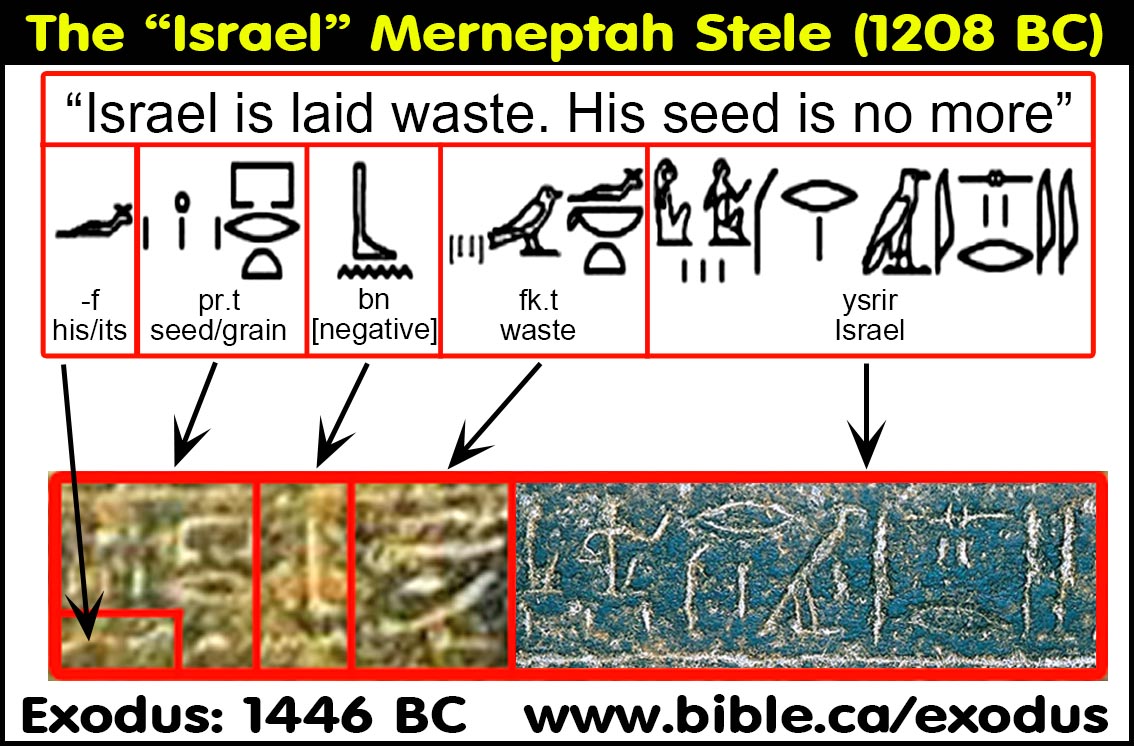
Ramses II’s son, Merenptah, has a famous Stele that names “Israel”.
Dated to c. 1205 BC, this document has been a source of great confusion for historians. For example: https://watchjerusalem.co.il/446-merneptah-stele-proving-israels-3200-year-existence
“The mention of Israel in this 3,200-year-old document suggests, at the time of its inscription, the nation of Israel was an established power and not a nomadic people who had just recently entered the land of Canaan. Before the discovery of the stele, many dated the Exodus much later, but now they are forced to reconcile with the fact that Israel was already an established power in Canaan in 1207 b.c.e”.
Tuesday, March 17, 2020
Na’aman and Hazael
by
Damien F. Mackey
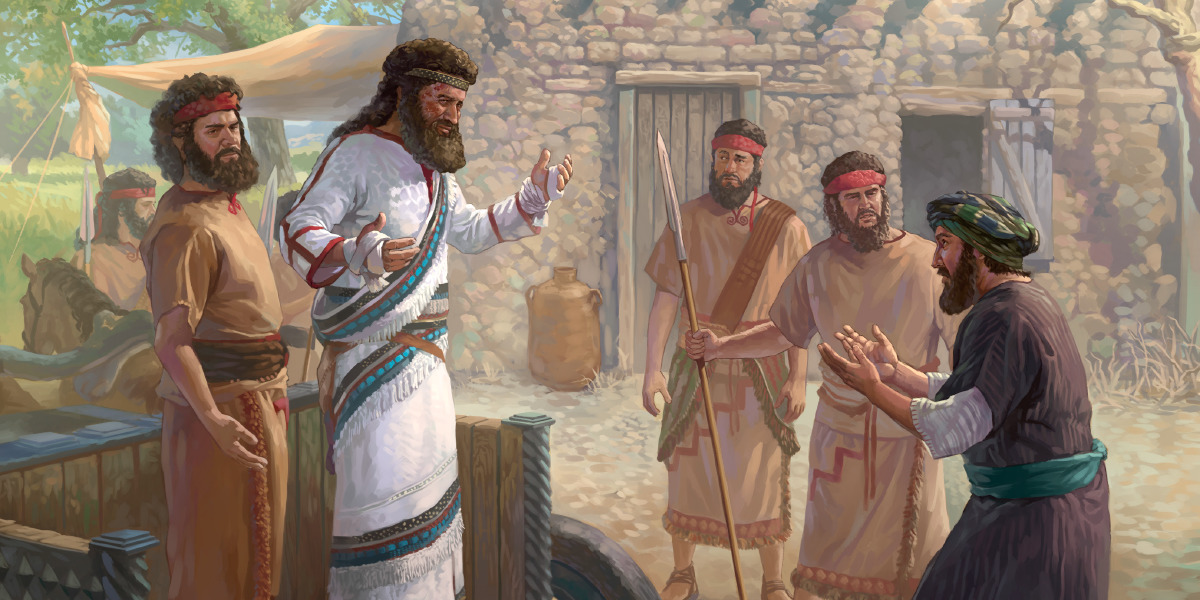
Hazael’s being Na’aman (if that is who he was) would account for the curious fact that Yahweh had commissioned the prophet Elijah at Sinai to anoint a Syrian.
For Na’aman was a Syrian who had (in his own fashion) converted to Yahwism.
Dr. Velikovsky had put together quite a reasonable case for EA’s Ianhama to have been the biblical Na’aman the leper.
Might this Ianhama, though, have been a bit too early for the healing of Na’aman by the prophet Elisha: “Yanhamu began his service under Amenophis III” (E. Campbell, The Chronology of the Amarna Letters, Section C. “Yanhamu and the South”, 1964, p. 93) - the miraculous biblical incident having occurred not very long, apparently, before the assassination of Ben-Hadad I? The latter event I would estimate to have been significantly later than the time of pharaoh Amenhotep ‘the Magnificent’.
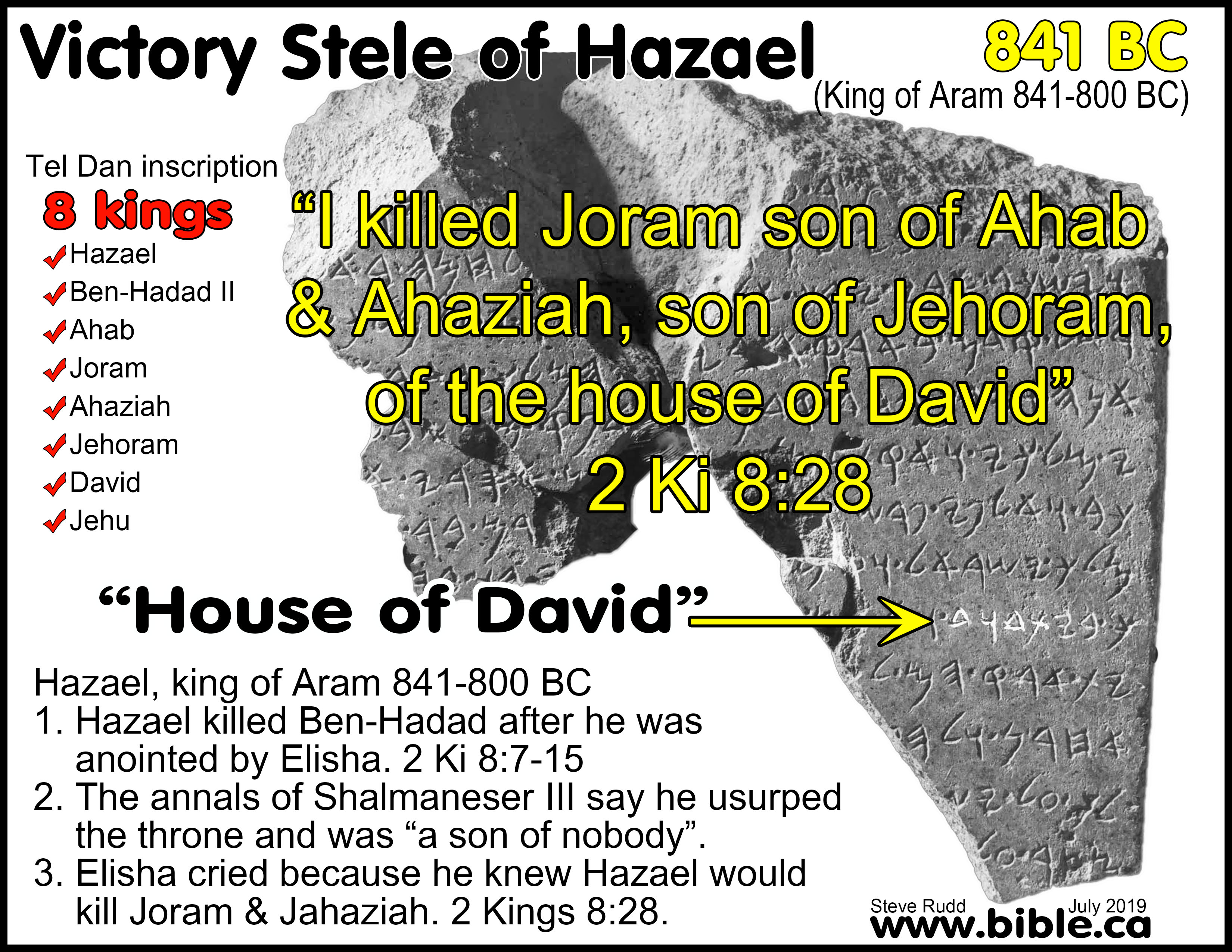
Another possibility for the historical identification of the haughty Syrian captain, Na’aman, I would tentatively suggest, would be Hazael himself, whom Dr. Velikovsky had wonderfully identified with Aziru of the EA series.
Hazael was, like Na’aman, a Syrian (I Kings 19:15): “The Lord said to [Elijah], ‘Go back the way you came, and go to the Desert of Damascus. When you get there, anoint Hazael king over Aram’.”
2 Kings 5:1: “Now Naaman was commander of the army of the king of Aram”.
Na’aman, Hazael, dwelt in very close contact with king Ben-Hadad I.
Compare Na’aman’s words to Elisha (2 Kings 5:18-19):
‘But may the Lord forgive your servant for this one thing: When my master [אֲדֹנִי] enters the temple of Rimmon to bow down and he is leaning on my arm and I have to bow there also—when I bow down in the temple of Rimmon, may the Lord forgive your servant for this’.
‘Go in peace’, Elisha said [,]
with the fact that Hazael had close personal access to his “master” (same Hebrew word, adoni
Then Hazael left Elisha and returned to his master [אֲדֹנִי]. When Ben-Hadad asked, ‘What did Elisha say to you?’ Hazael replied, ‘He told me that you would certainly recover’. But the next day he took a thick cloth, soaked it in water and spread it over the king’s face, so that he died. Then Hazael succeeded him as king.
Hazael’s being Na’aman (if that is who he was) would account for the curious fact that Yahweh had commissioned the prophet Elijah at Sinai to anoint a Syrian. For Na’aman was a Syrian who had (in his own fashion) converted to Yahwism.
Moreover, the former Syrian captain was militarily astute, “Na’aman …. was a valiant soldier” (2 Kings 5:1), who may have begun the demise of the House of Ahab himself by fatally shooting Ahab with an arrow (Emil G. Hirsch, et al., “Naaman”):
And the Syrian captain would have considered the disposal of Ben-Hadad I as being a Divinely commissioned task, especially after this (2 Kings 8:13): “Hazael said, ‘How could your servant, a mere dog, accomplish such a feat?’ ‘The Lord has shown me that you will become king of Aram’, answered Elisha”.
Finally, as Velikovsky had found Na’aman to have been “a generous man”, as is apparent from 2 Kings 5:5: “So Naaman left, taking with him ten talents of silver, six thousand shekels of gold and ten sets of clothing”, so, too, was Hazael an extremely generous man (2 Kings 8:9): “Hazael went to meet Elisha, taking with him as a gift forty camel-loads of all the finest wares of Damascus”.
The Statutes of Omri
by
Damien F. Mackey
“For the statutes of Omri are kept, and all the works of the house of Ahab,
and you walk in their counsels; that I should make you a desolation, and the inhabitants
thereof an hissing: therefore you shall bear the reproach of my people”.
Micah 6:16
With the obscure King Omri (qua Omri) now expanded into Jeroboam I:
Great King Omri missing from Chronicles
then it becomes somewhat clearer what may have been “the statutes of Omri” as referred to by the prophet Micah.
They were the unorthodox religious laws and teachings of Jeroboam I.
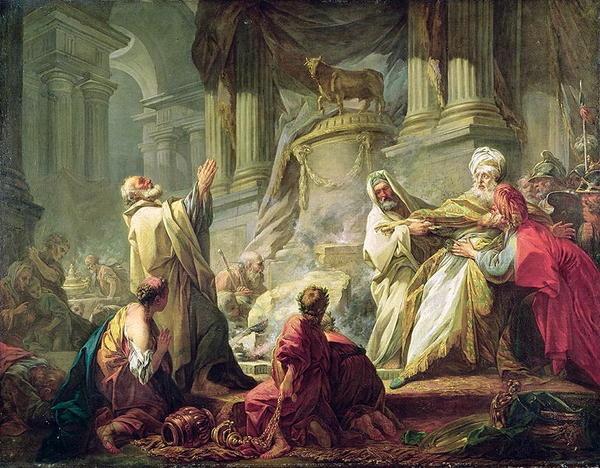
And they had much of their inspiration from Egypt, where Jeroboam lived prior to his reign in Israel. King Jeroboam even uses the very same description of his golden calves that the MBI Israelites had used of theirs in the desert:
Cf.
(Exodus 32:4): ‘These are your gods, Israel, who brought you up out of Egypt’.
(I Kings 12:28): ‘Here are your gods, Israel, who brought you up out of Egypt’.
Here, then, are the statutes of Omri = Jeroboam I (I Kings 12:26-33):
Jeroboam thought to himself, ‘The kingdom will now likely revert to the house of David. If these people go up to offer sacrifices at the temple of the Lord in Jerusalem, they will again give their allegiance to their lord, Rehoboam king of Judah. They will kill me and return to King Rehoboam’.
After seeking advice, the king made two golden calves. He said to the people, ‘It is too much for you to go up to Jerusalem. Here are your gods, Israel, who brought you up out of Egypt’. One he set up in Bethel, and the other in Dan. And this thing became a sin; the people came to worship the one at Bethel and went as far as Dan to worship the other.
Jeroboam built shrines on high places and appointed priests from all sorts of people, even though they were not Levites. He instituted a festival on the fifteenth day of the eighth month, like the festival held in Judah, and offered sacrifices on the altar. This he did in Bethel, sacrificing to the calves he had made. And at Bethel he also installed priests at the high places he had made. On the fifteenth day of the eighth month, a month of his own choosing, he offered sacrifices on the altar he had built at Bethel. So he instituted the festival for the Israelites and went up to the altar to make offerings.
Micah compares, but also distinguishes between, “the statutes of Omri … and all the works of the house of Ahab”.
For, as we read in the above-mentioned article, Omri and Ahab - though universally thought to have been successive rulers of Israel - in reality belonged to separate houses, that of Jeroboam and that of Ahab.
Subscribe to:
Comments (Atom)