Wednesday, July 3, 2019

Pharaoh Amenhotep III a Solomon like ruler of Egypt


by
 
Damien F. Mackey


“Eminent historian Trevor Bryce estimates Amenhotep III's harem at 1,000 women. Interestingly enough, the Bible uses that exact same number for Solomon's wives:
"He had 700 royal wives and 300 concubines…." First Kings 11: 3”
 
Jim Stinehart


Given my identification of the historical King Solomon of Israel with the quasi-royal official Senenmut (or Senmut) of Eighteenth Dynasty Egypt - not to mention Senenmut’s being the model for ‘Solon’ of the Greeks - in e.g. my article:
 
Solomon and Sheba
 
 
then the definitely Solomon-like pharaoh of that same dynasty, Amenhotep III, could be only, at best, an imitator of the illustrious Solomon, and not be identical with Solomon as some think.
 
For, chronologically, Amenhotep III (c. 1385 BC, conventional dating) came to the throne some 7-8 decades after the death of Senenmut (c. 1460 BC, conventional dating).
 
Jim Stinehart, writing on the Graham Hancock site, has a somewhat different angle.
There was no actual King Solomon, he claims. This “fictional” character was based on the historical Amenhotep III, father of the controversial Akhnaton (or Amenhotep IV):
 
Author: Jim Stinehart ….
Date: February 10, 2005 07:24PM
SOLOMON IS AKHENATON'S FATHER

Hebrew King Solomon is fictional. But Solomon is very closely modeled on a very real, historical person -- Akhenaton's father, Amenhotep III, the "King of Kings".

1. Each reigned for 40 years in peace.

2. Neither great king ever did anything militarily. Rather, both were renown [sic] for adroit diplomacy. (In the real world, that "adroit" diplomacy of Amenhotep III consisted primarily of him throwing unbelievable amounts of gold foreign kings' way, as bride's-prices for their semi-royal half-sisters, which was possible only because Egypt was temporarily awash in gold being mined just south of Egypt proper in Nubia.)

3. Both ruled in ridiculously extravagant, totally decadent, grandeur. (In humble Canaan? Not!)

4. Their Queen was an Egyptian princess. (In Canaan? Outside of Egypt? Not!!! Perish the thought.)

5. Each had an unbelievably large number of harem wives. Eminent historian Trevor Bryce estimates Amenhotep III's harem at 1,000 women. Interestingly enough, the Bible uses that exact same number for Solomon's wives: "He had 700 royal wives and 300 concubines…." First Kings 11: 3

Meanwhile, neither king ever sent even one daughter/princess abroad to marry a foreign leader.

And neither king (including Solomon) is known to have had a Hebrew wife.

6. Both were very famous for building a magnificent tripartite temple (Luxor Temple/ Solomon's Temple) to the deity referred to as A-M-N. (Amen is a 14th century BCE Egyptian god. In Hebrew, Amen later meant "so be it, it is God's will".)

7. Yet despite #6, each is equally famous for BREAKING with that deity A-M-N. A-D-N (Adon or Aton or Aten) will be the new deity in Amenhotep III's later years, and the sole deity for his son Akhenaton. Solomon's apostasy is of course well-known.

So though Hebrew King Solomon is fictional, there's nevertheless quite a bit of accurate ancient history in the King Solomon saga in the Bible.
SOMEBODY was THERE in mid-14th century BCE Egypt and witnessed first-hand what was going on, and it all made it into the Bible. First Kings tells us about Akhenaton's father.
 
Jim Stinehart really gets carried away after that, seeming to find the eccentric pharaoh Akhnaton (“Akhenaton”) embedded in:
 
The last 40 chapters of Genesis tell us about Akhenaton (complete with Lot impregnating his 14- and 12-year-old daughters "that we may maintain life through our [son-less] father" at Genesis 19: 34, and the whole 9 yards of the Amarna saga). And though the Book of Exodus has few accurate historical facts, it does beautifully recall all those darn mudbricks, made of clay and straw, that Akhenaton ordered up on the double to build his entirely new city of Amarna.

SOMEBODY was THERE, brothers and sisters, and that somebody must have been the world's first Hebrew. All the professors in academia assure us not to worry, that all that jazzy stuff was made up out of whole cloth by wily Hebrew scribes 700 years after the fact, in 7th century BCE Jerusalem. But how on earth could wily Hebrew scribes in Jerusalem, 700 years after the fact, conjure up all that ACCURATE historical information about Akhenaton's father and Akhenaton? Not!
[End of article]
 
That last piece of uninformed and frenzied collapsing of biblical history by Jim Stinehart reminds me of Islamic scholar Ahmed Osman’s own perfervid efforts that I have so roundly criticised in my articles:
 
Osman's 'Osmosis' of Moses. Part One: The Chosen People
 
and:


As Senenmut (King Solomon) was to Hatshepsut (the female ruler of Egypt), so, too, did Amenhotep III have his own Senenmut type in the mysterious Amenhotep son of Hapu, leading me to wonder who the latter was.
For more on this intriguing character, see e.g. my article:
 
Amenhotep son of Hapu had rĂ´le like Senenmut
 
 
If Amenhotep III had modelled himself on King Solomon of Israel, might not his high official and namesake, Amenhotep son of Hapu, have done so even the more?
In an article, “Amenhotep the Magnificent”, we read further about the enigmatic son of Hapu, here likened instead to Imhotep (biblical Joseph of Egypt): https://erenow.net/ancient/temples-tombs-and-hieroglyphs-a-popular-history-of-ancient-egypt/20.php
….
Like other kings of the Eighteenth and Nineteeth Dynasties, Amenhotep built himself a mortuary temple along the cultivation on the West Bank. Amenhotep’s mortuary temple was the largest of the lot. So badly destroyed was it that in modern times nothing remained except a vast plain covered with weeds and prickly camel grass—and two of the most imposing monuments on the West Bank, the so-called Colossi of Memnon. These giant, badly battered statues marked the entrance to the temple. Recent excavations by a German team have uncovered buried remains of the structure itself, including some fine statues.
 
The man responsible for the erection of these gigantic statues is an interesting character in his own right. His name was Amenhotep, son of Hapu, and like that of another great official, Imhotep, it survived in men’s memories for millennia, so that he became a demigod. His only titles were those of a scribe and he is shown in the traditional scribal position, seated, with his writing implements on his lap. But the king Amenhotep must have cherished him, for there are several such statues, carved by the king’s order, and the scribe even had his own mortuary temple, a signal token of royal favor. He was eighty years old when he died, and how we wish we knew more about him! ….
 
[End of quote]
 
Indeed: “… how we wish we knew more about [Amenhotep, son of Hapu]!”
My sentiments, exactly.
 
The proper chronological relationship between King Solomon and pharaoh Amenhotep III is explained in an article, “Was there such a King as Solomon?” – {which I think was one of my titles at the old www.specialtyinterests.net site, here greatly modified by sysop, Johnny Zwick}:
 
Because of widespread misconceptions on the historicity of the early Israelite kings we endeavor here to make a comparison study to show how things fit together. Especially the very existence of King Solomon has come under criticism because of the apparent lack of corroborating evidence from excavations in Israel itself. How can we explain that? Shouldn't there be at least some evidence attributable to King Solomon or David by way of inscriptions? To be sure small items have been found, i.e. a Solomonic seal for instance, but we are looking more for larger items. Egypt's kings left inscriptions on buildings, statues, stela - why is there such a lack of the same in Israel from any king?

This is a fair question to ask and we must address this issue. On the outset we would like to say that the lack of inscriptions, carvings, ornate stone reliefs in Israel and Judah must have a definite reason and that it does we shall try to explain. Of course they were very much aware of the richness of Egyptian inscriptions and stone carvings, after all they used to live there.
 
The evidence for that however is very early in their experience, right after they had left Egypt. Arriving at Mt. Sinai they clamored for the same things they were used to have around them in Egypt. The Israelites wanted images to dance around and worship - something they could see. But the faith they were taught about of the very God who had led them out of slavery was directed at worshipping Him in faith and deeds rather than by representations.
 
Self glorification of rulers also was not in accord with their beliefs. Only God deserved veneration and being written about. If Solomon would have left inscriptions in his cities the Jewish people themselves would have defaced and done away with them not to leave any trace. This may be not good for us today who are trying to understand those times from the remains, but it is why we should not even expect such artifacts. Those who want to make comparisons to Egypt and argue because of the lack of artifacts in Israel that these kings did not really live and reign as we are told just don't seem to take into account the times they lived in and the Jewish mind. We cannot impose Egyptian conventions on the Jewish people.
 
However, other scholars note that there are other blank spots in Jerusalem's archaeological record during periods when the city is known to have been occupied, and they caution against reading too much into a lack of evidence. Ronny Reich, an archaeologist with the Israel Antiquities Authority, notes, for example, that excavations near the Gihon spring outside the present Old City have turned up "no pottery, nothing" from the Byzantine era–roughly A.D. 330-1450. "Does that mean there were no people in Jerusalem?" Reich asks. "Of course not. How do you explain it? You can't."[J.L. Sheler, `News from the Holy Land']
 
In fact the lack of such personal records carved on stone is evidence in itself that we are at the right place of Jewish habitation. But a few reminders of the early Israelite monarchy are being found often in the form of the stone masons skill to produce smooth stones, with no chisel marks for constructions. All other cultures in the ancient Near East were much closer to Egyptian conventions with respect to artifacts, the Jewish lands are quite singular on the lack of such. But we must not forget that the kinds of artifacts like idols, ushabtis, scarabs and the like found in Palestine are probably those used and on occasion hidden or kept by Israelites who employed them in trade or, in the case of idols perhaps, had become unfaithful to their God.
 
Laws pertaining to royalty - "When you enter the land...and you say: `Let us set a king over us like the nations around us' be sure to appoint over you the king the Lord your God chooses. He must be from among your own brethren. Do not place a foreigner over you, one who is not an Israelite. The king...must not acquire great numbers of horses for himself or make the people return to Egypt to get more of them, for the Lord has told you, `You are not to go back that way again.' He must not take many wives, or his heart will be led astray. He must not accumulate large amounts of silver and gold."
 
Deuteronomy 17:14-17
Critics also often doubt the existence of the early Israelite accounts of constructions and achievements because during excavations they are unable to locate any of these supposed palaces, city gates, walls or dwellings. The cities of Hazor, Gezer and Megiddo have been excavated to a great extend [sic]. A stratum containing remains of palaces, temples and fortifications was found in each of these cities but strangely enough the name of Solomon was not found but that of Pharaoh Amenhotep III was. How can that be? In conventional thinking Pharaoh Amenhotep III reigned from about 1405-1367 BC, long before Solomon. No wonder critics are baffled and discount the scriptural account of history.
But let us see what happens when we apply revised chronology.
In revised view Pharaoh Amenhotep III reigned from about 878-870 as coruler with Amenhotep II, and sole from 870-843 BC, right in the middle of the El Amarna Age. That is just 60 years after the death of King Solomon. He, like Solomon, inherited a vast, glorious and rich empire with connections from the Nile to the Euphrates river. He left a wealth of evidence of his existence in his many constructions of palaces, temples, monuments, documents, art unparalleled and numerous except perhaps that of Ramses II. It was during the reign of Amenhotep III that cities like Gezer were refortified and Egyptian garrisons were set up in strategic locations. Why? Because of the many incursions into Palestine by restless rulers from Damascus, Syria, the great deserts and Assyria. For the Egyptians Palestine was a buffer zone. Stop any would-be-enemies before they reach the border of Egypt. We just need to read about the troubles involving Palestine in the days of Jehoshaphat, Ahab and their sons to understand how desperate the situation sometimes could become. So when we mentioned the palaces of Gezer, Hazor and Megiddo - we must be blind not to realize that they are the ones we had been looking for as belonging to the time of the early Israelite kings. What has been hiding their presence from us is not sand and dirt, but a false, conventional, Egyptian chronology, for Amenhotep III did not live 400 years before Solomon but 60 years after him.
 
It appears that Amenhotep III patterned his life after that of Solomon. But he was not hampered by religious oriented restrictions like Solomon, he could freely create idols, images of himself and vain glorious monuments to his greatness. But as the reader may recall we claim that Solomon most likely was Senenmut, the most trusted noble of Queen-Pharaoh Hatshepsut. It appears that in time Solomon, after having married an Egyptian princess, may have felt himself too restricted in his own kingdom and during the second half of his 40 year reign his gaze was directed toward Egypt. Being a cozy friend with the Egyptian king, he became the highest official and closest adviser to Hatshepsut. What he could not do in Israel he could do in Egypt - leave inscriptions, representations and monuments with his name on them. No wonder his own people would not leave any stone unturned in their homeland which would remind anyone of their wayward king.
 
Having said this we may get an idea about the importance of correct chronology before we go around and teach doubt and reproof of the Hebrew sources. But we realize that the majority of those who have voiced opinions on the ancient history of the Bible lands are still captivated by the rightness of conventional chronology. How can so many famous historians, scholars, archaeologists, scientists be wrong and so few, nameless new people be right? Could it be that sometimes being too close to something for too long disables us to get a clear view? Should we trust in the pronouncements of famous people just because `they must know what they are saying for they dig it out themselves and see it?' Yes, they certainly do, but still their interpretations are colored by their scholarly upbringing. What can we say? Explaining the same history in line with revised chronology will open up so many more intrinsic, grand views of enchanting history that it is well worth to try and study and think our way into it.


His scarabs found in Ashurnasirpal’s city of Calah

 
“Strange as it may seem, Ashurnasirpal II was also a great builder.

He too raised monuments throughout Assyria. These included a new capital named Calah.

In Calah archaeologists found numerous [artifacts] … of Egyptian manufacture.

There were, for example, many scarabs of the latter Eighteenth Dynasty,

especially from the time of Amenhotap [Amenhotep] III”.
 

Emmet Sweeney


Emmet Sweeney gives evidence here to indicate that pharaoh Amenhotep III reigned closely in time to Ashurnasirpal (so-called II) of Assyria, who Emmet thinks must also be the enigmatic “Assuruballit” of El-Amarna (EA letters 15 and 16).

EA 15 is addressed “To the king of the land of Egypt”, whereas

EA 16 is addressed more specifically “To Napkhororia, Great King, king of Egypt, my brother”- generally considered to be Akhnaton, the son of Amenhotep III.


Shalmaneser III and Egypt


….

Immanuel Velikovsky argued that roughly five and a half centuries needed to be subtracted from New Kingdom Egyptian history to bring it into line with that of Israel; and indeed in Ages in Chaos (1952) he demonstrated many striking synchronisms between the two histories once these extra years were removed. In line with that system he suggested that Ahab of Israel and Jehoshaphat of Judah were two of the correspondents of the Amarna documents who exchanged letters with Amenhotep III and Akhnaton.


He also argued that Shalmaneser III of Assyria, a contemporary of Ahab, was the “King of Hatti” who threatened northern Syria in the time of Akhnaton. This part of his reconstruction however was not well received, and always remained problematic. We know, for example, that the King of Hatti named in the Amarna Letters was Suppiluliumas I, whilst the King of Assyria at the time was called Ashuruballit, a man who was very definitely not the same person as Shalmaneser III.


For all that, a host of other evidences suggest that Velikovsky was broadly correct in his demand for a five and a half century reduction in Egyptian dates, and that the errors he made in his reconstruction of the Amarna period were errors of detail. What was needed was fine tuning, not complete rejection.


All attempts at historical reconstruction must be based firmly upon the evidence of stratigraphy; and it so happens that the stratigraphy of Assyria fully supports Velikovsky. A whole series of sites in northern Mesopotamia show the following:


Neo-Assyrians and Neo-Babylonians (860-550 BC)

Mitannians (1550-1350 BC)

Akkadians (2350-2250 BC)


We see that, without exception, the Mitannian levels are followed immediately, and without any gap, by the Neo-Assyrian ones; and the Neo-Assyrian material is that of the early Neo-Assyrians, Ashurnasirpal II and his son Shalmaneser III. Now, since the last Mitannian king, Tushratta, was a contemporary of Akhenaton, this would suggest that Ashuruballit, who wrote several letters to Akhenaton, was the same person as Ashurnasirpal II, father of Shalmaneser III.


The end of the Mitannian kingdom is documented in a series of texts from the Hittite capital. We are told that Tushratta was murdered by one of his sons, a man named Kurtiwaza. The latter then [fled], half naked, to the court of the Hittite King, Suppiluliumas, who put an army at his disposal; with which the parricide conquered the Mitannian lands. The capital city, Washukanni, was taken, and Kurtiwaza was presumably rewarded for his treachery.


The region of [Assyria] … was a mainstay of the Mitannian kingdom. A few years earlier Tushratta had sent the cult statue of Ishtar of Nineveh to Egypt. So, if Kurtiwaza was established as a puppet king by Suppiluliumas, it is likely that his kingdom would have included Assyria. We know that immediately after the overthrow of the Mitanni lands we find a supposedly resurgent Assyria reasserting itself under King Ashuruballit.

The latter’s domain included the Mitanni heartland, for we find him plundering the Mitanni capital of Washukanni and taking from there various treasures with which to adorn his own monuments in Nineveh and Ashur. Indeed, Ashuruballit seems to have been a great builder, and we hear of many new monuments raised by him and many old ones renovated. Strangely, however, none of these structures have been found by excavators. What they have found, right on top of the monuments built by the last of the Mitannians, are the monuments of Ashurnasirpal II, supposedly five and a half centuries after the destruction of Mitannian power.


Strange as it may seem, Ashurnasirpal II was also a great builder. He too raised monuments throughout Assyria. These included a new capital named Calah. In Calah archaeologists found numerous [artifacts] … of Egyptian manufacture. There were, for example, many scarabs of the latter Eighteenth Dynasty, especially from the time of Amenhotap [Amenhotep] III. (See Austen Layard, Discoveries in the Ruins of Nineveh and Babylon (London, 1853) p. 282)


So, just in the place where we would expect to find the monuments of Ashuruballit, who was a contemporary of the latter Eighteenth Dynasty, we find the monuments of Ashurnasirpal II, whose buildings are full of artifacts of the latter Eighteenth Dynasty. This would strongly suggest, even demand, that Ashuruballit and Ashurnasirpal II are one and the same person. Furthermore, since Ashuruballit, the new king of Assyria after the death of Tushratta, seems to be an Assyrian alter-ego of Tushratta’s parricide son Kurtiwaza, this would imply that Ashurnasirpal was yet another alter-ego of Kurtiwaza, and was himself the murderer of Tushratta.


Is there then any evidence to suggest that Ashurnasirpal II was a parricide?


The Babylonian Chronicle tells us that a “Middle Assyrian” king named Tukulti-Ninurta was murdered by his own son. The name of the murderer is give: it is Ashurnasirpal.


The “Middle Assyrians” were a mysterious line of kings who ruled Assyria before the time of the Neo-Assyrians and supposedly after the time of the Mitannians. Yet we know of no Assyrian stratigraphy which can give a clear line from Mitannian to Middle Assyrian to Neo-Assyrian. On the contrary, as we saw, the Mitannians are followed immediately by the Neo-Assyrians of Ashurnasirpal II and Shalmaneser III. This can only mean that the Middle Assyrians must have been contemporaries of the Mitannians, and were most likely Mitannian kings using Assyrian names. We know that ancient rulers often bore several titles in accordance with the various nations and ethnic groups over which they reigned. Since the Mitannian royal names are Indo-Iranian, and therefore meaningless and probably unpronounceable to the Semitic speakers of Assyria, it is almost certain that they would also have used Assyrian-sounding titles.


That the Middle Assyrians were in fact contemporary with the Mitannians is shown in numberless details of artwork, pottery, epigraphy, etc. (See for example P. Pfalzner, Mittanische und Mittelassyrische Keramik (Berlin, 1995)


Thus it would appear that Tukulti Ninurta, who was murdered by his son Ashurnasirpal, was one and the same as Tushratta, who was murdered by his son Kurtiwaza. This latter, upon being appointed king of Assyria by Suppiluliumas, first used the Assyrian name Ashuruballit, but later changed it to Ashurnasirpal. Such adopting of new titles to mark different stages in one’s life and career was by no means uncommon in ancient times.

[End of quote]


But Ashurnasirpal of Assyria’s reign also appears to have been quite close to the era of pharaoh Seti I of the Nineteenth Egyptian Dynasty, which, if that truly be the case, does not bode well for Dr. Velikovsky’s lengthy separation of the Nineteenth from the Eighteenth Dynasty.

This is what I wrote about it, again with reference to Emmet Sweeney, in my university thesis:


A Revised History of the Era of King Hezekiah of Judah

 and its Background


(Volume One, pp. 80-81)  


Some Related Technological and Art Anomalies


Though a neo-Assyrian king as to dating (C9th BC), there are strong indications that Ashurnasirpal II was also in fact closely contemporaneous with the early 19th dynasty (c. 1300 BC, conventional dating) and the latter’s Hittite opponents - and by no means, therefore, was he separated from these by the approximately four centuries that are usually estimated. Similarities between C9th BC Assyrian art and that of the early Ramessides (and contemporaneous Hittites) is of course just what one should expect in terms of this revision. They are reflected in both warfare - particularly in cavalry tactics

and horsemanship - and in art. (For more on this, see Chapter 10, p. 250).


….


Here is what Sweeney has noted in regard to the similarities between Ashurnasirpal’s cavalry tactics and that of the Hittite opponents of pharaoh Seti I (c. 1294-1279 BC, conventional dates):[1] “Hittite cavalry are shown in action against Seti I, and their deployment etc. displays striking parallels with that of the cavalry belonging to Ashurnasirpal II”. Thus for example the Assyrian horsemen, he says, “ride bareback, obtaining a firm grip by means of pressing the raised knees against the horse’s flanks - exactly the method of riding employed by the Hittites portrayed on the monuments of Seti I and Ramses II”. Again, both the early neo-Assyrian cavalry and those of the Hittites against whom Seti I battled, employed the bow as their only weapon. “Even more importantly, they are used in an identical way tactically: they are invariably used in conjunction with the chariotry”.


Sweeney next turns to Maspero’s description of the cavalry of Ashurnasirpal: “The army [of Assyria] ... now possessed a new element, whose appearance in the field of battle was to revolutionize the whole method of warfare; this was the cavalry, properly so called, introduced as an adjunct to the chariotry.” More specifically, he writes:


This body of cavalry, having little confidence in its own powers, kept in close contact with the main body of the army, and it was not used in independent manoeuvres; it was associated with and formed an escort to the chariotry in expeditions where speed was essential, and where ordinary foot soldiers would have hampered the movements of the charioteers.


Again, this is just what one would expect from the prevailing ‘Indo-European’ influence, the ‘chariot-riding aristocracy’, with its magnificent horsemanship.

Similarly, James tells of the definite likeness between the neo-Assyrian art of Ashurnasirpal II and that of the ‘Middle’ Assyrian period several centuries earlier, C13th-12th BC:[2]


One scholar noted that the forms of decoration of the intricately carved Assyrian seals of the 12th century are ‘clearly late’, as they ‘point the way to the ornate figures which line the walls of the Neo-Assyrian palace of Assurnasirpal [mid-9th century BC]’. The sculptors employed by this king, in the words of another expert on Assyrian art, ‘worked within a tradition that went back to the thirteenth century BC’.


Professor Greenberg has observed, along the same lines, that Mycenaean Greece Shaft Grave Stelae, currently dated variously to the late C14th, or mid C13th BC, “make a good deal more art historical sense when compared, for example, with the hunting scenes of Ashurnasirpal II from Nimrud, which are dated in the ninth century BC …”.[3]


Thus [Eduard] Meyer was being perfectly logical, according to his own artificial context - with its subsequent misalignment of the early history of Israel - when issuing his bold challenge to gainsay the traditional view that Moses was a real historical person. And Meyer was entirely correct too back then, in 1906 (a full century ago), when stating that “not one of those who treat [Moses] as a historical reality has hitherto been able to fill him with any kind of content whatever …”. For Meyer’s chronology, as promoted by the Berlin School of Egyptology, and later by Sir Henry Breasted, which had become the standard, had made it quite impossible for scholars even to locate Moses in that complex scheme, let alone “to fill him with any kind of content”. Whilst an independent-minded historian like Sir Flinders Petrie might try valiantly to make a major adjustment to Sothic chronology - though still unfortunately based on that system’s faulty premises, by adding an extra Sothic period - he did not like what he eventually saw and so had to reject his novel idea.[4] Meyer’s Sothic chronology therefore survived the challenge and prevailed.

Today, for those who do give some credence to the story of Moses and the Exodus account, the favoured era is, as it was in Meyer’s day, the 19th Ramesside dynasty, Sothically dated to the C13th-C12th’s BC – but still two or more centuries after properly calculated biblical estimates for Moses. Ramses II (c. 1279-1212 BC, conventional dates) is now generally considered to have been the Pharaoh of the Exodus; though no evidence whatsoever for a mass exodus of foreigners can be found during his reign.


Fortunately, the work of revision is serving to resurrect some long-lost biblical characters of great import. I have already shown in fair detail in Part I how C9th BC biblical characters, for instance, emerge in some profusion when a Velikovskian-based revision is carefully applied to the well-documented EA period. ….


[1] Ibid, p. 24.

[2] Centuries of Darkness, p. 273.

[3] ‘Lion Gate at Mycenae’ (1973), p. 28.

[4] Researches in Sinai, ch. xii; q.v. his A History of Egypt, vol. i, add. xvii, xviii.

”.204


Thursday, May 16, 2019

Conventional fudging has Seti occupying centuries


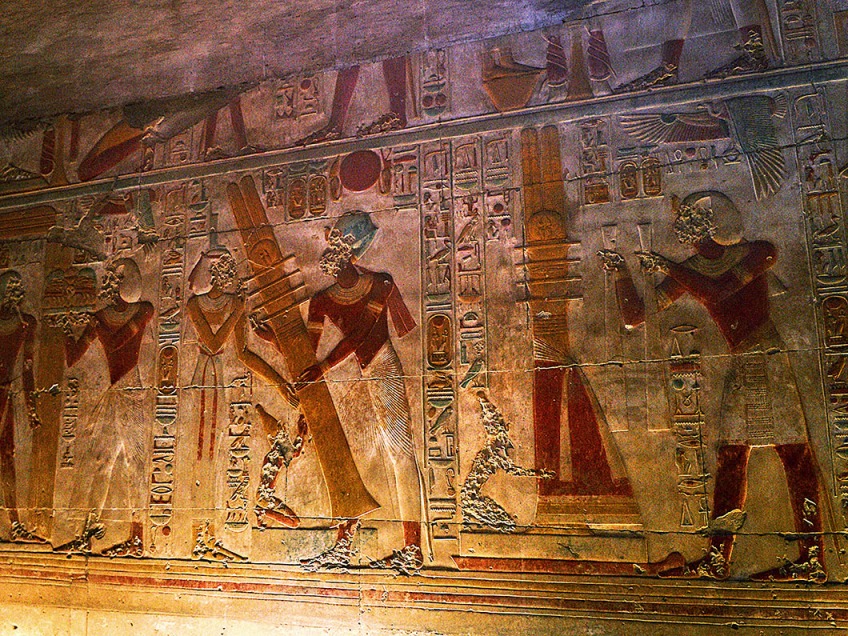
 Egyptian Temple relief


by
 
Damien F. Mackey


In the case of the so-called Twentieth Dynasty, Seti-nakhte, the heroic dynastic founder
who drove out the usurper, and who is Seti, rears up again in the guise of Ramses XI
at the end of that dynasty.


The characteristic feature of the early reign of Horemheb, of Seti, is restoration (and lawgiving) after a period of chaos and usurpation. Hence the institution of a new era, whm mswt (‘Repetition of Births’).
 
This connection between the Nineteenth Dynasty and, supposedly, the era the preceded it, is picked up again with Ramses XI, also (like Seti) named Menmare, with his new era of restoration, whm mswt.
Ramses XI is supposed to have reigned, like Horemheb, for 28 years.
 
Topsy-turvy Egyptian dynasties, as we noted elsewhere, with a dynasty’s beginning re-emerging at its end.
Thus, in the case of the so-called Twentieth Dynasty, Seti-nakhte, the heroic dynastic founder who drove out the usurper, and who is Seti (supporting the strong tradition of a “Sethos” as dynastic founder), rears up again in the guise of Ramses XI at the end of that dynasty. 
 
That is already a chronological stretch from c. 1320 BC (Horemheb) - 1070 BC (Ramses XI).
250 years for he who I consider to be the one pharaoh: Seti the Great.
 
And this does not yet take into account possible further extensions of Seti, via Psusennes I (=II) and on even into the 25th dynasty.
 

Wednesday, May 15, 2019

Merenptah completes Seti


Reliefs of Amenhotep III found in the temple


by
 
Damien F. Mackey


“Merenptah’s involvement with the Osireion raises some questions,
not least, how did he gain access when the brick arch appears
to have been blocked up by Seti?
 
Keith Hamilton


The somewhat poorly known pharaoh Merenptah - generally thought to have been the son and successor of Ramses II - needs, it seems, to be filled out with his supposed grandfather, Seti (the father of Ramses II), whom I have multi-identified in e.g. my series:
 
Seti I and Seti II Merenptah
 
See especially:
 
Seti I and Seti II Merenptah. Part Three: Seti I and II Merenptah and Merenptah
 
https://www.academia.edu/39120467/Seti_I_and_Seti_II_Merenptah._Part_Three_Seti_I_and_II_Merenptah_and_Merenptah
 
Merenptah’s relative obscurity (qua Merenptah) is apparent from the following quotes:
 
http://www.ancientpages.com/2018/04/17/pharaoh-merneptah-his-giant-sarcophagus-and-unique-victory-stele/
“Greatly overshadowed by his dominant and long-lived father, Merneptah never had a chance to become a famous pharaoh and he was almost unknown for most of his life”.
 
Note, in the next quote, the sequence: “probably”, “likely”, “presumed”, “possibly”.
 
https://en.wikipedia.org/wiki/Merneptah
“Merneptah was probably the fourth child of Isetnofret I, the second wife of Ramesses II, and he was married to Queen Isetnofret II, his royal wife, who was likely his full sister bearing the name of their mother. It is presumed that Merneptah was also married to Queen Takhat and one of their sons would succeed him as Seti II. They also were the parents of Prince Merenptah and possibly the usurper, Amenmesse, and Queen Twosret, wife of Seti II and later pharaoh in her own right”.
 
https://www.britannica.com/biography/Merneptah
“He left few monuments, but in his conduct of Egypt’s defense and diplomacy he was at least the equal of his father”.
 
http://www.newadvent.org/cathen/10208b.htm
“His original works are comparatively few and insignificant. His name is constantly found on the monuments of his father …”.
 
Merenptah is thought to have “decorated” (in some cases, “largely”) monuments of Seti, even though he is considered to have been separated from Seti by the almost seven decades of reign of Ramses II.
 
https://therolesandcontributionsofsetii.weebly.com/builder.html
“The Osireion is located behind the Abydos temple and may have been intended to be a 'cenotaph' (empty tomb.) The architecture of the Osireion is particularly unusual: a rectangular 'island' surrounded by a channel of water was constructed in the middle of the hall on which large pillars were built. This design may have represented the primeval waters and mound which began all of creation. Although the structure was built by Seti I it was largely decorated by his grandson, Merenptah with scenes from 'The Book of Gates', images of the journey to the underworld, texts relating to astronomy and depictions of gods and goddesses”. 
 
https://www.researchgate.net/profile/Keith_Hamilton4/publication/328225133_The_Osireion_A_Layman%27s_Guide/links/5bbf5cbe299bf1004c5a4617/The-Osireion-A-Laymans-Guide.pdf
“When Murray discovered and excavated the two chambers at the end of the entrance passage, she found them decorated with texts; she states,
 
“The cartouche of Merenptah appeared in every place where it could be inserted, and we therefore had to consider the possibility of its being his tomb.”24
 
It seems clear therefore, that a lot of the preliminary laying out of the texts was accomplished by Seti, and that these texts were utilised by Merenptah, who only had to sculpt the walls and replace Seti’s name with his own; though his workers appeared to have missed Seti’s name on two occasions.
 
There are indications that Ramesses II did likewise in the adjacent temple, when he completed Seti’s work; though there is no evidence that Ramesses did any work on the Osireion.
 
Merenptah’s involvement with the Osireion raises some questions, not least, how did he gain access when the brick arch appears to have been blocked up by Seti? Frankfort makes no comment on it, other than to question Strabo’s access; he states, Ingress could not be obtained by the arch at the north end of the entrance passage, because we found it still bricked up with Seti’s bricks,..”25
 
But if this logic is good for Strabo, what about Merenptah? Merenptah was Seti’s grandson and he ruled after his long lived father Ramesses II, who ruled about 66 years: Merenptah would not be so fortunate and his reign is believed to be a more modest 10 years. It would seem therefore, that Merenptah took an unusual interest in the subterranean Osireion some 66 years after Seti bricked up the arch. If Merenptah had used this entrance, might not he have used bricks with his own name on it? So how did he gain access? ….
 
http://www.historyembalmed.org/egyptian-pharaohs/merneptah.htm
“Children:  Little information about his children but it is believed that his son Seti-Merneptah became Pharaoh Seti II”.
 

Thursday, May 9, 2019

What Third Intermediate Period?


Image result for the third intermediate period

by

Damien F. Mackey
 
 
Now, if these syncretisms work out, then the famous Nineteenth Dynasty of Egypt must hold a very fat key to the notorious Third Intermediate Period (TIP) of Egyptian history.


With “Shishak” properly identified by Dr. I. Velikovsky … with Thutmose III,
the mighty pharaoh of Egypt’s Eighteenth Dynasty … then pharaoh Shoshenq I
must needs be lifted right out of the C10th BC and located some centuries later.


Shoshenq I considered a ‘new Smendes’
 
Conventional dates for Smendes, considered to have been the first ruler of the 21st Dynasty, are c. 1069-1043 BC.
Conventional dates for Shoshenq I, considered to have been the first ruler of the 22nd Dynasty, are c. 945-924 BC.

In terms of biblical chronology, Smendes would probably have been a younger contemporary of Samuel; whilst Shoshenq I has famously been identified (e.g. by Jean François Champollion) as the biblical “Shishak king of Egypt” at the time of King Rehoboam (I Kings 4:25-26).

However, I have – along with other revisionists – rejected Champollion’s view of Shoshenq I as “Shishak”:

Shoshenq I.
A (i): Who Shoshenq I was not
With “Shishak” properly identified by Dr. I. Velikovsky (as I believe) with Thutmose III, the mighty pharaoh of Egypt’s Eighteenth Dynasty:

Thutmose III best candidate for “Shishak”
then pharaoh Shoshenq I must needs be lifted right out of the C10th BC and located some centuries later.
So significant a chronological shift must also impact upon Smendes who would also need to be lowered down the time scale.
But then we start to get that awful crush of Third Intermediate Period (TIP) dynasties, 21-25, with which revisionists have to contend.

https://www.cemml.colostate.edu/cultural/09476/egypt02-05enl.html

The Third Intermediate Period usually refers to the time in Ancient Egypt from the death of Pharaoh Ramesses XI (reign 1107–1078/77 BC) during the Twentieth Dynasty to the foundation of the Twenty-Sixth Dynasty by Psamtik I in 664 BC, following the expulsion of the Nubian rulers of the Twenty-Fifth Dynasty.

Smendes, apart from being considered as the founder of the 21st dynasty, is also thought to have been the first ruler of TIP.

A possible solution to early TIP would be to identify Smendes with Shoshenq I of supposedly a century later.
That there was a degree of similarity between Smendes and Shoshenq I is apparent from this quote from N. Grimal (A History of Ancient Egypt, Blackwell 1994, p. 332): “Shoshenq I immediately sought to prove that his claim to the throne went back to the preceding dynasty, and did so by adopting a set of titles based on those of Smendes I”.

Names shared: Meryre; Sekhempehti; Hedjkheperre-setpenre

Similarity can – but does not always – mean identity.

However, it is at least worth considering that Smendes and Shoshenq I were one and the same, with the possibility of aligning dynasty 21 with 22 to overcome at least some of the dynastic crushing of TIP.

“… Shoshenq was, so to speak, ‘another Smendes’ … a ‘new Smendes’.
 
Kenneth Kitchen
 

As I noted above: “Similarity can – but does not always – mean identity”.
And, just because someone is described as ‘a new’ someone else, or ‘a second’ someone else (e.g. ‘a new king David’; ‘another Solomon’, ‘a second Judith’) does not necessarily mean that the ‘second’ version is the same person as the original.

Hitler, for instance, is considered to have been a new Haman (of the Book of Esther).

But Hitler was not Haman, who was, though - like Hitler - an historical character.
See e.g. my article:
King Amon's descent into Aman (Haman)
Previously, I quoted N. Grimal who had likened Shoshenq I to his supposed predecessor, Smendes.
  1. A. Kitchen is more expansive on the similarities. As I noted in my university thesis:

A Revised History of the Era of King Hezekiah of Judah
and its Background
 

(Volume One, p. 335), with reference to Kitchen’s text, The Third Intermediate Period in Egypt, 1100-650BC, pp. 287-288):

[Shsohenq I’s] very titulary exemplifies his qualities and policies. By taking the prenomen Hedjkheperre Setepenre, that of Smendes I, founder of the previous dynasty, Shoshenq proclaimed at one stroke both his continuity with the past – i.e. that he was, so to speak, ‘another Smendes’  - and a new beginning. Like Smendes, he now opened a new era. Nor is the concept of a ‘new Smendes’ limited to Shoshenq’s prenomen. He also adopted Horus, Nebty, and Golden Horus names reminiscent of those of Smendes I. Just as the latter had been Horus ‘Strong Bull, beloved of Re’ plus epithets (whose arm Amun strengthened to exalt Truth), so now Shoshenq I was Horus ‘Strong Bull, beloved of Re’ plus epithets (whom he (= Re) caused to appear as King to unite the Two Lands).

[End of quote]

Whilst similarity does not necessarily mean identity, there are reasons to think that, in this case, it might.
For one, the obviously significant pharaoh Smendes is, yet, so poorly attested, is crying out for an alter ego.

And, in the context of the revision at least, a crunching of Smendes with Shoshenq I would provide far more room for chronological manoeuvring.

More room is needed.

Smendes so poorly attested
 
“… most of what we know of Smendes predates his rise to the throne”.
“… we can only guess at Smendes' origins”.
“… there is a great deal of confusion concerning the origin of Smendes”.
 Jimmy Dunn
Statements like the above from Jimmy Dunn (Tour Egypt) would suggest that pharaoh Smendes, said to have reigned for as many as 26 years, may be sorely in need of an alter ego – with Shoshenq I being my suggestion for another face of Smendes.
Jimmy Dunn has written: http://www.touregypt.net/featurestories/smendes.htm

Smendes, the First King of the 21st Dynasty

and the Third Intermediate Period

….
Smendes (Smedes), who we believe founded the 21st Dynasty, ending the New Kingdom at the beginning of the Third Intermediate Period, is a very difficult individual with almost intractable origins and affiliations. His reign, which Manetho assigns 26 years, produced only a tiny handful of monuments and we have never discovered either his tomb or his mummy (though many believe his tomb to be NRT-I at Tanis, this structure offers up no clues concerning Smendes).
Smendes is a Greek rendering of this king's name. His birth name and epithet were Nes-ba-neb-djed (mery-amun), meaning "He of the Ram, Lord of Mendes, Beloved of Amun". His throne name was Hedj-kheper-re Setep-en-re, meaning "Bright is the Manifestation of Re, Chosen of Re".
In fact, most of what we know of Smendes predates his rise to the throne. From the Report of Wenamun, dating to Year 5 of the "Renaissance Era" during the last decade of the reign of Ramesses XI, we learn much of what we know of this future king. While on the way to Lebanon to obtain wood for the renewal of the divine barque of Amun-Re, Wenamun stopped at Tanis, which he describes as "the place where Smendes and Tentamun are". Smendes is specifically described as being the one to whom Wenamun gave his letters of credence from Herihor, the High-Priest of Amun and a powerful general in the south. Wenamun was then sent in a ship by Smendes to Syria. Smendes, along with Herihor and others, was cited as having contributed money to this expedition.
Smendes, together with Tentamun, are therefore shown to be of great importance in Egypt's Delta, equals at least of the High-Priest of Amun in the south. Consider the fact that Ramesses XI at this time presumably lived at Piramesses, only about 20 kilometers to the southwest of Tanis, and yet Wenamun came to Smendes for assistance rather than to the king. In fact, Herihor assumed some royal titles even while Ramesses XI was still alive, and the implication would seem to be that Smendes had a similar standing in the north.
Nevertheless, we can only guess at Smendes' origins. It has been suggested that he was a brother of Nodjmet, the wife of Herihor, but it has also been suggested that Nodjmet could have been a sister of Ramesses XI. However, Tentamun, who was presumably Smendes' wife, may have been a member of the royal family. She could have been a daughter of another woman named Tentamun, who may have been the wife of Ramesses XI (or possibly another Ramesside king).
The older Tentamun was certainly the mother of Henttawy, who later became the wife of the High-Priest of AmunPinedjem I, who also acquired kingly status in the south. As a royal son-in-law, Smendes' status is more easily understood, though perhaps not his total eclipse of the king.
Obviously there is a great deal of confusion concerning the origin of Smendes. Nevertheless, it is very probable that the families of Smendes and Herihor, or at least their descendants, were linked.
Whatever his original status, after the death of Ramesses XI, Smendes became a king of Egypt, and is recorded as such in most reference material. However, only two sources specifically name him as pharaoh, consisting of a stela in a quarry at Dibabia near Gebelein (Jebelein), and a small depiction in the temple of Montu at Karnak. Interestingly, while there are no known unambiguously dated documents from his reign, the contemporary High-Priests of Amun used year numbers without a king's name, and it is generally believed that, at least through year 25, these refer to Smendes' reign.
In fact, Smendes probably never ruled over a united Egypt as such, a condition which probably also existed at the end of the reign of Ramesses XI. During much of what we refer to as the 21st Dynasty, there was also a dynasty of High-Priests of Amun at Thebes who effectively ruled Upper Egypt, while the kings at Tanis ruled the north. However, there appears to have been a rather delicate balance of powers, and perhaps even a formal arrangement for this division of Egypt. The Priests at Thebes seem to have held sway over a region which stretched from the north of el-Hiba (south of the entrance to the Fayoum) to the southern frontier of Egypt, and their aspirations became apparent around year 16 of Smendes' reign, when Pinedjem I apparently began to take on full pharaonic titles, yet at all times he continued to defer to Smendes as at least a senior king.
….

Might Psusennes I and II be the same person?


“On the Dakhleh Stela of the Twenty-second Dynasty reference is made to
the 19th year of ‘Pharaoh Psusennes’. …. As Gardiner observes, one cannot determine
from this statement whether Psusennes I or II is intended”.
 
Beatrice L. Goff
 

If our suspicion in this series that Smendes of the 21st Egyptian dynasty was the same pharaoh as Shoshenq I of the 22nd (Libyan) dynasty, then this is going to assist in the necessary curtailing of the troublesome Third Intermediate Period (TIP), so-called, of Egyptian history.

It will the open the door for further shrinkage, enabling, for instance, for the Psusennes I at the time of Smendes to have been the same as the Psusennses II at the time of Shoshenq I – as some have already suspected.

Conventionally, the 21st dynasty is set out something like this:
http://looklex.com/e.o/egypt.ancient.dynasty.21.htm


KingsYears BCE
Smendes1069-1043
Amenemnisu1043-1039
Psusennes 11039-991
Amenemope993-984
Osorkon the Elder984-978
Siamun978-959
Psusennes 2959-945
About three decades separate Psusennes I from Psusennes II.

Then follows the 22nd dynasty, commencing with Shoshenq I, a known younger contemporary of Psusennes (so-called II).

According to the following site:
https://www.genealogieonline.nl/en/stamboom-homs/I6000000006758798461.php
some have been suggesting an identification of Psusennes I and II:

While some authors, including New Chronology followers claim that Psusennes I may actually be identical with Psusennes II, this is impossible because Psusennes II is clearly distinguished from Psusennes I by Manetho and is given an independent reign of 15 years in the author's Epitome. Moreover, Psusenness II's royal name has been found associated with his successor, Shoshenq I in a graffito from tomb TT18, and in an ostracon from Umm el-Qa'ab. This shows that Shoshenq I was Psusennes II's successor. In contrast, Psusennes I died almost 40-45 years before Shoshenq I's appearance as Chief of the Ma, let alone King of Egypt.
[End of quote]

“Psusennes I died almost 40-45 years before Shoshenq I …” according to the conventional calculations.
But that would no longer apply if Smendes were Shoshenq I, and Psusennes I and II were also the same person.


Psusennes I and Ramses XI
 
 
“Like his successors, Psusennes himself was a chief priest of Amun of Tanis, but he also
traced his succession back to Rameses XI by renaming himself ‘Rameses Psusennes’.”
 
Nicolas Grimal

The plot may have thickened startlingly, because I have already tentatively linked Ramses XI, of the so-called Twentieth Dynasty, with Horemheb:

 
and so possibly with Seti I:

Seti I’s Kom Ombo inscription mentions pharaoh Horemheb
Now, if these syncretisms work out, then the famous Nineteenth Dynasty of Egypt must hold a very fat key to the notorious Third Intermediate Period (TIP) of Egyptian history.

Already, my revision has seen this Nineteenth Dynasty ‘swallow up’, like Nebuchednezzar (Jeremiah 51:34), the significant Twentieth Dynasty, with (Seti I as Setinakhte, Setnakhte, and) Ramses II as Ramses III:

Ramses II, Ramses III. Part One: Some ‘ramifying’ similarities
 
Now the Nineteenth Dynasty may be set to ‘gorge’, as well, the Twenty-First, Twenty-Second and (at least) Twenty-Fifth (TIP) dynasties, the latter, if, as I asked at the end of my article:

“Now, what if we could tie up, all together, So and Si’be with pharaonic names from two supposed TIP dynasties: Psibkhenno/Psusennes and Shabaka?”

In the course of our Egyptian revision we have found, as is thought, Ramses III harkening back to Ramses II; Psusennes I harkening back to Ramses XI, who seems to have copied Seti I; Shoshenq I harkening back to Smendes.
All of this harkening back! But no one, it will be found, harkens back like the Twenty-Fifth dynasts! Piankhy, for instance, adopted the names of Thutmose III and Ramses II (see below).

From N. Grimal’s A History of Ancient Egypt (Blackwell 1994), we read of some fascinating aspects - {in our new context, using the Nineteenth Dynasty as a reference point} - pertaining to ‘harkener back’ Psusennes (so-called I):

  1. 315:

“… Psusennes I. …. He clearly emphasized his Theban heritage: his Horus name was ‘Powerful bull crowned at Thebes’ and his Two Ladies name was ’Great builder in Karnak’.”

Mackey’s comment: That sounds suspiciously like Horemheb, because, according to Grimal:

  1. 243: “Horemheb was certainly a prolific builder: … it was at Karnak that he devoted his energies, as his choice of Two Ladies name suggests ….”.
Grimal had given that name as: ‘With countless miracles in Karnak’.
“His Horus name is ‘Powerful bull with wise decisions’.”

Mackey’s comment: This program seems to be encompassed largely in the titulature of Seti I. Grimal again:

  1. 246: “Sethos [Seti] I … his Horus name was ‘Powerful bull who gives life to the Two Lands after having been crowned at Thebes’.”

  1. 315: “It is known that in the fortieth year of Psusennes I’s reign the chief priest Menkheperre inspected the temples at Karnak”.

Mackey’s comment: “Menkheperre” was a name taken by Piankhy of the Twenty-Fifth dynasty so-called:

“[Piankhy] identified himself with the two great rulers who were most represented in the Nubian monuments, Tuthmosis III and Ramesses II, and adopted each of their coronation names: Menkheperre and Usermaatra respectively”. In other words, Piye was an eclectic in regard to early Egyptian history; and this fact may provide us with a certain opportunity for manoeuvring, alter ego wise.

as I noted in my article (also quoting N. Grimal):

Piankhi same as Bible's Tirhakah?

Grimal continues (p. 315):

“Like his successors, Psusennes himself was a chief priest of Amun at Tanis, but he also traced his succession back to Rameses XI by renaming himself ‘Rameses Psusennes’.”
At Tanis, Psusennes I built a new enclosure around the temple dedicated to the triad of Amun, Mut and Khonsu. If the few traces of reuse of earlier monuments are to be believed, he made many other contributions for the temple, but because of the current condition of the site little is known concerning this work”.

Mackey’s comment: In fact there is a whole archaeology missing for the Twenty-First dynasty. I wrote about this parlous situation in my university thesis

A Revised History of the Era of King Hezekiah of Judah
and its Background
 

following Peter James (and without then perceiving any 21st dynasty correlation with the 19th) (Volume One, beginning on p. 328):

Dearth of 21st Dynasty Artefacts

The 21st dynasty, to which at least two pharaohs Psusennes are assigned, is extremely problematical, as we saw in the previous chapter. So much of it seems to be missing, archaeologically speaking. Ways have to be invented to ‘explain’ this dearth of information. Rohl for instance, according to de Meester,[1] “thinks that the 21st and 22nd Dynasties coexisted in the same period, but in a different way. …. He … thinks [for example] that Siamun was not a king but a Theban high-priest”. De Meester though, regards this as being “unlikely because Siamun left buildings in Memphis and Tanis and did not bear the title of High Priest of Amun”. “Velikovsky”, de Meester adds, “thought that all kings of the 21st Dynasty were only High Priests in the western oases”.
The TIP is thought, as we read, to have begun with a Smendes. This Smendes, according to Gardiner, “can have had no personal right to the throne”.[2] And James, who, firstly having noted that the 22nd dynasty pharaoh “Osorkon I is attributed thirty-five years (924-889 BC) on the most equivocal evidence”, then adds:[3] “Equally suspect is the twenty-six years of sole rule accorded to Smendes (1069-1043 BC), whose reign is thought to have bridged the transition between the 20th and 21st Dynasties”.
Just as Smendes may be lacking substance, so, too, is the dynasty to which he belongs, the 21st, lacking in archaeological information.
….
Bierbrier has written about the dearth of 21st dynasty material:[4]

With the advent of Dynasty XXI the copious sources of information which were available in the previous two dynasties vanish. Administrative papyri and ostraca prove practically non-existent. Votive statuary would seem to disappear almost totally. Graffiti and inscriptions decline to a few badly preserved examples.
Most important of all, tombs which have provided the basic material for the study of the families of Dynasty XIX and Dynasty XX are for the most part no longer built but are replaced by small intrusive burials in older tombs or by large caches of coffins secreted in obscure tombs in the rock cliffs of Thebes. … Because of this dearth of material, it is not possible as in Dynasty XIX and Dynasty XX to present a coherent outline of the descent of various families and their interrelations”.

Bierbrier thought that:[5] “This paucity of information is partly due to the shift of political power to the northern cities which have been less well preserved and excavated than those of the south and partly due to the less prosperous and more unsettled times”.  James refers to the lack of stone statues at the time as described by Bierbrier as “a bizarre absence not encountered in other periods of Egyptian history”.[6] And he adds here: “Yet with the advent of the 22nd Dynasty, ‘a wealth of data on the priests and officials of Thebes’ is known ...”.
….


- Apis Bulls
 
James again, in his discussion of Apis bull burials at Saqqara - which burials he considers to be “potentially one of the most important sources of chronological information for the TIP” - gives this yet further example of the lack of 21st dynasty evidence:[7]  
 
The most striking gap in this sequence [of Apis burials] is for the 21st and early 22nd Dynasties, so far totally unattested. On the conventional dating this period was some 210 years, during which time there should have been about 12 Apis burials, based on the average life expectancy of eighteen years, as calculated by Jean Vercoutter. An ‘embalming table’ with the name of Shoshenq 1 suggests that there may have been one 22nd Dynasty burial which has not been recovered, but the complete lack of records for the 21st Dynasty is still extraordinary.

- Tanis Royal Tomb Complex

A further clear indication that something is seriously wrong with the usual reconstruction of this early TIP phase is provided by the tomb evidence at Tanis. Thus James again:[8]

Striking evidence that something is amiss with the conventional placement of the 21st and 22nd Dynasties comes from the royal tomb complex at Tanis, discovered by Pierre Montet. In the south-western corner of the main temple enclosure he uncovered the underground burials of Psusennes I and Amenemope of the 21st Dynasty, Osorkon II and Shoshenq III of the 22nd Dynasty, as well as three unattributed tombs. Montet and his architect Lézine were clearly puzzled by the relationship between Tomb I, belonging to Osorkon II, and Tomb III, containing the burials of Psusennes I, Amenemope and others.
[End of quotes]

Grimal continues in a similar vein:

  1. 317: “… Tanis. Nothing remains of the actual buildings of Psusennes I – only a few blocks of additions made by Shoshenq V. Also lost is the temple of Mut, established in the south of the site probably at the time of Psusennes”.


A whole “lost … temple of Mut”!


[1] ‘The relief of Sheshonk in Karnak’, section: “The end of the 22nd Dynasty”, (un-numbered pages).
[2] Op. cit, p. 316.
[3] Centuries of Darkness, p. 232.
[4] Op. cit, p. 45.
[5] Ibid.
[6] Op. cit, p. 235.
[7] Ibid, pp. 236, 238. Emphasis added.
[8] Ibid, p. 243.

Wednesday, May 8, 2019

Horemheb and Ramses XI

Pharaoh of Egypt Horemheb

by

Damien F. Mackey


“It is worthy of notice that the two Pharaohs who employ this dating, namely Sethos I
and Ramesses XI, both bear the prenomen Menmare. I imagine that Ramesses XI
copied in this, for some reason unknown to us, his homonymous predecessor,
just as Ramesses III in several things imitated Ramesses II”.

Jaroslav ÄŒernĂ½


Except, I do not think that: “Ramesses III in several things imitated Ramesses II”, because, in my opinion (for what it is worth): Ramses III was Ramses II. See e.g. my article:

Ramses II, Ramses III. Part One: Some ‘ramifying’ similarities


So could it perhaps likewise be that: “Sethos [Seti] I and Ramesses XI [who] both bear the prenomen Menmare”, and “who employ [whm mswt] dating”, were one and the same pharaoh?

Then why have I, in my title above, lined up Ramses XI, not with Seti I, but with Horemheb?
The reason for this is because I have already drawn comparisons, and a potential identification, between Horemheb and Seti I. See the latter part of my article:

Seti I’s Kom Ombo inscription mentions pharaoh Horemheb


Jaroslav ÄŒernĂ½ is quoted in William Austin’s article:

The Riddle of the Renaissance during the reign of Ramesses XI


telling of the supposedly two separate incidents in later Egyptian history involving whm mswt (Austin pp. 135-135):

….
A year later Jaroslav Cerny took on another chronological problem concerning the late 20thDynasty: where to place the puzzling era known as the whm mswt, which translates literally as “Repeating of Births”, but is more commonly called the Renaissance. In one sense, Cerny demonstrated remarkable insight. Notice that his list of sources does not include Pap. Turin Cat.2034, with the explicit dateline “Year 1 whm mswt = Year 19” (figure 9-2, E), yet he correctly made that connection from the fact that thieves listed on the back of Pap. Abbott, in two ‘dockets’ dated “Year 1 = Year 19” (figure 9-2, C & D), were the same as those on trial in Pap. Brit. Mus. 10052 and Pap. Mayer A, dated “Year 1 of the whm mswt 
” (figure 9-2, G & H). Thus he had connected Year 1 whm mswt to Year 19 of an unnamed king, but he did not connect that Year 19 to Amenhotep or to Year 3 of Ramesses X.

Dating by means of the expression “Repeating of Births” occurs in five papyri: Years 1 and 2 in Pap. Mayer A, Year 1 in Pap. Brit. Mus. 10052, Year 2 in Pap. Brit. Mus. 10403, Years 4 and 5 in Pap. Turin, Cat. 1903/180, and Year 6 in Pap. Vienna, No. 30. It is thus evident that “Repeating of Births” lasted at least six years; but the question where in the Twentieth Dynasty this epoch is to be placed is very difficult. Fortunately in this era we are somewhat helped by the text on the verso of Pap. Abbott, which is itself dated “Year 19 corresponding to (hft) Year 1.” In the sequel the text gives a list of thieves precisely those whose trial occupies a great part of Pap. Mayer A and Pap. Brit. Mus. 10052, both of them dated, as has been said, in Years 1 and 2 of the “Repeating of Births.” Consequently it seems quite legitimate to consider the Year 1 of Abbot as identical with the Year 1 of “Repeating of Births,” and further this latter as identical with the Year 19, probably of a king.
Jaroslav Cerny,
“A Note on the Repeating of Births”
Journal of Egyptian Archaeology, vol. 15, (1929), p. 194.


Next Cerny went in search of clues to the identity in of the unnamed king in Year 19 who was also connected to Year 1 of the whm mwst. He noted that the front of Papyrus Abbot was written in Year 17 of Ramesses IX, and contemplated that the dockets, dated “Year 1 = Year19” on the back, were from the reign of Ramesses IX as well. But he ruled that out because he noticed a clue placing the whm mswt no earlier than the reign of Ramesses XI: part of the name of Ramesses XI was identical to that of the 19th Dynasty pharaoh Sety I, and in Papyrus Mayer A it seemed that this was known during Year 1 of the whm mswt. Therefore the whm mswt could not be earlier than the reign of Ramesses XI.

The curious form of Menmare Sety instead of the simple Menmare, which would be quite sufficient, can only be explained if we admit that at the epoch of the whm mswt it was necessary to distinguish between Menmare Sety (Sethos I) and another king Menmare, i.e., Ramesses XI; in other words we are forced to place the whm mswt at least in the reign of Ramesses XI, if not after it.
Jaroslav Cerny,
JEA 15, p. 196.

Furthermore, the term whm mswt had already been used by Sety I, thus Ramesses XI seemed to have been honoring Sety I by the reuse of his name.

That Sethos I did occasionally use an whm ms•wt dating we know from one of his inscriptions at Karnak… It is worthy of notice that the two Pharaohs who employ this dating, namely Sethos I and Ramesses XI, both bear the prenomen Menmare. I imagine that Ramesses XI copied in this, for some reason unknown to us, his homonymous predecessor, just as Ramesses III in several things imitated Ramesses II. Peet’s suggestion to see the in whm mswt  an epoch “of restoration after a period of foreign invasion” might be right after all, though the last known invasion of Libyans under Ramesses X Khepermare becomes now separated from whm mswt  by at least 19 years.
Jaroslav Cerny,
JEA 15, p. 198.
[End of quotes]

In a recent series:


beginning with:


I began a potential shrinkage of the early Third Intermediate Period (TIP) of Egyptian history, collapsing Smendes of the 21st dynasty into Shoshenq I of the 22nd dynasty.
As the series proceeded, the suggestion was made also about Psusennes that:


Now, Smendes is supposed to have followed Ramses XI, a subject of this present article.
If Ramses XI is to be identified with Horemheb-Seti I, then this makes for a very interesting indeed potential alter ego for Smendes (= Shoshenq I).
We have already learned that Horemheb was likewise associated with a whm mswt.
Moreover, “Horemheb reigned for 28 years …”: https://www.ancient.eu/Horemheb/
(1320-1292 BC, conventional dating)
And so, apparently, Ramses XI “… reigned for some 28 years on the throne of Egypt between 1098 and 1070 BC” : http://www.touregypt.net/featurestories/ramessesxi.htm